

See How Much You Could Get
Your info is private and secure.
 |
Michael G. Branson, CEO of All Reverse Mortgage, Inc., and moderator of ARLO™, has 45 years of experience in mortgage banking, with the past 20 years devoted exclusively to reverse mortgages. A Forbes Real Estate Council member, he developed the industry's first fixed-rate jumbo reverse mortgage and has been featured in Forbes, Kiplinger, the LA Times, and Yahoo Finance. (License: NMLS# 14040) |
 |
Cliff Auerswald, President of All Reverse Mortgage, Inc., and co-creator of ARLO™ — the industry's first real-time reverse mortgage pricing engine — has 27 years of experience in mortgage banking, with 20+ years focused exclusively on reverse mortgages. A recognized expert in reverse mortgage technology and consumer education, he has been featured in Kiplinger, Yahoo Finance, Realtor.com, and HousingWire. (License: NMLS# 14041) |
How Does a Reverse Mortgage Work? 2026 Expert Guide | ARLO™
A reverse mortgage is a loan available to homeowners 62 and older that converts part of your home equity into cash without requiring monthly mortgage payments. You retain ownership of your home and continue paying property taxes, insurance, and maintenance. The loan balance grows over time as interest accrues, and repayment is due when the last borrower sells the home, moves out permanently, or passes away. The most common program — the FHA-insured Home Equity Conversion Mortgage (HECM) — is non-recourse, meaning you and your heirs can never owe more than the home is worth.

 Michael G. Branson, CEO of All Reverse Mortgage, Inc. and moderator of ARLO™, has 45 years of experience in mortgage banking, with the past 20 years devoted exclusively to reverse mortgages. A Forbes Real Estate Council member, he has been featured in Forbes, Kiplinger, the LA Times, and Yahoo Finance. (License: NMLS #14040)
Cliff Auerswald, President of All Reverse Mortgage, Inc. and co-creator of ARLO™ — the industry's first real-time reverse mortgage pricing engine — has 27 years of experience in mortgage banking, with 20+ years focused exclusively on reverse mortgages. (License: NMLS #14041)
Michael G. Branson, CEO of All Reverse Mortgage, Inc. and moderator of ARLO™, has 45 years of experience in mortgage banking, with the past 20 years devoted exclusively to reverse mortgages. A Forbes Real Estate Council member, he has been featured in Forbes, Kiplinger, the LA Times, and Yahoo Finance. (License: NMLS #14040)
Cliff Auerswald, President of All Reverse Mortgage, Inc. and co-creator of ARLO™ — the industry's first real-time reverse mortgage pricing engine — has 27 years of experience in mortgage banking, with 20+ years focused exclusively on reverse mortgages. (License: NMLS #14041)
From Michael G. Branson, CEO: For more than 20 years, I’ve helped homeowners 62 and older understand the reverse mortgage program and use it to support their retirement as safely as possible. At All Reverse Mortgage, Inc., we focus on one loan type — reverse mortgages. You won’t see ads for other lending products on our pages. That single focus is intentional: it lets us go deep on every variation of the program so you can decide whether the loan fits your goals, and if so, which structure best meets your needs. We do this with clear numbers and no pressure. This guide walks you through the essentials in plain English: what a reverse mortgage is, how it works, what it costs, the different ways you can receive the funds, and what it means for your heirs. The goal is to give you the facts so you can decide whether this loan fits the way you want to live in retirement.
What Is a Reverse Mortgage?
A reverse mortgage is a loan. It is not a grant, and you are not selling your home. You continue to live in the home, hold the title in your name, and pay taxes, insurance, maintenance, and any other costs of ownership. You can sell the house at any time, and all equity remains yours. The loan becomes due and payable when the last borrower permanently leaves the home — through death, a move, or a sale.
The difference between a reverse mortgage and a traditional forward mortgage is straightforward: you make no monthly payments, and instead of the balance going down each month, it rises as interest accrues on the debt. With a traditional loan, you borrow a fixed amount up front and interest accrues on that full amount from day one. With a reverse mortgage, you borrow only as you need or want funds, and interest accrues only on the portion you’ve actually drawn. The more you borrow early in the loan, the more interest accrues. If you draw funds only as needed instead of taking a lump sum, you limit the interest that builds on your balance. That is your choice as the borrower — borrow quickly and use the funds, or borrow slowly and preserve equity.
The most common type of reverse mortgage is the Home Equity Conversion Mortgage (HECM), insured by the Federal Housing Administration (FHA) and regulated by the U.S. Department of Housing and Urban Development (HUD). HECMs account for the vast majority of reverse mortgages originated today. They are available as fixed-rate loans (which require a one-time draw) or as adjustable-rate loans, which can be structured as a lump sum, a line of credit, a monthly term payment, a tenure payment for life, or a combination. The HUD HECM program requires borrowers to be at least 62 years old and limits the funds available at closing unless those funds are used to pay off existing liens or purchase a new property. The HUD HECM is federally insured and requires FHA mortgage insurance.
Eligible property types include single-family homes, HUD-approved condominiums, FHA-approved manufactured homes (built after June 1976 and meeting HUD standards), and 2–4 unit properties where the borrower occupies one unit as a primary residence.
Reverse mortgages are also available through privately offered programs known as proprietary or jumbo reverse mortgages, which serve homes valued well above the HUD limit. These private loans accept borrowers as young as 55 (some states still require a minimum age of 62). Because jumbo programs are funded by private investors, they do not require mortgage insurance, so initial costs are lower — but the programs are more restrictive and the rates are higher. Most borrowers whose property value falls at or near the HUD maximum of $1,249,125 will find the HUD program works best, but that is not always the case for higher-value homes.
How Does a Reverse Mortgage Work?
A reverse mortgage gives you access to part of your home equity without a monthly mortgage payment. The lender disburses funds as a lump sum, monthly payments, a line of credit, or a combination — based on the option you select. Your maximum loan amount is determined by four factors: your property value, the age of the youngest borrower, the HUD lending limit, and the interest rate at the time of application. All four feed into the HUD calculator that produces your loan amount.
Interest and FHA mortgage insurance charges are added to the loan balance over time rather than billed monthly. This means the amount you owe rises while your remaining equity may decrease — unless property appreciation offsets the balance growth.
The loan becomes due when you no longer live in the home as your primary residence, or if property taxes, homeowners insurance, or basic maintenance requirements are not kept current. As long as those obligations are met, you can live in the home for life — even if you’ve used the entire line of credit and have no further funds available. The loan becomes due and payable when you leave the home, sell the property, or default on the property charge requirements.
The HECM Process: From Application to Funding
As a safeguard for every borrower, HUD and every state require borrowers to complete a counseling session with a HUD-approved counselor before a lender can originate the loan. We cannot order any services or spend one cent of your money to start the process until you’ve completed this counseling. The federal and state requirement is not optional and exists to make sure you fully understand how the loan works, what your obligations are, and what alternatives may be available. The counselor is independent from the lender, and the session can be completed in person or by phone. Once you complete counseling, you receive a certificate, and the counselor forwards a copy to your lender so the application can proceed.
The timeline from application to funding is 30 to 45 days, depending on the appraisal, title work, and individual circumstances.

Expert Insight: “The more you borrow at the beginning of the loan, the faster interest accrues on the larger balance. If your goal is to pass on the largest asset to your heirs, you can significantly reduce the interest that accrues by borrowing smaller amounts later in the loan cycle, as comfort or necessity dictates.”
Reverse Mortgage vs. Traditional Mortgages and Home Equity Loans
Most homeowners 62 and older weigh a reverse mortgage against a traditional mortgage or a home equity line of credit (HELOC) when considering a new loan. The concern with both is the burden of another monthly payment — and with the HELOC, what happens when the loan enters the repayment period and the payment increases, or the lender freezes the line. A reverse mortgage is fundamentally different. It was built specifically for homeowners 62 and older, eliminates the requirement for monthly mortgage payments, and the line of credit can never be closed or frozen. These differences make a reverse mortgage a better fit for retirees on a fixed income.
With a traditional mortgage or a HELOC, you must make monthly payments or risk default. A HELOC can also be frozen, reduced, or called due by the lender at any time based on market conditions or changes in your financial situation. A reverse mortgage line of credit, by contrast, cannot be frozen or reduced once established — and repayment isn’t required as long as you live in the home and meet your obligations (property taxes, insurance, and reasonable maintenance).
Here’s How They Compare:
| Feature | Reverse Mortgage (HECM) | Traditional Mortgage | Home Equity Loan / HELOC |
|---|---|---|---|
| Age Requirement | 62 or older | 18 or older | 18 or older |
| Monthly Payments | Not required | Required every month | Required every month |
| How You Receive Funds | Lump sum, monthly payments, line of credit, or a combination | Lump sum at closing | Lump sum (loan) or a revolving line of credit (HELOC) |
| When the Loan Is Repaid | When you sell, move out permanently, or pass away | Paid monthly over 15-30 years | Paid monthly over a set term |
| Impact on Home Equity | Balance increases as interest adds to the loan (unless you make voluntary payments) | Balance decreases as payments are made | Balance decreases as payments are made |
| Borrower Protections | FHA-insured, non-recourse: you never owe more than the home’s value | Standard protections only | Standard protections only |
Key takeaway: With a reverse mortgage, you stay in your home and can choose whether or not to make payments. Unlike a HELOC or cash-out refinance, repayment isn’t required until you move out, sell, or pass away. That flexibility is why many homeowners use a reverse mortgage to supplement retirement income while preserving monthly cash flow.
Expert Insight: “If your goal is flexibility, the reverse mortgage line of credit is unmatched. It grows over time and gives you access to more funds in the future — unlike a HELOC that can be frozen or reduced by the bank.”
How Much You Can Get From a Reverse Mortgage
The amount you can receive from a HECM ranges from about 34.5% of your home’s appraised value at 62 up to about 71% at 97 and older, based on HUD’s table at today’s lowest adjustable rate (6.25%). The exact figure depends on three things: your age, your home’s value (up to HUD’s lending limit of $1,249,125), and the interest rate at the time you apply. Older borrowers qualify for a higher percentage because the expected loan duration is shorter. Lower interest rates also increase the available amount, because less equity needs to be reserved to cover future interest accrual. Proprietary programs lend a smaller percentage of value but accept homes valued well above the HUD limit.
HUD publishes Principal Limit Factor (PLF) tables that determine the exact percentage available at every age and interest rate combination. These tables are based on actuarial data and are updated periodically.
Factors That Determine Your Loan Amount:
- Age of the youngest borrower or eligible non-borrowing spouse — older borrowers qualify for a larger percentage of the home’s value.
- Your home’s appraised value or the HUD lending limit, whichever is lower — this is the Maximum Claim Amount and sets the ceiling for your calculation.
- Current interest rates — the Expected Rate (for adjustable-rate HECMs) or the Note Rate (for fixed-rate HECMs) is used to look up your Principal Limit Factor.
For a personalized estimate based on your exact age, home value, and today’s rates, use our reverse mortgage calculator for an instant, no-obligation calculation. The calculator also runs quotes for proprietary programs.
How Age Affects Your Principal Limit
Your Principal Limit is the maximum amount you can access through a reverse mortgage. It is calculated using the age of the youngest borrower (or eligible non-borrowing spouse), the lesser of your home’s appraised value or HUD’s lending limit, and current interest rates.
Here’s why each factor matters:
- Age: The older you are, the more you receive. HUD’s actuarial tables assign a higher loan-to-value ratio at every age increment because the expected loan duration is shorter.
- Home value: Higher property values mean more available equity, up to HUD’s lending limit of $1,249,125.
- Interest rates: Lower rates mean less equity is reserved for future interest accrual, leaving more funds available to you upfront.
An 85-year-old borrower will qualify for a meaningfully higher percentage than a 62-year-old borrower at the same interest rate — the difference can be 15 to 20 percentage points or more.
Key Point: When a homeowner has a reverse mortgage, they can live in their home for the rest of their life without any monthly mortgage payment owed, as long as they occupy the home as their primary residence, pay the property taxes, maintain homeowners insurance, and keep up the property.
Proprietary programs do not lend as much by percentage. Properties valued above the HUD limit often still produce more proceeds under the HUD program than the proprietary programs, even when the home is worth more than the HUD maximum. But depending on rates and property parameters, there comes a point where the proprietary programs deliver more — so it always makes sense to check both options when your property value exceeds the HUD limit.
Pro Tip: If you are within 6 months of your next birthday at the time of loan closing, the calculator rounds your age up to the next year. This matters because you qualify for a slightly higher loan-to-value at every age increment — even one year can make a measurable difference in your available funds.
How You Can Receive the Funds
One of the strongest advantages of a reverse mortgage is the flexibility in how you receive your proceeds. Unlike other loan products that offer a single disbursement method, the HECM program gives you five distinct options:
- Lump Sum: A single, one-time disbursement at closing of all available proceeds. The full draw amount is set at closing and is often less than what’s available to borrowers who can take an initial draw and wait 12 months for the remaining funds. The fixed-rate option is only available as a one-time lump sum draw — compare all draw options and funds availability before choosing fixed rate.
- Line of Credit: Draw funds as needed over time. Any unused portion is subject to a growth rate that increases your available borrowing capacity — a feature unique to reverse mortgages. This is the most popular option and is only available with the adjustable-rate HECM.
- Term Payment: Receive equal monthly disbursements for a set number of months — for example, $1,500 per month for 10 years. Available with the adjustable-rate HECM.
- Tenure Payment: Receive equal monthly disbursements for as long as you live in the home and keep the loan in good standing. This option provides guaranteed income for life. Available with the adjustable-rate HECM.
- Combination: Mix two or more of the above options to match your specific financial goals. For example, structure the loan as a line of credit, take a draw of your choosing now for immediate needs, set aside an amount for a fixed monthly payment, and place the rest in a line of credit for future access.
Scenario Example:
A 66-year-old borrower owns a $500,000 home that is free and clear (no existing mortgage). At current interest rates, they could structure the following combination:
- Take an $80,000 initial draw to complete a full home renovation — kitchen, bathrooms, and accessibility features for aging in place.
- Set up a $1,000 per month term payment for 4 years to supplement income until age 70, when they begin collecting Social Security at a higher monthly benefit.
- Leave the remaining ~$60,000 in a line of credit for emergencies. Funds left in the line of credit grow annually at the line of credit growth rate, providing access to more money later.
The available options let borrowers and their financial planners determine the best course of action based on individual circumstances.
Want to see how each payout option works? Explore real examples and discover which reverse mortgage payment plan best suits your needs. Learn more about Term, Ten-Year, and Tenure payments →
Expert Insight: “A reverse mortgage can be a smart way to bridge the gap before claiming Social Security. By using monthly term payments or a line of credit to cover expenses, some homeowners delay filing for Social Security until a later age — locking in a higher lifetime benefit. This strategy can increase long-term retirement income while still giving you flexibility to use your home equity on your own terms. Your line of credit grows on the portion you do not use, so you can let the line build, giving you greater borrowing power later. Check with your financial advisor to see what’s right for you regarding your Social Security and pension plans.”
The Line of Credit Growth Advantage

The growth rate feature in the HECM program is one of the most compelling aspects of a reverse mortgage and sets it apart from every other home loan product. Here’s how it works: all unused funds in your reverse mortgage line of credit are subject to a growth rate equal to your current loan interest rate plus the HUD mortgage insurance renewal rate (currently 0.50% annually).
This means your available line of credit grows each month — not because you’re earning interest, but because HUD’s program rules increase your borrowing capacity on the unused portion. The growth compounds monthly, and the effect over time is substantial. The growth represents money that is available, but it isn’t borrowed until you actually draw the funds, so you don’t accrue any interest on these funds if you never use them. This is an important distinction. The lender does not set aside money on which you earn interest. You never receive a payout of these funds if you don’t use them, and you and your heirs never repay them. (If the lender did pay these funds out, you would owe interest on them, and they would be added to the balance due at payoff.)
Example:
A borrower establishes a line of credit of $200,000 with a growth rate of 5.50% and makes no withdrawals:
- After 5 years: Available credit grows to $263,141
- After 10 years: Available credit grows to $346,215
- After 15 years: Available credit grows to $455,517
These figures are based on monthly compounding at a 5.50% annual growth rate with no withdrawals. In practice, interest rate fluctuations and withdrawals will affect actual growth, but as long as funds remain in your line of credit, the growth rate is applied to that remaining amount every month.
Important distinction: This is not interest you are earning — it is an increase in borrowing capacity. You are not building a savings account; you are expanding the amount you can access from your home equity in the future.
What makes this feature so unusual is that your available credit can eventually exceed your home’s current market value. Unlike a HELOC, which is capped at a fixed credit limit and can be frozen or reduced by the bank, the reverse mortgage line of credit is guaranteed by HUD and continues to grow regardless of what happens to your property value or the broader housing market.
Expert Insight: “Even if your reverse mortgage line of credit eventually grows larger than your home’s value, you can still withdraw every dollar and remain in your home for life. HUD guarantees full access to your line of credit — even if your lender goes out of business — through built-in FHA mortgage insurance protections.”
Comparing Interest Rates and Closing Costs
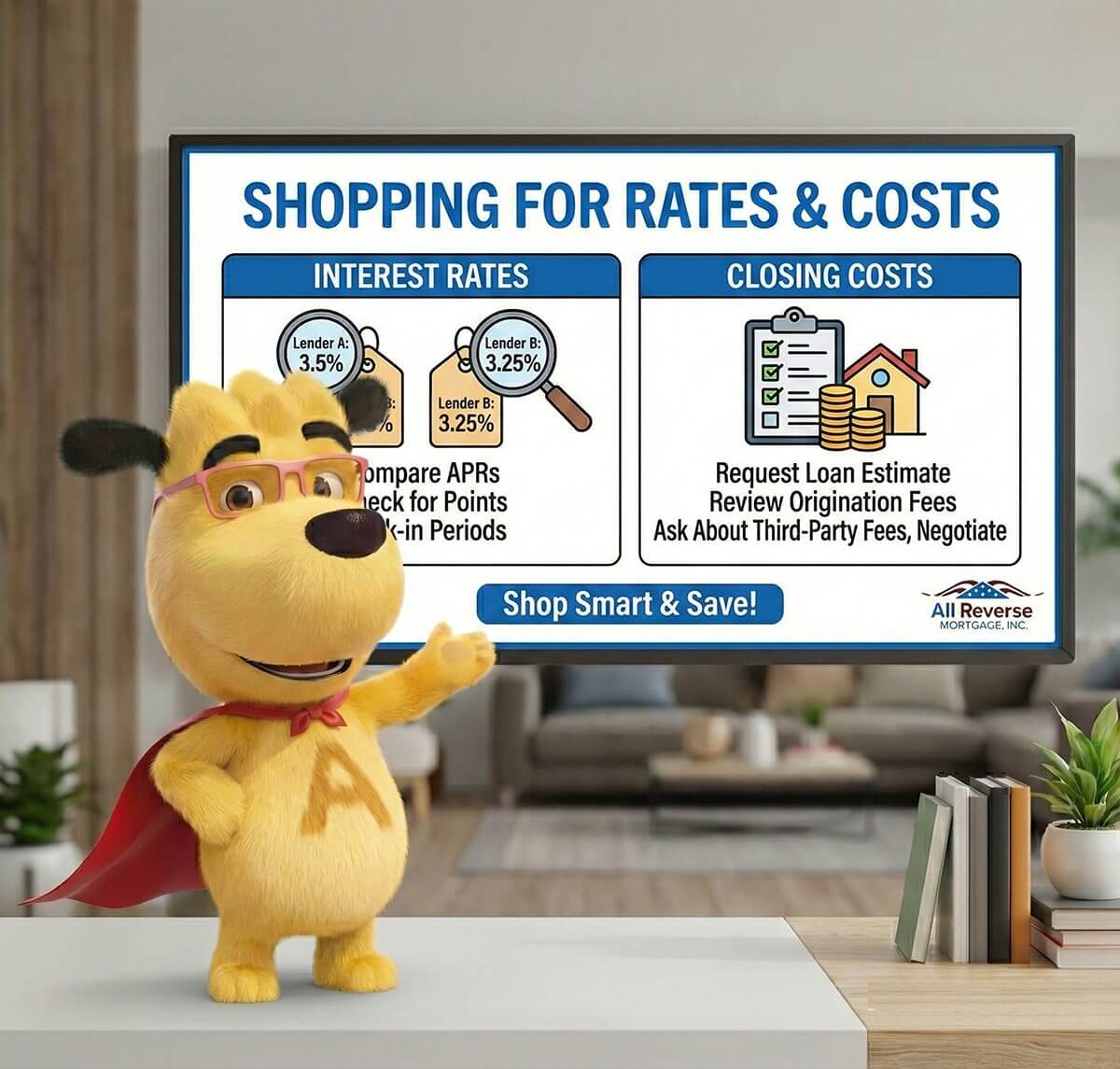
Not all reverse mortgages are created equal. Interest rates, margins, and closing costs differ significantly between lenders, and these differences directly affect both how much money you receive upfront and how quickly your loan balance grows over time.
A lender with slightly lower upfront closing costs may appear attractive at first glance, but if their margin is 0.50% higher, the result is a lower available loan amount and higher interest accrual over the life of the loan. Over 10 or 15 years, that difference in margin can add tens of thousands of dollars to your balance.
A loan with a slightly higher margin also produces a higher growth rate on the unused funds in your line of credit. So if maximizing long-term line of credit growth is your primary goal, a slightly higher margin can work in your favor — but this trade-off requires careful analysis based on your specific situation. Tell us what’s most important to you so we can lay out the pros and cons both ways. The decision is yours, and we want you to have all the information to make it well.
What to Compare When Shopping for a Reverse Mortgage:
- Interest rate + margin — the margin is the lender’s markup added to the index rate, and it stays fixed for the life of the loan. This is often the single most important number to compare.
- Initial loan amount (Principal Limit) and starting line of credit — a lower margin typically means a higher initial loan amount and more money available to you.
- Closing costs — including the origination fee (capped by HUD), appraisal fee, title insurance, and third-party service provider fees.
- Servicing fees — rare in today’s market, but some lenders still charge monthly servicing fees that are added to the loan balance.
Smart Strategy: Choose the option that best achieves your most important goal — whether that’s maximizing the available loan amount, preserving as much equity as possible, or building the highest possible line of credit growth over time. A good loan officer walks you through every scenario side by side.
Expert Insight: “Watch your financing terms. Don’t accept a larger margin that costs you thousands in accrued interest over the years and leaves you with less money at closing — just to save a little on one fee. Look at all the terms offered and compare lenders.”
Reverse Mortgage Costs vs. Benefits in 2026
A reverse mortgage can be a valuable retirement planning tool, but as with any financial decision, there are trade-offs. Here’s a balanced look at both sides:
Key Benefits
- No required monthly mortgage payments — frees up monthly cash flow by eliminating the obligation of a mandatory mortgage payment. You can still choose to make voluntary payments at any time with no prepayment penalties.
- Stay in your home for life — as long as you live there as your primary residence, maintain property taxes and insurance, and keep the home in reasonable condition.
- Flexible payout options — choose from a lump sum, monthly payment plan (term or tenure), line of credit, or a combination tailored to your needs.
- FHA non-recourse protection — HECM reverse mortgages are non-recourse, meaning neither you nor your heirs can ever owe more than the home is worth at the time the loan is repaid. If the loan balance exceeds the home’s value, the FHA insurance fund covers the difference. For special needs or high-value properties, jumbo or proprietary options may serve you better.
- Use proceeds for any purpose — home improvements, medical expenses, debt consolidation, supplementing retirement income, in-home care, or simply building a financial safety net.
- Line of credit growth — unlike a traditional HELOC, your unused line of credit grows over time and cannot be frozen or reduced due to market conditions or changes in your credit profile.
- Non-borrowing spouse protections — if you have a younger spouse not on the loan, HUD’s protections (for HECMs originated after August 4, 2014) allow an eligible non-borrowing spouse to remain in the home after the borrowing spouse passes away, with no immediate repayment required. Proprietary loans have different rules for non-borrowing spouses — if you need a proprietary loan and have a non-borrowing spouse, check with the lender first.
Pro Tip: Before deciding on a reverse mortgage, think carefully about your long-term aging-in-place plans. Do you live in a two-story home? Is it fully accessible as you get older? In some cases, downsizing or “right-sizing” with a reverse mortgage for home purchase is a smarter way to secure both comfort and financial flexibility for the years ahead. If you think the changes after a reverse mortgage will still leave you feeling strapped for cash, consider a downsize or right-size while you still have all your equity — a purchase reverse mortgage may be the right fit before your equity is depleted.
Main Costs & Considerations
- Upfront mortgage insurance premium (MIP) — HECMs require an initial MIP of 2% of the home’s appraised value (up to HUD’s lending limit). This funds the FHA insurance pool, which provides the non-recourse protection and guarantees your line of credit access even if your lender goes out of business.
- Ongoing MIP charges — an annual renewal MIP of 0.50% is calculated on the outstanding loan balance and added monthly. This is in addition to the loan interest that accrues on the balance.
- Jumbo or proprietary loans have no MIP (upfront or renewal) but carry higher interest rates.
- Interest accrual increases your loan balance — because no monthly payments are required, unpaid interest compounds on the balance. Over time, this can reduce the equity remaining in your home, particularly if property values stay flat or decline.
- Potential equity reduction for heirs — as the loan balance grows, the inheritance value of the home may decrease. However, heirs always retain the option to sell the home and keep any equity above the loan balance, or pay off the loan and keep the property.
- Property obligations remain your responsibility — you must continue to pay property taxes, homeowners insurance, and maintain the home. Failure to do so can trigger a loan default.
- Primary residence requirement — HECMs are only available on your primary residence. Vacation homes and investment properties are not eligible. If you move out of the home for more than 12 consecutive months (including for medical reasons such as assisted living), the loan becomes due and payable.
Pro Tip: If preserving home equity for your heirs is your top priority, consider making optional monthly payments or taking smaller draws to slow balance growth and retain a larger portion of your home’s value.
| Feature | Pro | Con |
|---|---|---|
| Home Equity Access | Tap into your home’s value without selling or moving. | Equity decreases over time as loan balance grows. |
| Monthly Payments | No mortgage payments required. | Must still pay taxes, insurance, and maintenance. |
| Stay in Your Home | Live in your home for life. | Must remain your primary residence. |
| Payout Flexibility | Lump sum, monthly income, line of credit, or combination. | Larger upfront draws may reduce future access. |
| Government-Insured | FHA insurance guarantees borrower protections. | Requires upfront and ongoing MIP. |
| Heir Options | Heirs can sell the home at 95% of market value. | Inheritance may be reduced if balance is high. |
| Non-Recourse | You or heirs never owe more than the home’s value. | Heirs must act quickly to settle the loan after death. |
Frequently Asked Questions
Who owns the home with a reverse mortgage?
How much money can I get from a reverse mortgage?
How is the loan amount determined?
Do I need good credit to qualify?
Is an appraisal required?
Can you make payments on a reverse mortgage?
What is the 95% rule on a reverse mortgage?
What are the downsides of a reverse mortgage?
Reverse mortgages are a valuable tool for many homeowners, but there are real downsides to consider:
- Higher upfront costs — HECMs include a one-time Mortgage Insurance Premium of 2% of the home’s value (up to HUD’s lending limit of $1,249,125), plus standard closing costs. These fees are higher than a typical refinance.
- Growing loan balance — because monthly payments aren’t required, interest and MIP charges compound on the balance each month. Over many years, this can significantly reduce the equity remaining in your home.
- Impact on means-tested benefits — while reverse mortgage proceeds are not taxable income, large lump-sum withdrawals that remain in your bank account can affect eligibility for Medicaid or Supplemental Security Income (SSI). Careful planning with a financial advisor avoids this issue.
A reverse mortgage works best as a long-term solution. If you’re only planning to stay in your home for a few years, the upfront costs may outweigh the benefits.
Can I lose my home with a reverse mortgage?
Yes. Just like with any mortgage, you can lose your home if you don’t meet the loan requirements. With a reverse mortgage, you must:
- Live in the home as your primary residence
- Stay current on property taxes and homeowners insurance
- Keep the home in reasonable repair
If these obligations aren’t met, the lender can call the loan “due and payable.” At that point, the balance must be repaid by refinancing, selling the home, or paying it off with other funds. If the loan is not repaid, foreclosure is possible. As long as you follow the occupancy, tax, insurance, and maintenance requirements, you remain the owner of your home and can stay there for life. Lenders also work with borrowers to resolve issues before pursuing foreclosure, and HUD requires servicers to follow specific loss mitigation procedures.
What if I outlive my home’s value?
How does a reverse mortgage get repaid?
A reverse mortgage is repaid when the borrower permanently leaves the home, but repayment can happen at any time since there are no prepayment penalties. The most common repayment methods are:
- Selling the home — the loan is paid from the sale proceeds, and any remaining equity belongs to the homeowner or their heirs.
- Refinancing — the borrower or heirs can refinance into a traditional mortgage or a new reverse mortgage if it makes financial sense.
- Paying with other funds — borrowers or heirs can use savings, life insurance proceeds, or other assets to pay off the balance and retain the property.
In most cases, repayment occurs through the sale of the home after the borrower passes away or moves to a care facility. If the sale price exceeds the loan balance, the remaining equity goes to the heirs. If the balance exceeds the home’s value, heirs owe nothing beyond the home’s worth — the FHA insurance covers the shortfall.
How long do you have to pay back a reverse mortgage?
A reverse mortgage does not need to be repaid until a maturity event occurs. This means:
- The last surviving borrower (or eligible non-borrowing spouse) permanently leaves the home, either by moving out or passing away.
- The borrower fails to meet the loan obligations — paying property taxes, maintaining insurance, or keeping the home in good repair.
Once the loan becomes due and payable, the servicer contacts the borrower or heirs to discuss repayment options. If heirs plan to sell the property, servicers allow extensions of up to 1 year, granted in 90-day increments, as long as good-faith efforts to sell are being made. HUD requires servicers to follow specific timelines and procedures before pursuing foreclosure, and the exact process varies by state law.
Is HUD counseling required before getting a reverse mortgage?

Key Takeaways: How Reverse Mortgages Work in 2026
- A reverse mortgage converts home equity into tax-free loan proceeds without required monthly mortgage payments.
- The most common program is the Home Equity Conversion Mortgage (HECM), insured by the FHA and regulated by HUD.
- You must be 62 or older and live in the home as your primary residence.
- Loan amount depends on your age, home value (up to $1,249,125), and current interest rates.
- HUD-approved counseling is required before your application can proceed.
- You choose how to receive funds: lump sum, line of credit, monthly payments, or a combination.
- Repayment is only due when you sell, move out permanently, or pass away.
- Non-recourse protection means you and your heirs can never owe more than the home’s value.
- You keep full ownership of your home and can sell or pay off the loan at any time with no prepayment penalties.
Expert Insight: “The biggest advantage of a reverse mortgage is flexibility. You’re not locked into monthly payments, but you can still make them if preserving equity is your goal.”
Need Personalized Answers? Get a free quote with live rates and your estimated lending limit, or try our reverse mortgage calculator. Or call us Toll-Free at (800) 565-1722.
Also See: Reverse Mortgage Definition, Key Terms & A-Z Glossary


September 19th, 2025
September 20th, 2025
July 1st, 2025
July 1st, 2025
You can pay it off using your own available funds,You can refinance it with another loan of your choosing,Or you can sell the home and use the proceeds to repay the reverse mortgage.
There is never a prepayment penalty, so you're free to choose whichever option works best for you.Please let us know if you'd like help exploring the next steps.June 30th, 2025
June 3rd, 2025
March 17th, 2025
March 2nd, 2025
January 14th, 2025
January 9th, 2025
November 16th, 2024
October 15th, 2024
October 3rd, 2024
September 13th, 2024
September 7th, 2024
August 2nd, 2024
May 13th, 2024
May 13th, 2024
April 29th, 2024
May 5th, 2024
June 9th, 2024
March 7th, 2023
March 7th, 2023
January 8th, 2023
January 12th, 2023
July 21st, 2022
July 21st, 2022
April 21st, 2025
May 17th, 2022
May 17th, 2022
December 30th, 2021
January 11th, 2022
October 27th, 2020
October 27th, 2020
You can take a lump sum of cash (lump sum option).You can take a set payment for life (tenure option).You can determine the payment you wish to take until you exhaust the funds (term payment).You can leave the money in a line of credit and draw from the line as you wish (line of credit option).
Or you can mix the line of credit with the tenure or term options to have both a payment for life or of your choosing and that would be either a modified tenure or modified tenure. In your case, you could choose the line of credit option, draw the amount you want, and the other funds would remain in the line, available to you. If you never draw the money, you never accrue any interest on the funds and you, or your heirs do not need to repay them. You only pay back what you use (plus any interest that accrues on those funds). In addition, the line of credit grows in availability on the unused funds over time. This means that the longer you have funds available on the line, the more money will be available to borrow later should you need them. Again, if you never need them you are not required to repay them but if you ever do need them for any reason, they are always available unlike a Home Equity Line of Credit that the bank can close at their discretion or that goes into a repayment period after 10 years.July 25th, 2020
July 27th, 2020
July 7th, 2020
July 7th, 2020