
See Your 2026 Jumbo Numbers
 |
Michael G. Branson, CEO of All Reverse Mortgage, Inc., and moderator of ARLO™, has 45 years of experience in mortgage banking, with the past 20 years devoted exclusively to reverse mortgages. A Forbes Real Estate Council member, he developed the industry's first fixed-rate jumbo reverse mortgage and has been featured in Forbes, Kiplinger, the LA Times, and Yahoo Finance. (License: NMLS# 14040) |
 |
Cliff Auerswald, President of All Reverse Mortgage, Inc., and co-creator of ARLO™ — the industry's first real-time reverse mortgage pricing engine — has 27 years of experience in mortgage banking, with 20+ years focused exclusively on reverse mortgages. A recognized expert in reverse mortgage technology and consumer education, he has been featured in Kiplinger, Yahoo Finance, Realtor.com, and HousingWire. (License: NMLS# 14041) |
Jumbo Reverse Mortgages: 2026 Rates, Limits & LTV by Age

 Michael G. Branson, CEO of All Reverse Mortgage, Inc. and moderator of ARLO™, has 45 years of experience in mortgage banking, with the past 20 years devoted exclusively to reverse mortgages. A Forbes Real Estate Council member, he has been featured in Forbes, Kiplinger, the LA Times, and Yahoo Finance. (License: NMLS #14040)
Cliff Auerswald, President of All Reverse Mortgage, Inc. and co-creator of ARLO™ — the industry's first real-time reverse mortgage pricing engine — has 27 years of experience in mortgage banking, with 20+ years focused exclusively on reverse mortgages. (License: NMLS #14041)
Michael G. Branson, CEO of All Reverse Mortgage, Inc. and moderator of ARLO™, has 45 years of experience in mortgage banking, with the past 20 years devoted exclusively to reverse mortgages. A Forbes Real Estate Council member, he has been featured in Forbes, Kiplinger, the LA Times, and Yahoo Finance. (License: NMLS #14040)
Cliff Auerswald, President of All Reverse Mortgage, Inc. and co-creator of ARLO™ — the industry's first real-time reverse mortgage pricing engine — has 27 years of experience in mortgage banking, with 20+ years focused exclusively on reverse mortgages. (License: NMLS #14041)
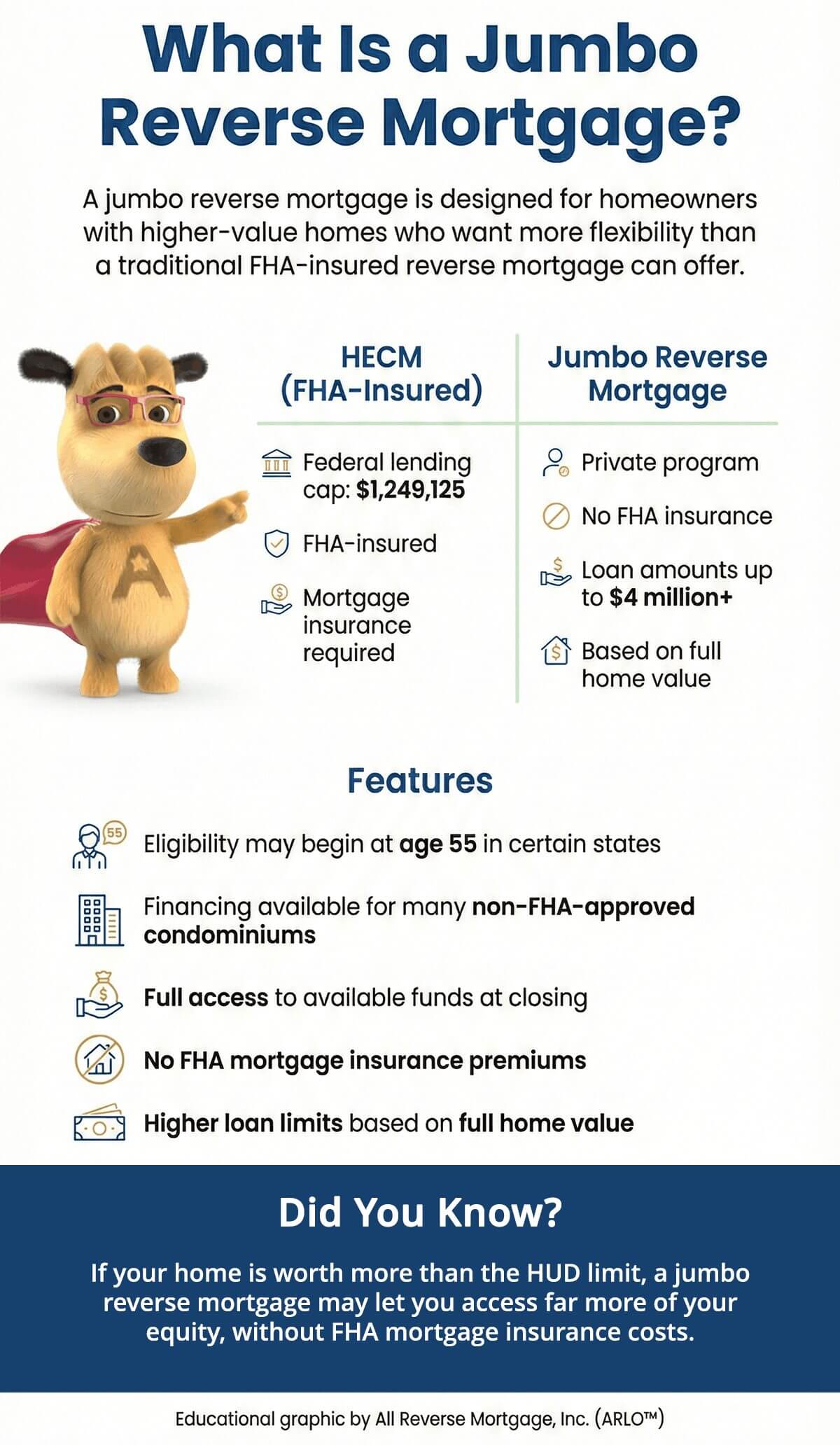
Short answer: In 2026, a HECM only counts your home’s value up to $1,249,125, while a jumbo (proprietary) reverse mortgage can lend up to $4 million on a higher-value home. It is a private loan with no FHA mortgage insurance, for homeowners 55 and older in most states (60 in MA, NY and WA; 62 in NC and TX) with homes worth at least $350,000.Jump to: LTV by age · Today’s rates · Closing costs · Jumbo vs HECM · FAQs
Today’s starting jumbo fixed rate: 8.490%, from our live rates table. A HECM is usually the better pick if your home is worth less than $1,249,125, you are 62 or older, or you want a line of credit that grows or lifetime monthly payments.
I helped develop the industry’s first fixed-rate jumbo reverse mortgage, and I have originated jumbo and proprietary loans since these programs reappeared in the years following the 2008 crash. I still find that most of what borrowers hear about them before they call me is incomplete. Most consumer content treats these loans as one simple idea: your home is worth more than the HECM allows, so here is the bigger loan for you. That is true for some borrowers, and it is the entire story for almost none of them.
The reality I see across real files is more layered. Home value matters, but so do age, household composition, and how much of the loan a borrower plans to use versus what they qualify for on paper. Some of what makes proprietary loans a better fit has nothing to do with home size at all, and some of what makes them a worse fit is rarely mentioned.
What follows is not a product brochure. It is what I actually tell borrowers, the questions that decide the outcome more than the headline numbers do, and the places where a proprietary loan genuinely falls short of a HECM, not just where it wins.
Key Facts
- Age: Jumbo/proprietary reverse mortgages can start at 55 in most states; the HECM minimum is 62.
- State floors: MA, NY, WA: 60; NC, TX: 62. Other state/program availability varies.
- Loan size: Up to $4 million.
- FHA MIP: Jumbo/proprietary loans do not require FHA mortgage insurance premiums.
- HECM comparison: The 2026 HECM cap is $1,249,125.
- Non-recourse: Jumbo loans are described as non-recourse: borrower/heirs do not owe more than the home’s value when sold, even if the balance is higher. The protection is contractual—not FHA insurance—so review the specific product documents.
Do You Need a Jumbo Reverse Mortgage?
Short answer: A jumbo reverse mortgage is usually the right call in five situations — your home is worth well above the HECM limit of $1,249,125, you are between 55 and 61, your condominium cannot get FHA approval, you need all of your proceeds at closing, or you need to pay off consumer debt at closing in order to qualify. Outside those five, a HECM is usually the better loan.
Every week I talk to borrowers about proprietary reverse mortgages, and no two conversations start from the same place.
Some borrowers have already done the math. They know the HECM has a maximum claim amount of $1,249,125 (as of 2026), they own a home worth $2,000,000 or more, and they call in already asking for a jumbo. They found out about the FHA limit themselves and ruled out the HECM before we ever spoke.
Others land somewhere entirely different. Their home value sits somewhere close to the FHA maximum claim amount, above it or below it, and they have not done enough research to know which program suits their wants and needs. They are trusting me to lay out every option, not just the one that closes fastest. I think that is the job. A lot of loan officers stop at the HECM because it is the program they are most familiar with, and I do not think that serves the borrower.
Plenty of borrowers fall somewhere between those two examples, or are driven by something else entirely. What decides it is rarely the home value alone. Some borrowers care most about keeping the interest rate low because they want to leave as much equity as possible to their children. Others have no heirs and want to know how much money goes into their pockets. Some are turned off the moment they see the FHA mortgage insurance premium, which runs at 2% of the property value or the maximum claim amount, whichever is less. None of these people are wrong; they just want different things from the same equity, and there is no single typical proprietary borrower.
For the borrowers who do want to start with the math, here is where proprietary loan-to-value percentages stand by age, with example loan amounts at three home values:
Jumbo Reverse Mortgage Loan-to-Value by Age Chart
Highest LTV tier, as of October 2026: applies to the 9.490% fixed rate and all adjustable rates (currently 10.075%, 5.625 margin) on our rates page; lower fixed rates use a lower LTV tier. APR varies by loan size, fees, and state. See the rate table below for a $1 million California example.
ARLO Jumbo vs HECM
ARLO Jumbo vs HECM: How Much Could You Get?
Example amounts by youngest borrower age and home value. In each cell, the higher amount is highlighted, and the green line shows the jumbo advantage.
| Age of youngest borrower | Home value | ||||||
|---|---|---|---|---|---|---|---|
| $350K home value | $500K home value | $750K home value | $1.0M home value | $1.5M home value | $2.5M home value | $4.0M home value | |
| Age 62HECM 34.5%ARLO Jumbo 38.0%Jumbo advantage | HECM $120,750ARLO jumbo $133,000Jumbo advantage: +$12,250 | HECM $172,500ARLO jumbo $190,000Jumbo advantage: +$17,500 | HECM $258,750ARLO jumbo $285,000Jumbo advantage: +$26,250 | HECM $345,000ARLO jumbo $380,000Jumbo advantage: +$35,000 | HECM $430,948ARLO jumbo $570,000Jumbo advantage: +$139,052 | HECM $430,948ARLO jumbo $950,000Jumbo advantage: +$519,052 | HECM $430,948ARLO jumbo $1,520,000Jumbo advantage: +$1,089,052 |
| Age 70HECM 40.3%ARLO Jumbo 42.3%Jumbo advantage | HECM $141,050ARLO jumbo $148,050Jumbo advantage: +$7,000 | HECM $201,500ARLO jumbo $211,500Jumbo advantage: +$10,000 | HECM $302,250ARLO jumbo $317,250Jumbo advantage: +$15,000 | HECM $403,000ARLO jumbo $423,000Jumbo advantage: +$20,000 | HECM $503,397ARLO jumbo $634,500Jumbo advantage: +$131,103 | HECM $503,397ARLO jumbo $1,057,500Jumbo advantage: +$554,103 | HECM $503,397ARLO jumbo $1,692,000Jumbo advantage: +$1,188,603 |
| Age 75HECM 43.2%ARLO Jumbo 46.7%Jumbo advantage | HECM $151,200ARLO jumbo $163,450Jumbo advantage: +$12,250 | HECM $216,000ARLO jumbo $233,500Jumbo advantage: +$17,500 | HECM $324,000ARLO jumbo $350,250Jumbo advantage: +$26,250 | HECM $432,000ARLO jumbo $467,000Jumbo advantage: +$35,000 | HECM $539,622ARLO jumbo $700,500Jumbo advantage: +$160,878 | HECM $539,622ARLO jumbo $1,167,500Jumbo advantage: +$627,878 | HECM $539,622ARLO jumbo $1,868,000Jumbo advantage: +$1,328,378 |
| Age 80HECM 47.7%ARLO Jumbo 51.4%Jumbo advantage | HECM $166,950ARLO jumbo $179,900Jumbo advantage: +$12,950 | HECM $238,500ARLO jumbo $257,000Jumbo advantage: +$18,500 | HECM $357,750ARLO jumbo $385,500Jumbo advantage: +$27,750 | HECM $477,000ARLO jumbo $514,000Jumbo advantage: +$37,000 | HECM $595,833ARLO jumbo $771,000Jumbo advantage: +$175,167 | HECM $595,833ARLO jumbo $1,285,000Jumbo advantage: +$689,167 | HECM $595,833ARLO jumbo $2,056,000Jumbo advantage: +$1,460,167 |
Assumptions, as of October 2026. Example only, not a loan offer. Amounts are gross principal limits before upfront mortgage insurance and closing costs. Jumbo amounts use the loan-to-value percentages in the chart above. Highest LTV tier, as of October 2026: applies to the 9.490% fixed rate and all adjustable rates (currently 10.075%, 5.625 margin) on our rates page; lower fixed rates use a lower LTV tier. HECM amounts use HUD’s principal limit factors at today’s lowest HECM adjustable rate (6.25%, 1.75 margin) times the lesser of home value or the 2026 HUD limit of $1,249,125. Jumbo examples start at the $350,000 minimum home value and go up to $4 million. Actual amounts depend on rate, fees and lender approval.
Want your own numbers? See the full jumbo reverse mortgage loan-to-value chart, get a free quote, or call us Toll-Free at (800) 565-1722.
Jumbo vs. Proprietary: Why “Proprietary” Is the More Honest Name
A proprietary reverse mortgage is a reverse mortgage created and funded by a private company instead of being insured by the FHA’s HECM program.
The name “jumbo” comes from the fact that these loans were only available for homes valued above the HECM limit in effect at any given time. For years, that was the whole point of the programs, but it is no longer true. A lot of consumer content still treats jumbo as strictly a high-value home product, and that has not been accurate for some time.
Today, proprietary or non-FHA reverse mortgages are available on homes below the FHA limit too, and the reason has less to do with home value and more to do with underwriting flexibility.
Take a condominium. To get a HECM on a condo, the project must be HUD-approved, and that approval process takes real time and real money. Plenty of projects never get there for one reason or another. Proprietary programs run a simpler, faster approval process for the project itself. They will often approve a condo that HUD would not. A condo owner who never cared about exceeding any lending limit at all can end up needing a proprietary loan for this reason alone.
Jumbo Reverse Mortgage Age Requirements: 55 vs. the HECM’s 62
Home value is not the only place proprietary programs diverge from the HECM. A borrower’s age is a major factor in reverse mortgage eligibility, and proprietary reverse mortgages permit younger borrowers than the HECM does in most states.
The HECM has a minimum age for eligibility: 62. It is universal: every state and every lender in the country uses the same number because it is set by HUD.
Proprietary programs are not bound by a single national minimum. Depending on the state and the specific program, the minimum age can be as low as 55, making these loans available to a segment of homeowners that the HECM cannot serve at all. Some borrowers end up in a proprietary loan for this reason alone, with no connection to the FHA limit or a property that would not otherwise qualify. They are simply not old enough for a HECM yet.
This varies considerably by state, so it is not a blanket rule. Massachusetts, New York, and Washington set a higher minimum of 60. North Carolina and Texas require 62, the same as the HECM. Not every proprietary program is even available in every state to begin with, since these are private products and each state has different regulations governing them. The HECM, by contrast, is available in every state.
The practical takeaway is simple: if you are between 55 and 61 and interested in a reverse mortgage, do not assume you are automatically excluded because of the requirements for a HECM loan.
Jumbo Reverse Mortgages in California
California is where the HECM limit pinches the most. In 2026, a HECM can only be based on up to $1,249,125 of your home’s value. In September 2026, the typical single-family home sold for about $1.9 million in Santa Clara County and about $2.3 million in San Mateo County, according to the California Association of REALTORS®. For homes like these, a HECM provides considerably less than a jumbo reverse mortgage can, because it draws on more of your home’s value, up to the program’s loan cap.
We offer jumbo and proprietary reverse mortgage programs directly. Some proprietary programs in California accept homeowners as young as 55. Age rules and loan terms differ by program and can change, so we’ll confirm which programs your home and age qualify for before you apply.
To compare lenders who serve your area, see our guide to California reverse mortgage lenders.
Non-Borrowing Spouses: Where Jumbo Reverse Mortgages Fall Short
Not every difference between these two programs favors the proprietary option, and this is the one I want borrowers to understand clearly before they sign anything.
On a HECM, an eligible non-borrowing spouse, meaning a spouse who is not on the loan as a borrower but resides in the property, has a federally protected deferral option. If the borrowing spouse dies or leaves the home permanently, an eligible non-borrowing spouse can remain in the home and defer the loan from becoming due and payable, provided they continue to meet the occupancy and other requirements. HUD built this protection directly into the HECM program.
Proprietary loans do not offer the same deferral option. If the borrowing spouse dies or leaves the home, the loan becomes due and payable, and the non-borrowing spouse will not have the same right to remain in the home as they would have under a HECM. This means they would have to consider paying off the mortgage by refinancing, using other funds, or selling the property. Different proprietary products have different requirements for when a non-borrowing spouse is permitted, and for some scenarios a non-borrowing spouse is not permitted at all.
This matters most for couples where one spouse does not meet the age requirement, and it deserves a real conversation before choosing a program, not an assumption that the protections work the same way as a HECM. If a non-borrowing spouse situation applies to you, this is one of the more important reasons to review the specific terms of any proprietary program you are considering, and to weigh it seriously against a HECM even if the proprietary loan otherwise offers more proceeds.
Jumbo Reverse Mortgage Rates, Closing Costs, and How You Access the Money
Interest rates on both HECM and proprietary loans move constantly, sometimes daily, so treat any specific rate mentioned here as a snapshot rather than a promise. As a general rule, proprietary loans carry higher interest rates than a HECM. Closing costs can go the other direction: proprietary loans sometimes carry lower total costs since there is no FHA mortgage insurance premium, though that is not guaranteed either. It depends on current market conditions and which rate option, fixed or adjustable, a borrower chooses. The only way to know the real numbers for your situation is to compare actual quotes at the time you are ready to move forward, not a table published months earlier.
Here is where jumbo rates stand as of today; this table updates as the market moves:
Today's Jumbo Reverse Mortgage Rates
| Rate Type | Rate/APR | Lending Limit |
|---|---|---|
| Fixed | 8.490% (8.569%e APR) | $4,000,000 |
| Fixed | 9.450% (9.456%e APR) | $4,000,000 |
| Fixed | 9.480% (9.634%e APR) | $4,000,000 |
| Fixed | 9.490% (9.719%e APR) | $4,000,000 |
| Adjustable | 10.115% (5.625 Margin) | $4,000,000 |
| Note: eAPR = estimated APR. APR figures are based on the following assumed scenario: borrower age 70 | loan amount $1,000,000 | located in California. | ||
And here is a real side-by-side of settlement costs, based on a $1,500,000 home and a 75-year-old borrower:
Jumbo vs. HECM Reverse Mortgage Closing Costs
| Cost Item | Jumbo / Proprietary | HECM (HUD-Insured) |
|---|---|---|
| Origination Fee | $6,405.00 | $6,000.00 |
| Mortgage Insurance Premium (Upfront) | Not Required | $24,982.50 |
| Appraisal Fee | $800.00 | $665.00 |
| Credit Report | $72.20 | $234.60 |
| Settlement / Escrow Fee | $700.00 | $700.00 |
| Title Insurance | $1,070.00 | $1,070.00 |
| Notary / Signing | $400.00 | $250.00 |
| Recording Fees | $188.00 | $188.00 |
| Flood Certification | $5.50 | $15.00 |
| Document Preparation | $140.00 | $206.00 |
| Counseling Fee | $145.00 | $145.00 |
| Misc. Title / Endorsements / Tax Cert / Sub Escrow | $710.00 | $525.00 |
| Total Estimated Settlement Costs | $10,635.70 | $34,981.10 |
Expert Insight from Michael Branson, CEO: “Look at the closing cost comparison above. On a $1.5 million home, the jumbo borrower saves over $24,000 just by not paying FHA mortgage insurance. That’s real money back in your pocket on day one. Jumbo loans are still non-recourse — neither you nor your heirs will owe more than the home’s value when it sells — but that protection is in the loan contract, not FHA’s mutual mortgage insurance.”
How you access the money depends less on which program you choose and more on which rate option you choose. A fixed-rate reverse mortgage, whether HECM or proprietary, is a closed-end loan, meaning it must be taken entirely as a lump sum at closing, with no future draws available. A line of credit reverse mortgage, whether HECM or proprietary, is open-ended, meaning funds remain available to draw over time.
The two programs differ in the details of that line of credit, and it is a good idea to confirm these specifics when you apply, since they are subject to change. As of this writing, proprietary line of credit products typically have a 10-year draw window, whereas a HECM line of credit has no such limit. The growth rate on a proprietary line of credit is typically limited to 1.5% for the first 7 years, whereas a HECM line of credit grows at the note rate plus the current mortgage insurance renewal rate of 0.50% for as long as the line remains open. Proprietary line of credit loans also generally require a mandatory minimum initial draw at closing, currently 25% of the principal limit the borrower is eligible for, a requirement the HECM line of credit does not share.
None of these differences make one option automatically better. They mean the line of credit feature is not identical across programs, and a borrower drawn to a proprietary loan specifically for the line of credit should understand exactly how that credit line behaves before assuming it works the same way a HECM does.
Jumbo Qualification: The Residual Income Advantage Nobody Talks About
Here is a difference that changes outcomes more than anything else in this article, and it has nothing to do with home value at all.
All reverse mortgages, HECM and proprietary alike, qualify borrowers through a residual income analysis rather than the debt-to-income ratio used for traditional loans, and both programs require borrowers to meet a residual income threshold. Where they differ is what you are allowed to do to get there. On a HECM, paying off credit card debt at closing to meet residual income requirements is not how HUD’s financial assessment works today. Revolving debt can still sink a HECM file, and the published workaround is a compensating factor, not using loan proceeds to clear the debt. On a proprietary loan, investors often let you pay off that consumer debt at closing to meet the residual income requirement.
I see this play out constantly with my own loan officers. They bring me a file in which the borrower does not qualify for a HECM, and it frequently comes down to residual income. A borrower on a fixed income, carrying credit card debt at high interest rates, is often barely covering the minimum payment, which does nothing to reduce the balance. This is exactly the borrower a proprietary loan can rescue, because paying off that debt through closing can be the difference between a denial and real, life-changing payment relief.
Jumbo Reverse Mortgage Property Requirements
Like any reverse mortgage, proprietary loans require the property to be your primary residence, and as the homeowner, you are responsible for the timely payment of property taxes, homeowners insurance premiums, and HOA dues (if any), as well as the overall upkeep of your home.
With proprietary loans, eligible property types vary by product, though there is substantial overlap with FHA property guidelines. One property type worth flagging specifically is manufactured homes. Manufactured homes are not eligible for the proprietary products we currently offer. If your home is a manufactured home, the HECM program is usually the only reverse mortgage option available. Proprietary products also tend to be stricter with rural properties and will sometimes limit the permissible acreage for any given product. If your home is on a large-acreage parcel of 20 acres or more, raise that right away to confirm your home would be eligible for the product you are interested in.
When More Money Available Is Not the Same as More Money Needed
Borrowers bring me a scenario like this often enough that it says more about human nature than it does about either loan program.
A borrower comes to me with a $3,000,000 home that is owned free and clear. There is no mortgage to pay off and no urgent need for cash today. A proprietary loan on that property will produce meaningfully more in proceeds than a HECM ever could, because the HECM formula is capped against the maximum claim amount in effect at the time, regardless of how much the home is worth.
The bigger figure gets attention, and I understand why. But I have watched it become the entire conversation, when the real question has nothing to do with how much a borrower could access and everything to do with how much they will actually use. A free and clear homeowner without an urgent need is not obligated to take the largest loan available just because it exists.
Plenty of these borrowers choose the HECM instead and draw the line of credit only as needed. If that need never grows beyond what the HECM provides, they may never touch a proprietary loan at all, and they will have avoided accruing interest on proceeds they never used. The HECM line of credit also offers a federally guaranteed growth feature, which is worth weighing against the proprietary alternative when a borrower is not in a hurry to draw funds.
The proprietary loan is not the wrong choice here. It is a choice that deserves more thought than the loan size alone. If the borrower’s plans genuinely call for more than the HECM can offer, the proprietary loan is exactly the right tool. My point to these clients is simply that a larger available balance is not the same as a greater need, and the two are often confused more than people realize.
What surprises people is what happens if a borrower starts a HECM and later finds their needs have grown. They are not locked out of the proprietary option at that point. Refinancing from a HECM into a proprietary loan, as of this writing, is available as a path to access additional equity once the HECM line of credit has been substantially drawn. That refinance usually requires investor seasoning — typically about a year from the original HECM closing — plus a demonstrated financial benefit to the borrower. Those are investor overlays, not a HUD 12-month lock.
HUD’s own HECM-to-HECM anti-churning test is different: a counseling waiver if the new principal limit exceeds the refinance cost by HUD’s required multiple (historically, five times closing costs) and the original HECM closed within the past five years. Proprietary programs are not adding a special extra hurdle here. A seasoning-and-benefit screen is used by the industry whenever a reverse mortgage is refinanced.
Jumbo or HECM: Choosing the Program That Fits, Not the One That Sounds Biggest
After all of this, the question I get most often is still some version of “which one is better.” I understand why people ask it that way. It would be easier if there were a single right answer.
There is not, and I hope that is clear by now rather than frustrating. A HECM and a proprietary reverse mortgage are not smaller or larger versions of the same loan. They are built for different situations, and the borrower who benefits most from one is not necessarily the borrower who benefits most from the other. Age can decide it before value ever comes up. A non-borrowing spouse can decide it regardless of how much a home is worth. A borrower’s real need for cash today, rather than the largest figure available on paper, can decide it too.
If you want the differences in one place, here is the side-by-side:
Jumbo Vs. HECM: Key Differences
| Feature | Jumbo Reverse Mortgage | FHA HECM Reverse Mortgage |
|---|---|---|
| Minimum Age | 55 (varies by lender and state) | 62 |
| Max Lending Limit | Up to $4,000,000 (some programs may allow more) | $1,249,125 (HUD national limit) |
| Eligible Property Types | Single-family, investor-approved condos (often FNMA-warrantable), 1–4 units | Single-family, HUD-approved condos, 1–4 units |
| Upfront Access | 100% lump sum available at closing | Limited (typically 60% or obligations + 10% in first year) |
| Line of Credit Term | 10-year draw period | Lifetime draw period |
| Line of Credit Growth Rate | Limited; e.g., 1.5% for the first 7 years (not FHA-guaranteed). | Note Rate + .50 MIP for Life |
| FHA Insurance | No mortgage insurance premiums (MIP) | Yes, MIP required (upfront and annual) |
| Younger Spouse Protections | Varies by lender – not guaranteed | Fully protected by HUD regulations |
| Use for Home Purchase | Yes | Yes |
| Note: *HECM lump sum capped at 60% of Principal Limit or obligations + 10% in first 12 months. | ||
What I ask every borrower to do, and what I would ask you to do, is be honest about your own situation before you get attached to a program. Do you actually need more than a HECM can offer, or are you drawn to a larger balance you may never use? Does your age, property, or household situation rule out one option before the comparison even matters? Are you solving a problem you have today, or planning for one that has not shown up yet?
A rate table or a calculator cannot answer those questions for you, and I cannot fully answer them in an article either. They take an actual conversation, with someone willing to walk through your specific numbers, your specific property, and your specific goals, and willing to tell you plainly if the loan you called about is not the right fit for your situation.
That is the conversation I have with borrowers every week, and it is the one I would have with you.
Jumbo Reverse Mortgage FAQs
What is a jumbo reverse mortgage?
What is the difference between a HECM and a jumbo reverse mortgage?
What lenders offer jumbo reverse mortgages?
Can a non-borrowing spouse stay in the home with a jumbo reverse mortgage?
What is the difference between jumbo and proprietary loans?
How much can you get from a jumbo reverse mortgage?
Do I need a jumbo reverse mortgage if my home is worth $1.3 million?
What are the rates for jumbo reverse mortgages?
What is the maximum jumbo reverse mortgage?
Can you get a jumbo reverse mortgage line of credit?
How does a jumbo reverse mortgage compare to a Home Equity Line of Credit (HELOC)?
Both allow homeowners to access equity, but they work very differently:
| Feature | Jumbo Reverse Mortgage | HELOC |
|---|---|---|
| Monthly payments | None required | Required (interest + principal) |
| Age requirement | 55+ (varies by state) | Any age (18+) |
| Income/credit requirements | Financial assessment (residual income) | Strict debt-to-income ratio |
| Maximum loan amount | Up to $4,000,000 | Varies by lender (typically lower) |
| Non-recourse protection | Yes, never owe more than the home’s value | No, full recourse loan |
| Upfront costs | Higher (no MIP, but closing costs apply) | Low ($0–$500) |
| Risk if you can’t make payments | No payments required (taxes/insurance still due) | Foreclosure risk |
| Best for | Eliminating payments, long-term cash flow, aging in place | Short-term needs with reliable income to repay |
For retirees on fixed incomes, the biggest difference is payment obligation. A HELOC requires monthly payments that can increase as rates rise. A jumbo reverse mortgage eliminates that payment risk entirely, though the loan balance grows over time. Each has trade-offs, and the right choice depends on your income stability, how long you plan to stay in the home, and your comfort with each structure.
What are the disadvantages of a jumbo reverse mortgage?
How long does it take to process a jumbo reverse mortgage?
What about my property tax and insurance with a jumbo reverse mortgage?
Are jumbo reverse mortgages still non-recourse?
Can you have more than one jumbo reverse mortgage?
Can I rent rooms privately, with a rental company, or Airbnb if we have a jumbo reverse mortgage?
Ready to have that conversation? Start with our reverse mortgage calculator to compare the HECM and jumbo programs side by side with real-time rates, or call us Toll-Free at (800) 565-1722.


Have a Question About Reverse Mortgages?
Over 2000 of your questions answered by ARLO™
Ask your question now!

August 19th, 2025
August 28th, 2025
January 19th, 2023
January 31st, 2023
July 15th, 2022
July 19th, 2022
February 15th, 2022
February 15th, 2022
February 9th, 2022
February 15th, 2022
August 20th, 2021
August 24th, 2021
September 22nd, 2020
September 22nd, 2020
October 1st, 2019
October 6th, 2019