

A+ BBB Accredited
★★★★★ 4.9/5 from 1,200+ reviews
HUD-Approved · NMLS #13999
X
ARLO Get the real facts on Reverse Mortgages →
Get the real facts on Reverse Mortgages →
Explore All Reverse×
Programs
How It Works
Calculators
Resources
Why All Reverse
HUD-approved direct lender · NMLS #13999
4.9/5 from 1,200+ reviews
ARLO

See What Your Home Could Do for You

Your instant quote includes eligibility, real-time rates
Michael G. Branson Michael G. Branson, CEO of All Reverse Mortgage, Inc., and moderator of ARLO™, has 45 years of experience in mortgage banking, with the past 20 years devoted exclusively to reverse mortgages. A Forbes Real Estate Council member, he developed the industry's first fixed-rate jumbo reverse mortgage and has been featured in Forbes, Kiplinger, the LA Times, and Yahoo Finance. (License: NMLS# 14040)
Cliff Auerswald Cliff Auerswald, President of All Reverse Mortgage, Inc., and co-creator of ARLO™ — the industry's first real-time reverse mortgage pricing engine — has 27 years of experience in mortgage banking, with 20+ years focused exclusively on reverse mortgages. A recognized expert in reverse mortgage technology and consumer education, he has been featured in Kiplinger, Yahoo Finance, Realtor.com, and HousingWire. (License: NMLS# 14041)

Dave Ramsey Offering Bad Advice on Reverse Mortgages

Michael G. Branson, CEO of All Reverse Mortgage
CEO · 45 yrs in mortgage banking
Cliff Auerswald, President of All Reverse Mortgage
President · All Reverse Mortgage Inc.
11 min read Fact Checked HUD-Lender #26031-0007 14 comments

Does Dave Ramsey know much about reverse mortgages? Dave does a hit piece on reverse mortgages, pointing out some of the less popular aspects of the loan. However, he is either OK with exaggerating the truth or reveals his ignorance about how reverse mortgages work.
Is Dave Right About Reverse Mortgages?

Firstly, let’s give Dave his due when he tells the truth. He is right when he says a reverse mortgage operates in reverse of a standard or forward loan.

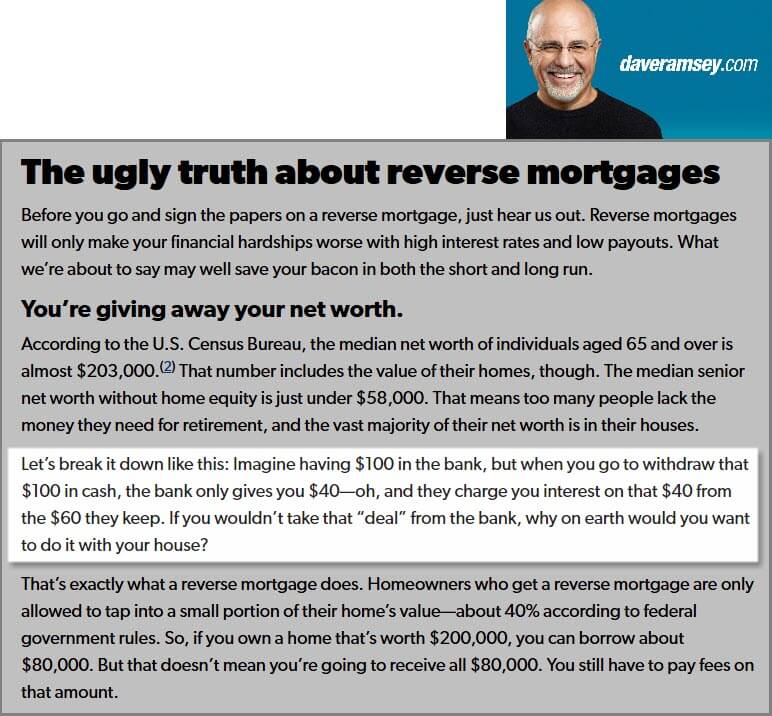
Instead of a rising equity, falling debt scenario, the reverse mortgage is a rising debt, falling equity loan. However, he uses an example where you put $100 in the bank, get $40 back, and they take the interest from the $60.00 you have remaining in the bank, and claim that no one would do this.

ARLO teaching how reverse mortgages work

How Debt Works

Dave doesn’t tell you that all debt works in much the same way. You use a small amount of the funds and pay much more back in payments. If you have a credit card and make a purchase, you then make monthly payments of $50.00, of which only $5.00 goes toward paying off the amount you borrowed.

Examine the disclosures for standard 30-year mortgages, which typically require monthly payments. After 30 years, you probably paid 2½ times more than you borrowed on those as well. So yeah, Dave, people take that “deal” day in and day out when they want or need something and don’t have the cash to pay for it outright.

I see ads for 30-year fixed-rate loans with low down payments or even no down payments for veterans, and think, what happens when they have no equity, AND they have been paying through the nose each month, so they have no cash either?

Dave, Where Are You Getting Your Info?

Fact or fake dice

Dave says homes above $679,650 don’t qualify for a reverse mortgage. Fact: The FHA lending limit is $1,249,125 for 2026 — and higher-value homes can still use a HECM.

Dave mistakes the HUD lending limit (now $1,249,125 for 2026) with the maximum your home can be worth. You could always have a home valued higher than the limit and still qualify for the loan; however, there were no additional benefits for homes valued above the maximum limit.

Dave thinks you can’t owe any federal debts, which is inaccurate, but you may be required to pay them at closing in some cases. Dave thinks heirs have two options when the borrowers pass: pay the loan off at the full amount or give the house to the lender.

This, again, is either false or misleading at best.

Dave tells listeners heirs must either pay off the full loan or give up the house. Fact: Heirs can refinance or pay just 95% of the current appraised value, or walk away with no debt if the home is underwater.

Heirs can choose several options. If you want to keep the home, you may pay off the amount owed, or 95% of the current appraised value, whichever is less. This is usually achieved by a new refinance loan in the heirs’ name if they want to keep the home.

If they do not want to keep the home and there is still equity in the property, they can sell the house and pocket the equity. Finally, if they do not want to sell the home because there is no equity remaining and do not wish to be involved in the property disposal, they can walk away and owe nothing, regardless of the value and loan balance.

Reverse Mortgages Are Insured, Unlike Bank HELOCs

Dave claims FHA insurance doesn’t benefit borrowers. Fact: FHA insurance guarantees borrowers get every penny promised and protects heirs from owing more than the home is worth at the time of sale.

The loan is a non-recourse loan, and the lender and HUD cannot look to any other assets of the borrower or the borrower’s estate for repayment of any shortfall.

The insurance covers this, the borrower received with the loan – oh, that Dave said doesn’t cover the borrower. Still, here we see that the borrower’s estate and heirs benefit from the insurance, other than just the availability of the loan itself.

The insurance also guarantees that, regardless of what happens to lenders in the future, borrowers will always receive all funds due to them, and the loan will never be closed, unlike HELOCs, which are often terminated when banks decide they no longer want the product due to declining values.

Dave talks about a reverse mortgage, giving away your net worth. He provides the example of the average net worth of senior borrowers being almost $203,000, but under $58,000 without home equity.

And this is where we encourage borrowers to consult with their financial advisors and families to determine what’s right for them. If they can’t afford to stay home without help, the family may work out their own “reverse mortgage” arrangement to help the senior homeowner.

But if it comes down to a reverse mortgage or a move, you must do all the math and consider the emotional aspects, which Dave doesn’t even mention.

Reverse Mortgages Aren’t for Everyone — and We Agree!

Here are some things we agree with Dave, but he only shows one side of the coin in this part of his pitch. Reverse mortgages are not for all senior borrowers. If you cannot pay taxes, insurance, and all other obligations even after you obtain your reverse mortgage, then it is not the right loan for you.

It is a default under the terms of the loan if you do not pay your taxes and insurance on time or if you let the property fall into serious disrepair, so we advise borrowers to bring family members into the discussion and to be sure that this loan makes their finances secure enough that payment of these obligations is never in question.

You should consider other options if you still cannot afford to live comfortably with all obligations after a reverse mortgage.

Dave Thinks Selling Your Home Is a Cheaper Alternative

Costs Compared Unfairly: Dave says selling is cheaper than a reverse mortgage. Reality Check: Realtor commissions, closing fees, and moving expenses can easily add up to $17,000 or more on a $200,000 home, before even paying for a new place.

And yes, the loan with the insurance is costly. However, neither is selling a house with 3–6% commissions. Rent in most areas of the country these days is not cheap either if you don’t have the income and credit to purchase again under Dave’s plan and can’t pay cash!

With Dave’s example: a $200,000 house with a 6% real estate commission ($12,000), miscellaneous closing costs ($2500), and moving expenses ($2500), you can easily “give away” (his words) $17,000 on the sale of and move from a $200,000 home and that doesn’t include any expenses at the new place, especially if you are buying there!

We recognize that this loan is not intended for multi-generational use. If you have family living with you who need to stay after you pass, and you don’t think they can refinance the loan (even after years of no payments), this may not be a good option for them if they can’t save up enough to move later.

We always advise borrowers and heirs to discuss future options and plans before it is too late.

What Dave Ramsey Doesn’t Tell You About Reverse Mortgages

Dave warns you could “lose your home” if taxes or insurance aren’t paid. Truth: That’s true for any mortgage, even a regular forward loan.

Finally, the one thing that Dave doesn’t tell you is that although there are no monthly mortgage payments due on a reverse mortgage, there is no prepayment penalty, so that you can make a payment in any amount at any time without penalty.

Dave says you can lose your home if you don’t pay your taxes, insurance, and HOA dues, but he doesn’t tell you that with a regular mortgage, the exact verbiage is also in their loan documents. You can lose any home with any mortgage (and even without a loan if you wait long enough) by not paying due assessments on your home.

Dave further points out all the steps you can take to create budgets and make payments, save money with a regular mortgage, and direct you to a forward mortgage lender with whom he may or may not have an affiliation. Still, if you can make those payments, you can do it with a reverse mortgage.

How can paying the same assessments plus a mortgage payment possibly be less risky if you run into trouble?

Is Dave Ramsey Biased Against Reverse Mortgages Because of Financial Interest?

I don’t want to cast any aspersions on Dave because I have no actual knowledge of the matter. Still, since Dave has a link to an intake form with his name on it and the name of another lender, I strongly suspect that Dave is acting as a lead generation source for the lender he names for compensation (he can’t originate the loan because he is not a licensed originator, so he has to send them your information as a lead if this is what he is doing).

If so, it stands to reason that this would incentivize Dave to push forward mortgages (specifically, their mortgages) because it brings him income. I’m not accusing Dave of anything; this is not illegal.

However, you won’t find us promoting other programs on our website to participate in a lead generation system. If Dave is doing this, as it strongly appears that he is, I think he should be a little more honest about that in his article and tell you from the start that a forward mortgage lender is compensating him for all the leads he generates.

What do you think about it, Dave? Is this the case?

I Come at This from a Different Perspective Than Dave

I had been a mortgage banker for many years and had never originated a reverse mortgage or even known what they were until my mother came to me, told me she was considering one, and asked for my thoughts on the idea.

This being almost 20 years ago, I told her I had to investigate them and would let her know. For her, it was the greatest thing we could have done. She fixed up her home, had a line of credit for other expenses that arose, and enjoyed a steady stream of additional income each month with the modified tenure loan.

We had to move Mom into assisted living a little under a year ago and sell the home she had owned for 55 years. Because the loan was used judiciously, she had the income she needed to do what she wanted; the house was in great shape, and with the repairs she had made, it sold quickly. Additionally, there was still significant equity in the home when we sold it.

But the biggest thing was that she could stay in the home she loved all those years.

For the last 20 years, I have originated only reverse mortgages, saving numerous borrowers from foreclosure, including some just hours before their homes were scheduled to be sold. I had counseled borrowers against the loan when it didn’t make sense and advised them to explore other options, even when I knew it meant I would not be able to originate the loan.

We give borrowers all the information (not half-truths, as I read here), and that, Dave, is no scam!

Confused by Dave Ramsey’s Reverse Mortgage Advice? Get the real facts with a free quote from All Reverse Mortgage, Inc. (ARLO™) — America’s #1 Rated Reverse Lender with a 4.99/5-star rating! Call (800) 565-1722 or click here for an instant quote.

Top FAQs

Q.

What does Dave Ramsey say about reverse mortgages?

Dave Ramsey does not endorse Reverse Mortgages, and instead, he encourages people to opt for 15-year fixed rates with a local lender with whom he is not affiliated but receives compensation. Most borrowers seeking a reverse mortgage do so because they cannot afford the payments on a 15-year fixed-rate loan; however, the two loans typically do not attract consideration from the same borrowers.
Q.

Will you owe more than the home is worth?

With a reverse mortgage, the balance can rise higher than the home’s value if you pay no payments and live in the house for a long time. You can repay any amount to keep the balance from rising, but you are not required to do so. Also, a reverse mortgage is a non-recourse loan which means that no matter what the balance may increase to, you or your heirs will only be required to pay the outstanding balance or the current value of the home, whichever is less, to pay off the loan if you wish to keep the home or you can walk away without owing anything to the lender.
Q.

Can you lose your home if you have a reverse mortgage?

As with any loan, you must pay the taxes, insurance, and other property charges (i.e., HOA dues) as they become due. Failure to do so could result in the lender calling the loan due and payable. However, if you pay your property charges, it makes no difference what the balance is on the loan; you may remain in the home for life without making a loan payment on the mortgage.
Q.

Are reverse mortgages scams?

The plain truth is no. We encourage all borrowers to discuss the loan with their families or trusted financial advisors. However, they are not suitable for all borrowers. You must attend counseling with a third-party counselor approved by HUD, which is not a lender, to ensure you understand the loan.
Q.

Is a reverse mortgage a good idea?

Like any loan, you should consider whether the loan makes sense in light of your circumstances. For some borrowers, it is a great idea, while for others, it is not. Talk to your family and a trusted advisor. Compare the loan results to your goals; if the loan does not help you achieve your goals, consider other options. If it does, then compare lenders – it pays to compare.

Also See: What Suze Orman Says About Reverse Mortgages (2011-Present)


ARLO Testimonials
America's #1 Rated Reverse Lender Celebrating 20 Years of Excellence.
Author Michael Branson
About the Author, Michael G. Branson | Mike@allreverse.com
Michael G. Branson CEO, All Reverse Mortgage, Inc. and moderator of ARLO™ has 45 years of experience in the mortgage banking industry. He has devoted the past 20 years to reverse mortgages exclusively.

Have a Question About Reverse Mortgages?

Look no further. Michael G. Branson, our CEO, brings a wealth of knowledge directly to you. With a robust 45-year tenure in mortgage banking and 20 years dedicated solely to reverse mortgages, he's the expert you want on your side.
Post your question in the comments below and anticipate a personalized response from Mr. Branson himself, typically within one business day. He's here to illuminate all angles of reverse mortgages, ensuring you're equipped with the knowledge to make informed decisions. Take this opportunity to gain insights from a seasoned professional.

Over 2000 of your questions answered by ARLO™
Ask your question now!

14 Comments on this Article
  1.   Andi
    May 10th, 2021
    After reading about reverse mortgages on your website, I agree with Dave Ramsay. Why would I accept 50% of my home's value? Scam!
    Reply to Andi
    • Michael Branson Michael Branson
      May 10th, 2021
      Hello Andi,
      I would not want to burst your bubble, but that is not the program. Unfortunately, you are completely erroneous about how the program works. That is why we busted the myth in the first place, you aren't accepting 50% for your home and if that is all you got out of it, then I would agree, the reverse mortgage is not for you.
      Firstly, you are not selling your home to the lender. You own it. You are talking a loan up to a starting amount that depends on your age and that amount can be a little over 50% of the value of the home (not a sales price but a loan amount) or it can be much higher if you are older. But then you still own the home, and you can sell the home at any time you wish, and the equity is yours.
      The reverse mortgage simply allows you to make no payments on the loan if that is your desire and pay the interest that accrues at the end of the loan - again, if that is your choice. There is never a prepayment on the loan, and you can pay any amount at any time without penalty so you can make monthly payments if you want to keep the balance from rising or any amount up to and including payment in full without penalty. And borrowers with a reverse mortgage can sell their home at any time and pay the loan off without penalty simply by paying off the amount owed at that time. Does that sound like you sold the home to someone?
      What you forget, Andi, is that most people have historically paid 2 to 2 ½ times the amount that they originally borrowed after they repaid all the interest on that regular 30yr fixed rate loan that they opted for down through the years if they paid it all back with the regular payments.
      However, most people don't keep one loan for 30 years and pay it off (or make payments more than required and pay it off early). Most people have refinanced the loan at some point, some people many times over, and so they have paid even more interest and costs than what they would have if they paid that one loan off in 30 years. But I don't hear you calling that a scam?
      There are commercials on TV and radio literally everyday advertising VA loans with 100% financing which means that those borrowers will have no equity AND if they can't make the payments, they can lose their homes.
      With a reverse mortgage, if you are making a monthly payment to keep the balance down or to repay it and something comes up to where you cannot pay it, nothing happens because there was no payment due in the first place. Or for those borrowers who obtain a Home Equity Line of Credit (HELOC), the loan typically has a 10-year draw period where borrowers only need to make payments of interest only and then they go into a repayment period where the loan fully amortizes for the remaining term (usually 20 years).
      At this time, the payment may rise 2 to 3 times the amount they had been paying and they also no longer have access to the line of credit for future draws. This is especially difficult for borrowers over 62 years of age who may have also seen their income decrease during this time. Do you consider a HELOC a scam?
      Finally, there are those borrowers who do care about the equity in the home and just want the funds available with no monthly payment necessary. Maybe they have no heirs, maybe they are supporting family members and need it now until those family members can get on their feet and later doesn't help. Or maybe they just want to enjoy their lives now while they can.
      Whatever the reasons, they can make payments on the loan if they want to keep the loan balance lower, but they are not required to make a payment on the loan while they live in the property. And not all borrowers borrow all the money available to them under the program either. Some find they just need help with some monthly expenses or annual taxes, etc. and come nowhere near maxing out their funds available.
      In those cases, the heirs do not need to pay back any funds that were not borrowed when they sell the home. So not only did the homeowner not "sell their home for 50%", but there is still a lot of equity for heirs and the homeowner was able to live the life they wanted in the home they loved.
      So, Andi, since you obviously do not want or need a reverse mortgage, I would invite you to steer clear of the program completely. And since you say you read about them and it is clear you still don't understand them, I think that is probably the best decision you can make.
      We do not try to market the loan to every borrower and in many cases, the loan really isn't a sound financial decision but that is for each borrower to decide after they review their circumstances and goals, then discuss with their own trusted financial advisor if needed.
      This loan worked wonders for my own mother and that was my first introduction to the program. It was not a scam for her, and it has not been a scam for the thousands of borrowers we have helped through the years since we did the first loan for my mom.
      Reply to Michael
      •   Cid
        May 15th, 2021
        Hi Arlo, People seem to have a really really hard time understanding reverse mortgages, so I thought to help you out by giving you some help from a consumer's perspective. I'd like to tell your readers why I chose a Reverse purchase mortgage.
        I am 70 years old, my husband is 73. Three years ago, I realized that the high cost of maintenance on our beautiful (but high maintenance) home was killing us financially. We both worked, but my husband's income had steadily and dramatically declined over just two or years or so. I owned my own business, and loved it, but I knew that i would really never be able to retire if we did not downsize. So, we sold the house, and got a smaller home more in concert with our income. Our new home is less than 1/2 the value of our old house. It is decent, but not fancy. It is about 1/4 the size of the old home, so in theory, all aspects of maintenance should be less expensive. But what about the loan you ask? Sorry, was giving you a little background. So we now had some cash from the sale, but qualifying on our income would be iffy, that's how much our income had declined. Good credit or not, you still have to qualify. Now, why a reverse mortgage? 1. We never had children. That eliminates the heirs situation. 2. I felt if I did not have the money left over after paying all the other bills, I could pass on the mortgage payment that month. We could pay our bills and not be worried about where the money would come from for the house loan. 3. If you have the house down payment, on the reverse purchase, you only have to qualify for taxes, insurance and estimated maintenance, therefor you can sometimes, based on your current income, qualify for a bit nicer house than if you needed to qualify for the principle and interest as well.
        At my age that down payment was a little less than 50%. The older you are, the less you must pay down. Interest rates on a RM are really not much more than any regular mortgage. What can really annoy you is the mortgage insurance (about $65 monthly on a 150K loan), and the higher closing fees. So Yes, the loan does cost more. On a loan amount of $150K, it might be as much as $8-$10,000 more than a standard loan (you can correct me on this not right Arlo). Why did i agree to pay these extra fees? Well, because what if something should happen to one of us down the line? We were not good savers. If we could not work, we would be left with only social security and a small pension to live on. How would we repay the monthly mortgage, pay our bills, and maintain the home? If one died, could the other still remain in the home? No, not on a reduced income if you were required to pay a mortgage payment every month. Hence, by looking forward, I felt that the reverse mortgage was a good choice. And it has been a good choice I think... Life after the move has been harder than expected. At the new home utilities are higher than expected and my husband has had several surgeries. My own income has declined due to having to take care of my husband and do all the chores, pay the bills, grocery shopping, cooking, etc. Not to mention that I am older now too. And yet, of all I have to do, I do not have to worry about the mortgage payment. I know I will always have money to pay the tax, insurance and decent upkeep of the home. I can live here forever and they can carry me out feet first, or I can sell the home and hope natural appreciation of the home will not leave me penniless.
        Reply to Cid
        • Michael Branson Michael Branson
          May 15th, 2021
          Hello Cindy,
          You have just eloquently explained exactly what we see day after day. People who say "just get a regular mortgage..." do not take into consideration everything you just laid out when incomes change/shrink or needs change, etc. You are correct that the loan is more expensive to get with the FHA (HUD) mortgage insurance and that is something each borrower must weigh in their decision making. People who use FHA forward loans also pay mortgage insurance and must also weigh this into their decision making but those loans also often also allow other benefits such as lower down payment requirements, etc.
          We do not believe this is the right loan for all people in all cases, but when borrowers have all the information available to make an informed decision, it works well for many borrowers such as yourself (and for so many years for my own mom). The definition of a scam is a dishonest scheme or fraud. When people have a chance to get the information, they need to make an informed decision and then do what's right for their circumstances, there is no fraud involved.
          Thank you for explaining a real-world narrative for how a reverse mortgage worked for you. It worked for my mom for over 14 years. As an heir of a reverse mortgage borrower, I too am very pleased with what the loan did for my mom and my siblings, and I have never once sat around and bemoaned the money we didn't get because my mom used her equity to enrich her life while she could. I wish you the best and thank you for your input.
          Reply to Michael
        •   Cid/Cindy
          May 15th, 2021
          I forgot to add one more very important thing. The number of friends, conventional lenders & real estate agents who said that this loan was a good idea, was exactly ZERO. (save the girlfriend who actually told me to look into the loan). Everyone, and I mean everyone, told me how bad it was, and that i should stay away. By the same token, not one of them could tell me with any detail as to "why" it was such a bad loan. Of course, as you said, this loan is not for everyone. Each borrower has a different set of circumstances which lead them to a particular product. Frankly any good lender should be able to recite the pros and cons of any loan program that they sell, and in fact if they're worth their salt, they should know at least the basic benefits and pitfalls of loans that they do not sell, rather than poo poo them out of hand.
          Too many people of influence, make too many claims, about things they truly have never taken the time to study and understand. And that's all she wrote :-).
          Reply to Cid/Cindy
    •   Cindy
      May 15th, 2021
      Andi, I am going to respond to Arlo from a "customer's" or "borrower's" point of view, and one who "believes" she understands the program. Since I don't know Arlo, or you, and have never seen this article before, I will reply to Arlo, but really hope you read it, so you may further understand.
      Reply to Cindy
  2.   Joe
    December 9th, 2020
    Gee, a representative of a company that SELLS reverse mortgages disagreeing with someone who says not to buy them. Didn't see that one coming. What's next, are you going to sell whole life insurance? A credit card? Why not do payday loans while you're at it?
    If you think you're going to convince Dave Ramsey listeners to listen to you and not Dave, all the power to you. It's an uphill climb at best.
    Asking a reverse mortgage salesman if they are a good product is the same result as asking your real estate agent if it's a good time buy or sell a home, or asking a dog if it's hungry. Wow, such an astounding point of view!
    Reply to Joe
    • Michael Branson Michael Branson
      December 9th, 2020
      Hello Joe,
      No, we offer only reverse mortgages (no other insurance, cards, or other types of loans) and we are recognized by the Better Business Bureau (BBB) for Ethics as a Torch Award Finalist because we also advise against them in many instances where they do not make sense for borrowers. And it is not so much of an uphill climb to believe that Dave might have ulterior motives once you understand the whole situation.
      You see, Dave Ramsay is collecting names of potential borrowers right with that article and selling the information to a lender of the people who respond to his article. That is right, Dave has exactly that financial incentive you are trying to associate with us with your analogies, but he is not disclosing that in his article.
      However, if you poke around a bit, you will find his disclaimers that he is not affiliated with the lenders to whom he sells the information but that he does receive financial reward from them. We are completely transparent and although we also write for various financial and news publications, we always disclose that we are a reverse mortgage lender without making people research to find that out.
      So, Joe, before you judge too harshly, you may wish to verify who has what financial incentives and how forthcoming they are with those arrangements. Some of the information in Dave's article that we reviewed was wrong, as we pointed out the errors as well as the information in our rebuttal to his comments.
      The more people who choose not to get the reverse mortgage and instead opt to get a regular loan through one of the lenders Dave works with means more income to Dave. Not being a lender himself, Dave has no worry about false advertising (and I am not saying he did any false advertising, just that he is not governed by the same laws as licensed lenders about what they say).
      So, if Dave does make an error about his program assertions, there are no repercussions. We cannot make untrue statements as we are governed by licensing laws, both federal and state, that prohibit us from false advertising.
      One of the reasons that the BBB chose to honor us with a nomination for an Ethics Award is because we would truly prefer a borrower not do a reverse mortgage for the right reason than close one for the wrong reasons.
      I understand your skepticism, but with your "logic", anyone anywhere who believes in their product is guilty. That would also include Dave who sells borrower information to some lenders, or anyone who offers any product who believes their product worthy of consumer consideration from automobiles to the clothes you wear.
      But what you are not taking into consideration is in this case, the person knocking the Chevy is the guy who gets paid to sell you a Ford, then tells you information about faulty parts on the Chevy that is not true and, by the way, does not tell you that he gets paid to sell Fords in the first place!
      As you put it, wow, what an astounding point of view!
      Reply to Michael
  3.   Tim M.
    April 14th, 2020
    I'm 63, my wife is 62. My children will not want our house when we are gone. Our house is worth 800k, and we have a 200k mortgage on the house with payments of 1000 per month. I see the equity in this house as stagnant. It is unusable. Rather than look at reverse mortgage as a mortgage, why not instead look at it as if I'm selling the current equity in my house for 350k and use it to pay the current mortgage and retire (along with a good retirement plan) I won't ever try to pay it back so the interest and fees don't matter. The 350k is now working for me in retirement. I know this is a different way of looking at it, but it seems like sound financial wisdom to me. I get to live in the house payment free, if it depreciates, it doesn't affect me, and if it appreciates a lot, my kids will get that, and so I don't see a downside...thoughts? Is my logic wrong?
    Reply to Tim
    • Michael Branson Michael Branson
      April 20th, 2020
      Hi Tim,
      I have heard some financial advisors describe the loan in just this manner. You can also consider the fact that the line of credit grows on the unused portion so you can not only pay off your existing mortgage and use funds as you need them with the line of credit and not accrue any interest on funds you have not borrowed and don't need yet, but the available amount also increases over time so if you do need the money later, there is more available for you to use at that time due to the growth.
      And if you never do use the money, the unused portion of the line does not need to be repaid and therefore, your heirs can sell the home and keep the additional equity from the sale if they don't want the house.
      You may have a line of credit of $300,000 at the start of the loan that will grow annually at the same rate as the index plus margin plus mortgage insurance accrual rate. If we use a rate of 3.5% for those combined, that would be a growth of $10,500 in the first year and then the second year will begin growing based on the new balance. Think of it like a credit card.
      This is not interest you earned, no one paid you the $10,500 but gave you an increase in your credit line. If you ever borrow it, you will begin to accrue interest on the borrowed funds but if not, you do not accrue interest on any funds you never borrowed.
      By being just a bit judicious on the funds you use, your balance remains much smaller than if you were to borrow all the funds at once and since the growth occurs on the unused portion of the line, using the line slowly as your need (or want it) rather than all at once ensures the greatest possible growth and most funds available on the loan for the longest period of time.
      Reply to Michael
    •   Avg
      March 17th, 2021
      If you are 62/63 with 600k equity in a 800k home:
      Will you start paying mortgage insurance if you do a reverse mortgage?
      What is the real rate of return of doing the reverse mortgage? The person loaning you this money is making a great rate of return off of you.
      Mostly wealthy people who want to continue making money would likely not do a reverse mortgage on their home. You should ask them why they would not.
      Also though your kids don't want the house, they likely will be grateful for any inheritance in the form of cash equity when they sell the house after you and your spouse are gone.
      One factor is where you live. The house price is a hedge for you on inflation. If I were your kids I would just pay you a monthly stipend and just let you stay in the house and sit on the equity. Then the kids will get the money back through your inheritance.
      Reply to Avg
      • Michael Branson Michael Branson
        March 19th, 2021
        Hello,
        So much to go over here but I would love to respond. Firstly, yes, if you close the most popular reverse mortgage loan, the HUD HECM (Home Equity Conversion Mortgage), there is mortgage insurance required.
        The mortgage insurance insures that you always have funds available under the terms, that those funds are paid to you in a timely manner, that the bank can never close your line of credit (as can happen with a HELOC), that you or your heirs can never be made to pay more than the value of the property to repay the loan in full, no matter what the balance does or what property values do in the future and it also protects banks and investors on the loan so they continue to lend and buy the securities that allow the loans to be made.
        Fixed rate reverse mortgage rates are typically in the low 3% range now and the adjustable rates are starting at or under 2% at the present. The interest rates on the loans are not well-above the current market for forward loans and you also need to consider that people who make and invest in these loans do not receive repayment on average for close to 7 years and no monthly payments on the loans.
        Of course, the interest does compound so in some cases where borrowers borrow money more rapidly, the real rate of return is higher than for those borrowers who use the line judiciously and only a little here and there when needed but by and large, considering the people who are investing in the bonds that are secured by the loans must wait years to see any return at all, the term "great return" is up for debate.
        I would need to know your definition of "wealthy people" to be able to really respond in depth to your question here. Jumbo reverse mortgages have only been a viable loan for a relatively few number of years and are only available to $4,000,000. After emerging around 2007 and then disappearing for years after 2009, there were only a couple of programs at markedly higher rates available until recently.
        However, truly savvy economists have seen the real benefits of the reverse mortgage when used correctly and you can read what a member of the Fed has to say about them on our website.
        "Could not be more satisfied. Product is one of the few structured financial instruments that may be fair to consumers under appropriate circumstances. (That's why Wells Fargo and Bank of America are leaving the market.) All reverse got my paper because of superior service, including pointing out a better deal than I had been ready to sign for."
        •Dr. W. Jackson, Ph.D, banking advisor to US Congress for 27 years
        We are seeing more and more affluent people who are turning to the reverse mortgage as a viable financial tool.
        Your statement about your kids wanting your home or not is way too broad. Our blog is filled with pages and pages of comments of heirs who have their own homes and do not want their parents' home, of those (including children and grandchildren) who do want their familial property, and even those who are living in the home still. It is much too much of a simplification to assume that no one wants their parents' home.
        In fact, you are assuming even with your comment about the stipend that the kids have the wherewithal to own their own home and have no interest in mom and dad's home and that they can help pay mom and dad a monthly benefit to help them out. In theory, it sounds great, and we agree, if you do not need a reverse mortgage, don't get one. But in most cases, we see, the parents do not want to burden their kids by asking for money from them or the kids simply do not have it to give. And if the parents have a home that has value, why should they have to?!
        If setting up a family reverse type situation where the family provides the cash for the parents' expenses works for your circumstances, great. But if that option is not available, and the reverse mortgage is to make the parents comfortable in their home, why should they not consider it?
        The first reverse mortgage loan we did was for a family member. Does that mean that there was less money for the heirs to split up when the house was sold? Yes, it does. But she was able to fix her home with a line of credit so that it better met her needs, she was very active and with the monthly payment she received, she was able to enjoy her life the entire time she lived in the home. And one thing to remember was the fact that the house was HERS, not her kids.
        She did not feel the pinch at Christmas and at Grandchildren's and Great Grandchildren's birthdays anymore. She loved to bowl, golf, and go to baseball games. None of her three kids were thinking of inheritance but rather were pleased to have their mother happy and living comfortably in the home she worked so hard to buy and keep all her life. So, in her case, a reverse mortgage was the perfect solution.
        We don't advocate that the loan is right for all people in all cases. But by the same token, we also don't agree when we see comments such as yours that seem to indicate that all families can just chip in and pay for mom and dad's retirement when they don't know mom and dad's needs, their finances, how they feel about it or even the family's situation.
        Just as the reverse mortgage is not the right answer in all cases, you cannot say that all families should do something else either.
        Reply to Michael
  4.   Thomas P.
    March 22nd, 2020
    Is there any monthly payment due for the mortgage insurance? Or is the upfront payment the total charge?
    Reply to Thomas
    • Michael Branson Michael Branson
      March 30th, 2020
      Hello Thomas,
      The Mortgage Insurance paid to HUD has both an initial premium and an annual renewal premium. The insurance accrues, but you do not pay either one of the charges out of pocket unless you want to. In other words, the premiums accrue and are added to the loan balance and are paid off when the loan is finally repaid in most instances. But borrowers can choose to make payments at any time in any amount.
      Reply to Michael

Leave a Reply to This Article