A+ BBB Accredited
★★★★★ 4.9/5 from 1,200+ reviews
HUD-Approved · NMLS #13999
X
ARLO Know the Rules, Make a Smart Decision →
Know the Rules, Make a Smart Decision →
Explore All Reverse×
Programs
How It Works
Calculators
Resources
Why All Reverse
HUD-approved direct lender · NMLS #13999
4.9/5 from 1,200+ reviews
ARLO

America's #1 Rated Reverse Mortgage Lender*

Understand the rules before you apply — free quote with expert guidance, no obligation.
Michael G. Branson Michael G. Branson, CEO of All Reverse Mortgage, Inc., and moderator of ARLO™, has 45 years of experience in mortgage banking, with the past 20 years devoted exclusively to reverse mortgages. A Forbes Real Estate Council member, he developed the industry's first fixed-rate jumbo reverse mortgage and has been featured in Forbes, Kiplinger, the LA Times, and Yahoo Finance. (License: NMLS# 14040)
Cliff Auerswald Cliff Auerswald, President of All Reverse Mortgage, Inc., and co-creator of ARLO™ — the industry's first real-time reverse mortgage pricing engine — has 27 years of experience in mortgage banking, with 20+ years focused exclusively on reverse mortgages. A recognized expert in reverse mortgage technology and consumer education, he has been featured in Kiplinger, Yahoo Finance, Realtor.com, and HousingWire. (License: NMLS# 14041)

5 Rules for Getting a Reverse Mortgage — Eligibility, Counseling, Property & Payment Options

Michael G. Branson, CEO of All Reverse Mortgage
CEO · 45 yrs in mortgage banking
Cliff Auerswald, President of All Reverse Mortgage
President · All Reverse Mortgage Inc.
9 min read Fact Checked HUD-Lender #26031-0007 19 comments

Reverse mortgages can provide older homeowners with financial flexibility, but navigating the rules doesn’t have to be daunting. As of 2026, important updates to reverse mortgage guidelines have been introduced, making it crucial for those 62 and older to stay informed.

If you’re considering tapping into your home equity, this guide simplifies the five essential rules for reverse mortgages. From eligibility requirements to key protections, we’ll cover everything in clear, straightforward language to help you make a confident decision about your future.

Let’s explore these rules step by step so you can unlock the potential of your home with peace of mind.
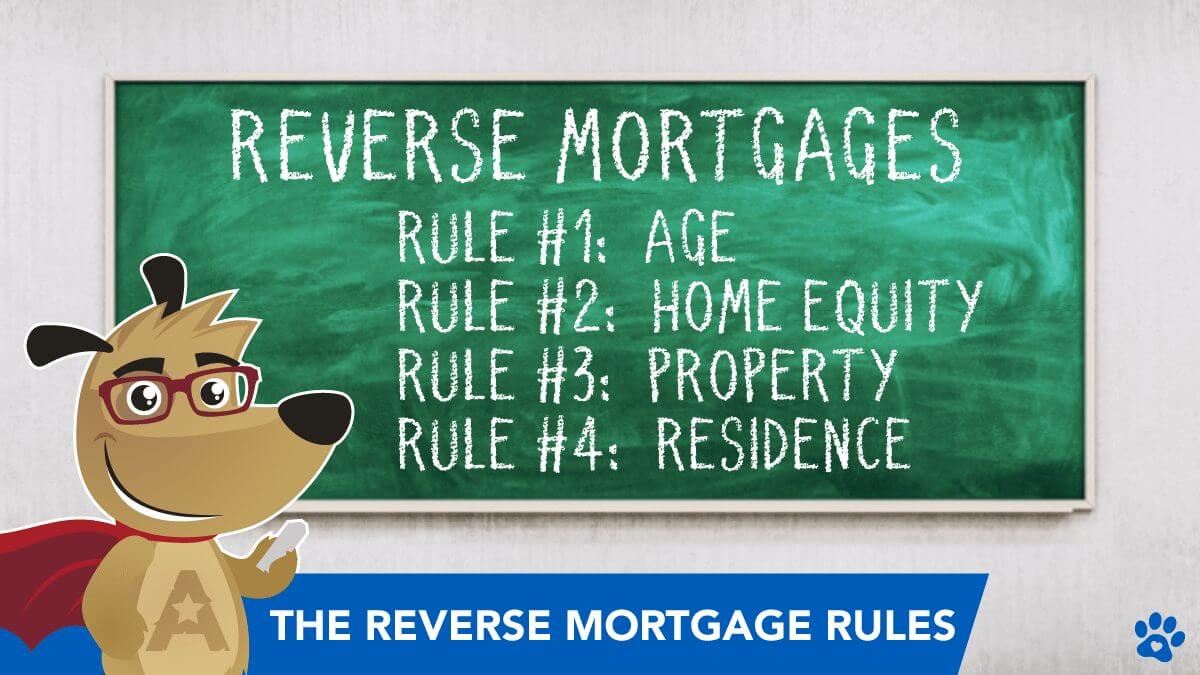
5 rules for getting a reverse mortgage

Key Criteria for Qualifying

RuleDetail
Borrower Age RequirementBorrowers must be at least 62 years old.
Primary ResidenceThe property must be the borrower's primary residence.
Equity RequirementBorrowers must have substantial equity in their home (typically at least 50%).
Financial AssessmentLenders conduct a financial assessment to ensure the borrower can afford taxes, insurance, and home maintenance.
Loan RepaymentThe loan becomes due when the borrower sells the home, moves out, or passes away.
Counseling RequirementBorrowers must undergo counseling from a HUD-approved agency.
Property EligibilityEligible properties include single-family homes, FHA-approved condominiums, and certain manufactured homes.
This table provides a concise overview of the primary rules associated with reverse mortgages, including borrower age, primary residence requirements, equity requirements, financial assessments, loan repayment terms, counseling requirements, and property eligibility.

#1. Limit on How Much You Can Borrow with a Reverse Mortgage

While it might be ideal to borrow as much as you need, reverse mortgages have strict borrowing limits set by the government. For 2026, the maximum amount you can borrow through a Home Equity Conversion Mortgage (HECM) is $1,249,125. However, it’s important to note that most borrowers will not qualify for the full amount.

The exact amount you can borrow depends on several factors:

  • Your Age: Specifically, the age of the youngest homeowner or eligible non-borrowing spouse.
  • Your Home’s Value: The loan is calculated based on your home’s value, but only up to the 2026 lending limit of $1,249,125.
  • Current Interest Rates: Lower interest rates often allow for a higher loan amount, while higher rates can reduce it.

These rules are designed to ensure that your loan aligns with your unique situation and provides financial security for both you and the lender.


#2. Required Counseling for a Reverse Mortgage

Before securing a reverse mortgage, you’ll need to complete a mandatory counseling session. This session ensures you fully understand the process, responsibilities, and implications of the loan, empowering you to make an informed decision about your financial future.

During the session, you’ll meet with an independent HUD-approved counselor who will:

  • Explain how reverse mortgages (HECM loans) work.
  • Answer any questions you may have about the loan process.
  • Discuss your financial situation to ensure a reverse mortgage is a suitable option for your needs.

You’ll also learn about ongoing responsibilities that come with the loan. Even after obtaining a reverse mortgage, you’ll need to cover:

  • Property Taxes: Keeping these up to date is essential.
  • Homeowners Insurance: Required to protect your property.
  • HOA Fees (if applicable): These must also remain current.

Additionally, you must not have overdue federal debts to qualify. Examples include:

  • Outstanding student loans.
  • Government direct loans.
  • HUD-insured loans.
  • Small Business Administration loans.

Once you’ve completed the session, you’ll receive a certificate of completion, which must be included with your loan application. This step ensures you’re well-informed and prepared before moving forward.


#3. Qualifying Property Types for a Reverse Mortgage

Not every property qualifies for a reverse mortgage, so it’s important to understand the property requirements before applying.

Here’s what you need to know:

General Ownership Requirements

  • You must either own your home outright or have a small remaining mortgage balance that the reverse mortgage can pay off.
  • The property must serve as your primary residence — vacation homes or second homes are not eligible.

Eligible Property Types

  1. Single-Family Homes: These are the most common properties eligible for a reverse mortgage.
  2. Multi-Family Homes (Up to 4 Units): Eligible if you live in one of the units as your primary residence.
  3. Condominiums: Must meet FHA approval standards.
  4. Manufactured Homes: Must meet specific criteria, such as being permanently fixed to a foundation and meeting HUD standards.

Ineligible Properties

  • Vacation homes or second homes.
  • Co-ops (cooperative housing units).

Meeting these requirements ensures your property is eligible for a reverse mortgage, helping you access the financial benefits of your home’s equity.


#4. Non-Borrowing Spouse Protections May Apply

A non-borrowing spouse (NBS) is a spouse who is not listed on the home’s title or the reverse mortgage loan. This can happen if the spouse is under 62 years old or for other personal reasons. While non-borrowing spouses are not considered borrowers, changes introduced by the Department of Housing and Urban Development (HUD) in 2014 provide important protections.

Key Protections for Non-Borrowing Spouses

If the borrowing spouse passes away, the non-borrowing spouse may be allowed to remain in the home, provided they meet specific conditions, such as:

  • The home remains the non-borrowing spouse’s primary residence.
  • The loan obligations, such as property taxes, homeowners insurance, and maintenance, continue to be met.
  • The non-borrowing spouse married the borrower when the reverse mortgage was taken out.

Why This Matters

Including your spouse in the reverse mortgage process is essential, even if they are not listed on the loan. By discussing these protections with your lender and HUD-approved counselor, you can ensure that both you and your spouse are prepared and secure.

Proactive Steps to Take

  • Involve Your Spouse Early: Make sure your spouse participates in all discussions about the reverse mortgage.
  • Understand the Rules: Ask your lender about non-borrowing spouse protections and how they apply to your specific situation.
  • Include Your Spouse in the Contract: Whenever possible, ensure your spouse is included to avoid potential issues in the future.

These steps can help protect your spouse’s right to remain in the home, giving you both peace of mind as you move forward with a reverse mortgage.


#5. Payment Options for Reverse Mortgages

When choosing a reverse mortgage, homeowners with an adjustable interest rate can select from several flexible payment options. Each option is designed to fit different financial needs and goals:

Payment Options for Adjustable Interest Rate Loans

  1. Line of Credit:
    • Withdraw funds as needed, either in scheduled installments or unscheduled payments at your discretion.
    • Offers flexibility to cover unexpected expenses or ongoing needs.
  2. Modified Tenure:
    • Combines a line of credit with steady monthly payments for as long as at least one borrower lives in the home.
  3. Modified Term:
    • Similar to Modified Tenure, but the monthly payments are made for a specific, predetermined number of months.
  4. Tenure:
    • Provides fixed monthly payments for as long as one borrower continues to live in the home.
  5. Term:
    • Offers monthly payments for a set period, defined in months, based on your preferences and financial plans.

Payment Options for Fixed-Interest Rate Loans

  • Lump Sum Payment:
    • Funds are disbursed as a single payment at the loan’s closing, giving you immediate access to your equity.

Popular Choices

The line of credit and tenure options are among the most popular for their flexibility and reliability, allowing homeowners to customize how they access their home equity.

Maximizing Retirement Income

For older homeowners looking to supplement their retirement income, a reverse mortgage can be a powerful tool. By leveraging your home equity, you can cover essential expenses, enhance financial security, or address unexpected needs — all while staying in your home.


WARNING: Serious Consequences for Breaking These 3 Reverse Mortgage Rules

A reverse mortgage can be a powerful financial tool, but there are critical rules you must follow to keep your loan in good standing. Breaking these rules can have serious consequences, including the loan becoming due and payable. Here’s what you need to know:

1. Occupancy

  • You must live in the home as your primary residence.
  • If you permanently move out or leave the home for more than 12 consecutive months (e.g., to an assisted living facility or nursing home), the loan must be repaid.

2. Tax and Insurance Obligations

  • You’re required to pay property taxes and maintain an active homeowner’s insurance policy.
  • Failing to meet these obligations will result in the loan becoming due, potentially putting your home at risk.

3. Maintaining the Home

  • The property must be kept in good condition to meet the loan servicer’s requirements.
  • This includes regular maintenance to ensure the home doesn’t deteriorate, protecting its value for you and the lender.

By following these guidelines, you can avoid the risk of foreclosure and continue enjoying your home throughout retirement.


Top FAQs

Q.

What are the basic rules of a reverse mortgage?

To obtain a reverse mortgage, you must meet the minimum age requirement, which in most cases is 62. Some private reverse mortgage programs allow for borrowers as young as 55 in some but not all states. The property must be the primary residence of the borrower(s) and remain the primary residence of at least one borrower for the duration of the loan to remain in good standing. Additionally, the borrower(s) are responsible for paying their property taxes, homeowners insurance, and upkeep of the property as they would be for all other loan types.
Q.

What happens when someone dies with a reverse mortgage?

When the last original borrower or eligible non-borrowing spouse permanently leaves home due to incapacity or death (or any other reason), the loan becomes due and payable. Borrowers or their heirs then have the right to repay the loan with funds available to them, or by refinancing the loan, they can sell the property and repay the loan with the sale proceeds, or they can walk away and owe nothing. If the borrower(s) die and heirs wish to keep the home, but the mortgage balance is greater than the value of the home, the heirs can repay the loan in full for an amount equal to the amount owed or 95% of the current value of the home, whichever is less.
Q.

What are some specific requirements for reverse mortgages in California?

California is one of the few states that impose additional time on the front end, such as the right of rescission that borrowers have on the back, which is meant to give borrowers a “cooling off” period after counseling. Lenders cannot begin processing a loan for a borrower for at least 7 days after borrowers have completed their counseling. Regardless of whether HUD will allow a returning borrower to waive counseling within 5 years, the state of California will not, and all borrowers must attend counseling for each new loan. Spouses and non-borrowing spouses must attend counseling. In the state of California, the water heater must be double strapped.
Q.

What are some specific requirements for reverse mortgages in Texas?

In Texas, you cannot do a loan for a non-borrowing spouse, whether eligible or non-eligible. The reverse mortgage loan must close within 180 days of counseling, or the borrower(s) must be re-counseled. The Preliminary Title Report is valid for 90 days per Texas state law. The lender must order a new, updated report if the loan does not close within that period. Texas loans cannot close with a Life Estate interest in the property. The loans in Texas also cannot close in the name of a trust. Transactions must use an attorney to review the title and closing package, which is in the state of Texas.
Q.

What are some specific requirements for reverse mortgages in Florida?

Florida requires the charges of transactions that can add considerably to the loan costs in that state. The state of Florida requires that each loan gets a copy of the survey or a signed survey affidavit. Florida charges additional taxes such as Intangible Taxes and Documentary Stamp Taxes. Although these are not lender fees, they are moving costs and getting new loans in Florida and must be considered.

Ready to Unlock Your Home’s Equity? Get a free, custom quote from All Reverse Mortgage, Inc. (ARLO™) — America’s #1 Rated Lender with a 4.99/5-star rating! Call (800) 565-1722 or click here for your free quote — simple, trusted, 100% secure!


ARLO Testimonials
America's #1 Rated Reverse Lender Celebrating 20 Years of Excellence.
Author Michael Branson
About the Author, Michael G. Branson | Mike@allreverse.com
Michael G. Branson CEO, All Reverse Mortgage, Inc. and moderator of ARLO™ has 45 years of experience in the mortgage banking industry. He has devoted the past 20 years to reverse mortgages exclusively.

Have a Question About Reverse Mortgages?

Look no further. Michael G. Branson, our CEO, brings a wealth of knowledge directly to you. With a robust 45-year tenure in mortgage banking and 20 years dedicated solely to reverse mortgages, he's the expert you want on your side.
Post your question in the comments below and anticipate a personalized response from Mr. Branson himself, typically within one business day. He's here to illuminate all angles of reverse mortgages, ensuring you're equipped with the knowledge to make informed decisions. Take this opportunity to gain insights from a seasoned professional.

Over 2000 of your questions answered by ARLO™
Ask your question now!

19 Comments on this Article
  1.   Laura
    August 1st, 2024
    Hello,
    Thank you for taking your time to answer questions. My parents-in-law are retired and receive Medicare and Medicaid supplemental assistance in Florida. They are considering a reverse mortgage with a lump sum payout to make some improvements to the house. They will give all the money to their son, who will handle all repair work for them. The question is, if by receiving a lump sum, could they lose their supplemental assistance? Thank you in advance.
    Reply to Laura
    • Michael Branson Michael Branson
      August 6th, 2024
      Hello Laura,
      They can possibly endanger their eligibility for any needs-based programs if they are not careful. Medicare is typically an age-eligible program and should not be affected, but Medicaid will review their assets to determine eligibility. Loan proceeds are not considered "income," but if they have cash in their bank accounts totaling over the eligible balance, they could accidentally eliminate their eligibility.
      You need to verify the eligibility requirements for the program. Most programs require the recipient to send in bank statements, and it makes no difference how much money goes through the bank account during the month. What counts is the final balance at the end of the month. If this is true for their program as well, you would need to ensure the loan proceeds were received and spent from the account within the same month, before the month-end statement is sent out. This way, the statements will show a balance that qualifies them to receive their benefits every month.
      In other words, if the bank statement is printed on the last day of every month, you would want to ensure that the deposit was made after the 1st day of the month and that all the funds deposited from the loan proceeds were spent before the month-end statement was printed and sent by the bank. Both statements' ending balances will then verify an eligible balance (even though a large sum was deposited and the funds were spent).
      This is much easier to do with a line of credit so that you can draw funds as needed and always keep the balance in your bank account below the amount required to remain eligible at the time the statement is printed. It can be done with the full draw as well (such as the plan you mentioned), but there is typically more money that needs to be spent in a very short time (less than 30 days). Remember, when you take the full draw, you are accruing interest on the full amount, even if you aren't using all the funds from the start, so the cost of borrowing all the money at the start is also something to consider.
      Reply to Michael
      •   Laura
        August 6th, 2024
        Thanks so much for your prompt response. This information is important and unfortunately not available, but thanks to you I got the answer I needed.
        Reply to Laura
  2.   Danny
    April 6th, 2024
    My brother and his wife have a reverse mortgage on their home. His wife died in January. I began to move into their home before she died. My brother wanted me to buy into their reverse mortgage. I have plans to buy one half of his equity. We requested that the reverse mortgage be changed to include me as the owner of the house. The new reverse mortgage was approved. But, when we got notice of the closing on the mortgage, the mortgage company required $40,000 at closing. We decided to leave the original reverse mortgage in place.
    Reply to Danny
    • Michael Branson Michael Branson
      April 8th, 2024
      Hello Danny,
      I am afraid you need to talk to an estate attorney about this question. The loan does not dictate who gets the house when the borrower passes. Whatever you and your brother, any heirship laws of the state would determine what happens to the property. I can tell you that when he passes, the reverse mortgage will become dues and payable at that time.
      This is why you need to speak to an attorney. You need to know what needs to be done so that your claim to title is secure at that time. You also need to know that to keep the home and continue living in the property, you would need to be able to refinance the loan at that time, or you would have to sell the property to pay the loan off.
      As you have found, you can't just add someone to an existing reverse mortgage, and since rates are higher now and you are younger than your brother, you would need $40,000 to refinance at this time. It might be less later in a lower interest rate market or more as more interest continues to accrue on the current loan if the property does not increase substantially in value. My point is that you may be able to get a reverse mortgage on your own later to pay off the existing loan, but there is no guarantee that the interest rates and property values would support a refinance without requiring you to bring funds in to close at that time. And the manner of title and your agreement with your brother will make a difference in what happens upon his death.
      Reply to Michael
  3.   William S.
    September 2nd, 2022
    My home needs considerable repairs. We owe nothing, having paid off our mortgage years ago. Needing funds from the HECM to complete those repairs, how do we achieve this considering FHA standards on the home appraisal? How can funds from a Reverse Mortgage be used to make those repairs as claimed can be done?
    Reply to William
    • Michael Branson Michael Branson
      September 6th, 2022
      Hello William,
      There are a few things you can do. Firstly, some repairs are required to be completed before the loan closes and some would be taken into consideration when the home is appraised and adjusted for with the final value is determined. Some repairs can have money set aside from the loan funds for their completion while others are considered a health and safety concern and must be completed before the loan may close. Finally, there are some companies who bill themselves as "FHA repair contractors" that will agree to complete FHA needed repairs knowing they will not be paid until after the loan closes. You should speak with a knowledgeable lender to determine which category your repairs fall into.
      Sometimes there is no way to know for sure until after the appraiser completes the inspection. If you do choose to go the last route with the FHA contractor, be certain you shop around. Your contract with the repair company is between you and the repairman and the lender is not part of that contract. If there are any disputes later because of the workmanship, etc., the lender cannot become involved in those disputes, so you need to be sure you are comfortable with the company you choose. Do a good job of checking references and company ratings to be certain you will be happy with the terms and the job results before you begin any work with any contractor and that you are certain your loan will be granted, and you can pay for the work you authorize before you begin.
      Reply to Michael
  4.   Marshall P.
    August 7th, 2021
    My home should appraise at $300,000. I owe $165 ,000.If I were to get a reverse mortgage and borrow no money or pay no payments which I understand is one benefit then after 10 years ,would I owe more than I presently owe since no money was borrowed other than the preset mortgage amount plus closing .If this would be the case then Could I get a conventional mortgage at some time and pay the reverse mortgage off .Point would be ,10 years without a payment and revert back to a similar mortgage that I now have or sell the house for market price ..77 years old and only want to be payment free.
    Reply to Marshall
    • Michael Branson Michael Branson
      August 10th, 2021
      Hello Marshall,
      If I could answer this question with any degree of certainty, I would be a very wealthy man! Unfortunately, a lot of this depends on future events and I cannot tell you what will happen in the future.
      If I run the criteria you provided through the HUD calculator, it tells me that in 10 years you will have a loan balance of $237,920 against a property valued at $444,073 which would give you about $206,153 equity at that time. But there is a big problem with that, the calculator can only estimate the numbers based on today's known facts. It uses today's interest rates, and it uses 4% per year appreciation.
      The interest rate it uses to determine the interest accrual is the 10-year rate and that is higher than the actual accrued interest at the start of the loan, but no one can tell you what future rates will be or when they will change. Most people I know (including myself) preferred fixed interest rates but those who received the adjustable-rate reverse mortgages have done so much better and have accrued so much less interest over the past 15 years than those who took the higher fixed rates.
      Will that continue to be the case? No one knows for sure. Will the properties appreciate at 4% per year or continue as they are now at 10% or higher in many parts of the country? According to the National Association of Realtors, Prices in March were up over 17% from a year earlier. Those kinds of results would skew the HUD calculator model just as would a sudden drop.
      So I guess the bottom line is that after more than 45 years in mortgage banking, the best I can tell you about rates and values is that they will either go up, down or stay the same! Since that is the case, I could never give you any kind of solid answer about whether you would have the equity to refinance into a conventional loan after 10 years or not.
      What I can tell you is that you can live the rest of your life in the home with a reverse mortgage if you continue to pay your taxes and insurance on time and maintain the home in a reasonable manner, regardless of what the equity does later. I can tell you that there is never a prepayment penalty so you can choose to sell your home at any time if that is your choice and sell without a penalty.
      I can tell you that if you want to make payments so that the balance does not rise as the interest accrues, while you are never required to do so, you can at any time and in any amount.
      And finally, I can tell you that if you do live in the home until you pass and the balance of the loan is much greater than the value of the home, your heirs can keep the home and pay off the loan at the lower of the amount owed or 95% of the current appraised value, or they can walk away and owe nothing.
      I can tell you those things because they are constant and do not change based on the interest rates or the appreciation the home experiences. After that, no lender, forward or reverse, can tell you what the future will bring.
      Reply to Michael
  5.   Janet V.
    June 16th, 2021
    Hi ARLO,
    I've had a recent mortgage for 8 years.my husband passed 2 years ago. I've kept all the requirements up however I have credit card debt and I'm sure there are judgments coming. Florida Is a homestead state however, can a civil judgment be a problem with my Reverse Mortgage? Should I consider bankruptcy or is that worse?
    Reply to Janet
    • Michael Branson Michael Branson
      June 18th, 2021
      A judgement will not affect a current reverse mortgage. If you keep your taxes, insurance, and any other property charges current, you will be ok.
      Any judgement filed would be filed after the reverse mortgage and therefore secondary to the mortgage loan so it is not a concern to the lender.
      A bankruptcy (BK) could interrupt any payments you currently receive from the loan. The BK would not cause the lender to call the loan due and payable either, but it would require the lender to cease making any payments to you until the BK court exempted the property/loan from the BK.
      As always, we cannot give you legal advice and since you are contemplating both actions, I would strongly suggest that you run both by your attorney for legal advice on the actions and how they will affect you in your circumstances.
      Reply to Michael
  6.   Julie M.
    June 1st, 2021
    I'm in the process of getting a reverse mortgage on my duplex. I was just recently told that I would have to be occupying the larger unit to qualify. Is this true? I've always used the larger unit for rental income.
    Reply to Julie
    • Michael Branson Michael Branson
      June 2nd, 2021
      Hello Julie,
      That is the HUD requirement whenever there is more than one unit involved. In all honesty, I really do not understand the rationale behind this requirement, especially when you are talking about a true duplex and not just an accessory dwelling unit (ADU) where the ADU is just a mother-in-law type unit that is much smaller than the main dwelling, but it is HUD's program and their requirement.
      When the second unit is a fully functioning duplex unit that suits the owner's needs and in some cases, even better than the larger unit, I believe HUD should allow the owner to live in the smaller unit but it is HUD's requirement for the reverse mortgage program that the owner occupy the larger unit.
      Reply to Michael
  7.   Allen L.
    November 25th, 2020
    A) are there closing costs to secure a reverse mortgage?
    B) if my home is appraised to sell at $213000 and my current loan is $125000 can I still obtain a reverse mortgage
    C) I am a full time occupant
    Reply to Allen
    • Michael Branson Michael Branson
      November 26th, 2020
      Hello Allen,
      Yes, there are closing costs and the amount you can expect to receive depends on your age.
      Your best bet is to visit our online calculator, put in your information (nothing personal but your birthdate and you do not need to use the actual day) and then you can see what benefits you would receive, the costs and whether the loan would work for your purposes.
      Reply to Michael
  8.   Joe G.
    September 14th, 2020
    I am US citizen, Does my wife have to be a permanent resident to qualify? Please direct me to the policy where it states that.
    Reply to Joe
    • Michael Branson Michael Branson
      September 14th, 2020
      Hello Joe,
      To be eligible for the loan, she does not need to be a permanent resident alien or a citizen.
      She does need to be a non-citizen with lawful residency, have a valid social security number, she must occupy the property as her primary residence, and she must be eligible to work in the US having an Employment Authorization Document (EAD) issued by the U.S. Citizenship and Immigration Services.
      The information can be found in the HUD manual 4000.1 on the HUD.gov website.
      The portion of the manual regarding citizenship and immigration status have been copied below for your convenience.
      hud manual on resident aliens
      Reply to Michael
  9.   Charles & Rhonda M.
    November 17th, 2019
    My husband Charles & I each have a living trust. Our house is included in this trust. Should this cause a problem with us getting a reverse mortgage? According to your tables, our house value is $551,200. Our house is paid off but we have a home equity loan remaining for$67,000.
    We are mainly wanting to have money as a cushion to stay our house longer. My husband is 77 & I am 65. Thanks, Rhonda Manetz
    Reply to Charles
    • Michael Branson Michael Branson
      November 25th, 2019
      Hello Rhonda,
      Your Home Equity Line of Credit (HELOC) is also a lien against the house so it is not paid off and the HELOC would have to be paid with the reverse mortgage in order to get the loan.
      It's not a problem, but you would have to pay that loan off and close it if you want the reverse mortgage. The trust is no problem as all if it meets HUD requirements and 99% of them do. HUD requires that there are certain safeguards in place and most estate attorneys put them in place for their clients anyway.
      Occasionally, we do run into one that requires an amendment to the trust but that is usually minor, the borrower's attorney can prepare it easily and inexpensively and it does not hold up the process. Each trust is reviewed though for HUD compliance.
      The good thing about the reverse mortgage instead of your HELOC too is that if you want to continue to pay down the balance with monthly payments, you can. There are no payments due on the reverse mortgage but there is no prepayment penalty and so you can make any payment in any amount at any time.
      If you want to make payments to continue to pay down the balance, you may. It's the best of both worlds in that regard. If you find that money is tight in any given month, you don't have to make a payment that month or can make one that is less than the interest accrued and it never adversely affects your credit because there was no payment due in the first place!
      Reply to Michael

Leave a Reply to This Article