
A+ BBB Accredited
★★★★★ 4.9/5 from 1,200+ reviews
HUD-Approved · NMLS #13999
Explore All Reverse×
Programs
How It Works
Calculators
Resources
Why All Reverse
HUD-approved direct lender · NMLS #13999
4.9/5 from 1,200+ reviews
ARLO

America's #1 Rated Reverse Mortgage Lender*

Have bankruptcy questions? Free consultation — no obligation.
Michael G. Branson Michael G. Branson, CEO of All Reverse Mortgage, Inc., and moderator of ARLO™, has 45 years of experience in mortgage banking, with the past 20 years devoted exclusively to reverse mortgages. A Forbes Real Estate Council member, he developed the industry's first fixed-rate jumbo reverse mortgage and has been featured in Forbes, Kiplinger, the LA Times, and Yahoo Finance. (License: NMLS# 14040)
Cliff Auerswald Cliff Auerswald, President of All Reverse Mortgage, Inc., and co-creator of ARLO™ — the industry's first real-time reverse mortgage pricing engine — has 27 years of experience in mortgage banking, with 20+ years focused exclusively on reverse mortgages. A recognized expert in reverse mortgage technology and consumer education, he has been featured in Kiplinger, Yahoo Finance, Realtor.com, and HousingWire. (License: NMLS# 14041)

Reverse Mortgage & Bankruptcy — What Happens to Your Loan If You File Chapter 7 or 13?

Michael G. Branson, CEO of All Reverse Mortgage
CEO · 45 yrs in mortgage banking
Cliff Auerswald, President of All Reverse Mortgage
President · All Reverse Mortgage Inc.
5 min read Fact Checked HUD-Lender #26031-0007 58 comments

We recently had several borrowers who had previously obtained a reverse mortgage call and asked us what the effect would be on those reverse mortgages if they had to begin a bankruptcy proceeding.

While we are not attorneys and would always advise you to seek competent legal advice from an attorney in your state, we wanted to contact an expert in the field of reverse mortgage loan servicing to obtain additional information we could pass along.
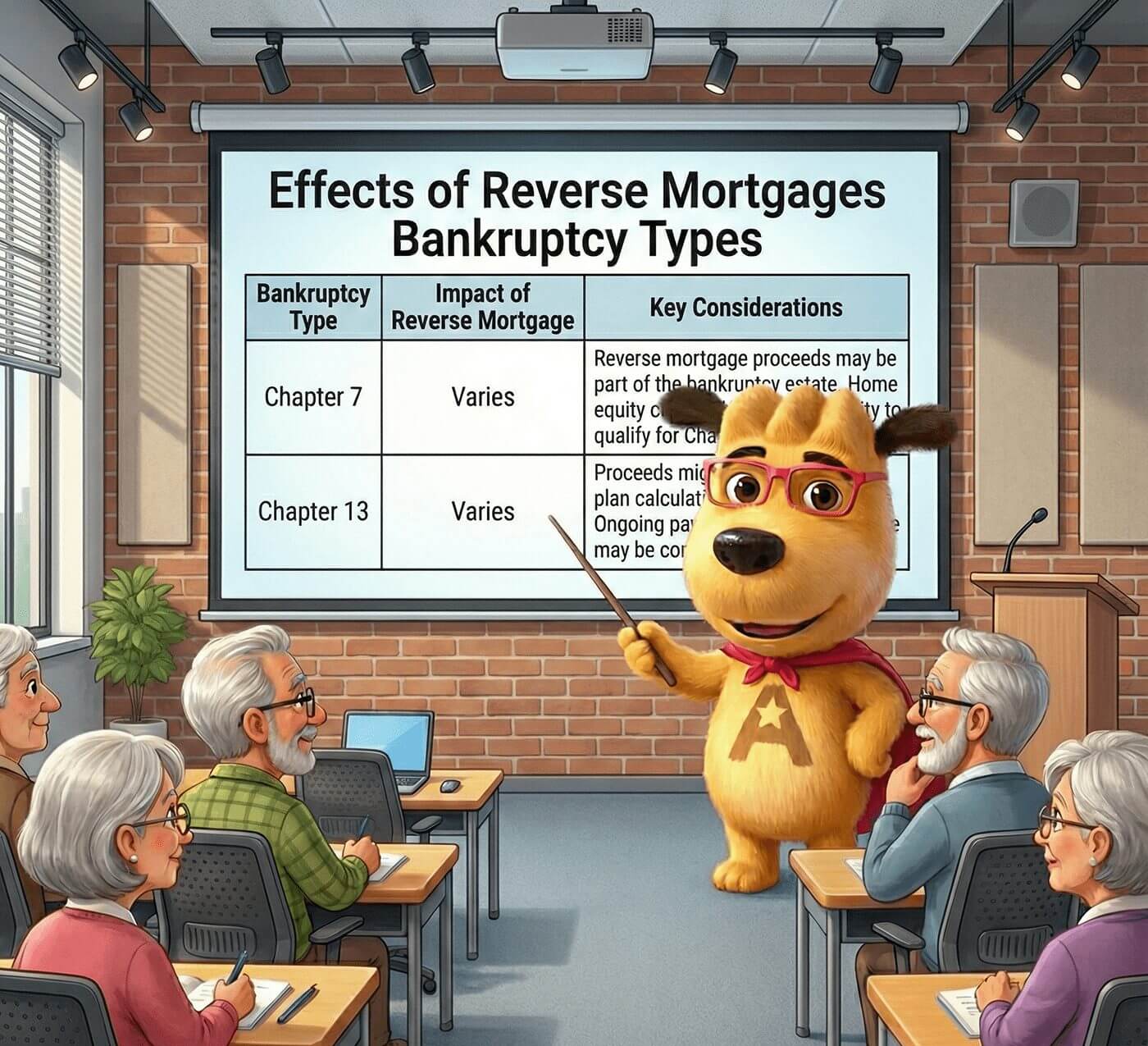
How bankruptcy can affect a reverse mortgage — Chapter 7 and Chapter 13 rules explained

We contacted Ryan LaRose, Chief Operating Officer of CELINK, the nation’s largest reverse mortgage sub-servicer, to ask what happens when a borrower files for bankruptcy.

Ryan told us there is a myth about reverse mortgages and bankruptcies — that many believe the lender would immediately call the loan due and payable upon notification of a bankruptcy. He stated that this was not the case.

The servicing agent receives notice of the filing and, in turn, sends it to their attorneys to file a “Proof of Lien,” which protects the reverse mortgage lender’s interest in the property during the bankruptcy proceeding. There are other steps the servicer must complete before the bankruptcy is dismissed or discharged, but calling the loan due and payable is different. -Mr. LaRose

How Bankruptcy Can Affect Your Existing Reverse Mortgage

While the servicing company does not provide the courts with an accounting of any remaining funds available to borrowers on their existing credit lines and under monthly payment provisions, borrowers cannot receive funds from their reverse mortgage during the bankruptcy proceeding.

This is because the Bankruptcy Trustee must approve any funds the borrower receives during this time, as borrowers are prohibited from incurring new debt during the Bankruptcy period.

Borrowers planning to file for protection under the bankruptcy laws and then live off their reverse mortgage proceeds may be in for a big surprise when they learn they can obtain additional funds only after the bankruptcy is complete. -Mr. LaRose

This is another area that reverse mortgage borrowers should discuss with their attorneys before they file. But it is comforting to get the facts rather than the myths about bankruptcies and existing reverse mortgages.

As we stated at the beginning, this is not legal advice. Be sure to consult your attorney before you do anything that may affect your circumstances!


Effects of Reverse Mortgages Bankruptcy Types

Bankruptcy TypeImpact of Reverse MortgageKey Considerations
Chapter 7VariesReverse mortgage proceeds may be part of the bankruptcy estate. Home equity could affect the ability to qualify for Chapter 7.
Chapter 13VariesProceeds might impact repayment plan calculations. Ongoing payments from the reverse mortgage may be considered income.
This table includes:
The type of bankruptcy (Chapter 7 or Chapter 13).
The general impact a reverse mortgage might have on each bankruptcy type.
Key considerations or factors that might influence this interaction.
The actual impact can vary greatly based on individual circumstances, and this table serves as a general guide. For specific legal and financial advice, it's crucial to consult with a bankruptcy attorney and/or financial advisor familiar with both reverse mortgages and bankruptcy laws.

FAQs

Q.

Can you do a reverse mortgage while in Chapter 13 bankruptcy?

You can obtain a reverse mortgage while in Chapter 13 under certain circumstances. You must have completed a minimum of 12 months of on-time scheduled payments and have been documented by the court (cannot prepay payments), and the Bankruptcy Court must approve you to enter into the reverse mortgage transaction.
Q.

What happens if you file bankruptcy after getting a reverse mortgage?

The bankruptcy will not invalidate your reverse mortgage, but could interrupt your access to funds or monthly payments until the property and loan are exempted.
Q.

What happens to my reverse mortgage if my lender goes bankrupt?

Suppose a reverse mortgage lender is no longer solvent; HUD takes over the loan. HUD has insured the loan to ensure every borrower receives every dollar due under the loan terms.
Q.

Does a reverse mortgage protect you from creditors?

The reverse mortgage has no impact on you and other creditors.
Q.

Can a reverse mortgage go into foreclosure?

The reverse mortgage does have “call events” that could result in foreclosure. Borrowers must live in the property and pay the installments of taxes and insurance on the property when due (and any other property charges, such as HOA dues). The borrower must also maintain the home in a reasonable manner.
Q.

Does a bankruptcy trigger a default on a reverse mortgage?

Filing for protection under bankruptcy laws does not trigger a default, but it can interrupt the borrower’s ability to continue to draw on the line until the loan and the property are exempted from bankruptcy. You should advise your attorney that you have a reverse mortgage and the loan status (whether you still have funds available to you on your line of credit). Since additional draws may be determined as taking on additional debt, you may need permission from the court to access your line, or you may need to wait until the Bankruptcy is complete to access additional funds. Some private programs may have terms with a call provision when the borrower files for bankruptcy, so if your loan is not an FHA-insured HUD HECM loan, it’s even more important to have your attorney review your loan documents in advance. Any way you look at it, I recommend that your attorney review your circumstances before filing any documents that affect your life, including documents that stop your income flow or access to cash.
Q.

What happens if your reverse mortgage lender files for bankruptcy?

Your loan will either be assigned to HUD, or another lender will purchase the servicing rights, but either way, you can continue to remain in your home under the original terms of the Note and Deed of Trust/Mortgage. You will be notified once the loan is transferred to a new servicer, and nothing will change in the meantime. Then the only thing that changes is the information for the new servicer (and even then, it is possible the new lender will use the same servicer — there aren’t that many contract servicers for reverse mortgages, so you may wind up with the same company).

Have Questions About Bankruptcy and Your Reverse Mortgage? Get a free consultation from All Reverse Mortgage, Inc. (ARLO™) — America’s #1 Rated Lender with a 4.99/5-star rating! Call (800) 565-1722 or click here for your free quote — simple, trusted, 100% secure!ARLO recommends these helpful resources:


ARLO Testimonials
America's #1 Rated Reverse Lender Celebrating 20 Years of Excellence.
Author Michael Branson
About the Author, Michael G. Branson | Mike@allreverse.com
Michael G. Branson CEO, All Reverse Mortgage, Inc. and moderator of ARLO™ has 45 years of experience in the mortgage banking industry. He has devoted the past 20 years to reverse mortgages exclusively.

Have a Question About Reverse Mortgages?

Look no further. Michael G. Branson, our CEO, brings a wealth of knowledge directly to you. With a robust 45-year tenure in mortgage banking and 20 years dedicated solely to reverse mortgages, he's the expert you want on your side.
Post your question in the comments below and anticipate a personalized response from Mr. Branson himself, typically within one business day. He's here to illuminate all angles of reverse mortgages, ensuring you're equipped with the knowledge to make informed decisions. Take this opportunity to gain insights from a seasoned professional.

Over 2000 of your questions answered by ARLO™
Ask your question now!

58 Comments on this Article
  1.   Donna J.
    February 19th, 2026
    I filed for bankruptcy. Can I still apply for a reverse mortgage? My husband also filed.
    Reply to Donna
    • Michael Branson Michael Branson
      February 19th, 2026
      Hello Donna,
      The answer to your question depends on several factors. For example, is the bankruptcy still active, or has it been discharged? How long ago did you file? If you were required to make payments, were they completed on time and according to the terms of the bankruptcy?
      Without those details, it would be difficult to give you a precise answer. That said, there are several situations in which a borrower who has filed for bankruptcy can still qualify for a reverse mortgage, provided they meet HUD guidelines.
      A good first step would be to use a reverse mortgage calculator, such as the one available on our website at https://reverse.mortgage/calculator
      . That will give you an estimate of what may be available to you based on your age, home value, and location. If the numbers look promising, the next step would be to speak with us directly so we can review your specific bankruptcy details and credit history to determine whether you meet HUD requirements.
      We would be happy to walk through it with you.
      Reply to Michael
  2.   Louis P.
    December 28th, 2025
    I am in my third year of a chapter 13 bankruptcy. My husband just lost his job and we need to do something about our house. Is a reverse mortgage an option for us if we have 1 more year to go in our bankruptcy? Can you possibly get a reverse mortgage if you are in a bankruptcy?
    Reply to Louis
    • Michael Branson Michael Branson
      December 28th, 2025
      Hello,
      A reverse mortgage may very well be an option. A BK is not an automatic deal breaker. The lender will look to see that you have made your required payments under the terms of the BK agreement on time, and that all your taxes and insurance payments have been made in a timely manner for at least the last 24 months.
      There will usually be a requirement to explain the reasons for the BK and the lender may still require a Life Expectancy Set Aside (LESA) account where they set funds aside from your proceeds to pay your taxes and insurance but if you have been on time with all your payments and the reason for the BK was out of your control, you may not even be required to have the LESA account. That would be the underwriting call based on your income and credit qualification during the financial assessment of your loan.
      But the bottom line is that it is entirely possible to get a reverse mortgage if your payments have all been made on time, the court approves it (the court must approve a reverse mortgage while you are in BK but if it benefits your situation, they usually will), and you meet the reverse mortgage requirements.
      Reply to Michael
  3.   Jocelynn J.
    January 8th, 2024
    Hi Arlo. I am an heir who inherited my grandmother's trust back in 2019 when she passed (5/10/19). My uncle did a quit claim deed as well as a preliminary change of ownership, so the title is in my name. I received a default notice from Compu-Link/HUD division on Aug. 22, 2023 stating the property was in violation due to the borrower passing a d in default. I was unaware my grandmother even had a reverse mortgage on the property. I thought the property was free and clear. After pulling the house records, I found out she took the RM (reverse mortgage) out back in 2008.
    I am currently on my 2nd and the final 90 day extension that HUD approved me for. I am waiting for the report from the appraiser so I can secure financing.
    Besides the fact I don't even know if I will qualify for this, but let's say I do qualify. Would filing bankruptcy 7 or 13 allow me to continue living in my home? As I mentioned, besides the bankruptcy end of it, would a reverse mortgage company allow an heir to file and continue living in the home they inherited this way? I plan on calling for a free consultation for a bankruptcy attorney, but I often read your website and wanted to get your input on this situation first.
    I'm trying all I can to keep my home as it is all I have. I am a survivor of domestic violence with mental health disabilities, so it is making it extremely difficult to find anyone who will approve me for such a high loan or refinance amount. I am facing homelessness. I am waiting for a new pay off statement.
    Thank you in advance!
    Reply to Jocelynn
    • Michael Branson Michael Branson
      January 8th, 2024
      Hello Jocelynn,
      The loan became due with the change of title in 2019. It sounds like the reverse mortgage lender is taking the normal steps they would under the circumstances. The reverse mortgage is not, and never has been, intended to be a multi-generational mortgage. HUD and the lender will be looking for the loan to be retired now. The lender will not allow you to continue living in the home now that they know the original borrower does not occupy the property.
      The loan became due when your grandmother passed in 2019, according to the terms of the loan. It sounds like the title was in the name of her trust, and as a result, the lender was not aware of her passing until the change of ownership was recorded. That's odd, though, because the servicer usually sends out an occupancy affidavit that the borrower must sign attesting that they still live in the property as their primary residence. Your grandmother would not have been able to sign for approximately 4 years. If that affidavit is not returned, an occupancy inspection will be conducted.
      The bottom line is that some legal steps may slow or stop the foreclosure process, but I honestly do not know what they might be. Bankruptcy might be one of them, but I don't know if bankruptcy is a good idea because that might also hurt your chances of getting other financing to pay off the loan. Lenders can have a property excluded from bankruptcy and so it might give you more time, but I'm not sure it would be a solution. And I don't know how much time it might give you.
      Either way, such a question would amount to legal advice, not lending advice. As such, I'm not licensed nor competent enough on the laws in each state to give you legal advice. Licensing law for lenders specifically forbids me from giving legal advice so I would suggest you continue the path you stated you were going and speak with an attorney soon to find out what you can legally do and how those steps might benefit your situation.
      I wish I could be of more assistance. I would have given options such as also checking with a local real estate specialist to see if a sale is possible with a move to another location if we were discussing this before the end of your second extension, but now time is of the essence, and your time to act is short.
      Reply to Michael
  4.   Sherry
    October 17th, 2023
    Hello Arlo,
    My husband is 64, and I am 67 Covid about did us in, and we want to look into a reverse mortgage. We intend to remain in our home from now on. Our home is a horse farm. We have a nice home of about 4700 sq ft on twenty acres barn and enclosed riding arena
    The farm appraises at between $500,000 and $520,000 and our existing mortgage payoff is about 330,000. We have had to file Chapter 13 reorganization due to job loss and my husband being hospitalized due to COVID complications. He is now back at work. The Chapter 13 payments are crazy, and very difficult for us to survive with them so high. Our credit has suffered, thus the reason for Chapter 13. Is it possible for us to do a reverse mortgage, as it would help alleviate the strain we are dealing with.
    Reply to Sherry
    • Michael Branson Michael Branson
      October 17th, 2023
      Hello Sherry,
      I would never want to dissuade you from trying without looking at your circumstances more in depth, but I need to be honest with you right from the start because you have several things going against you now. The reverse mortgage is meant for single family, residential homes, and traditional "farms". Commercial properties and properties with industrial applications will not be eligible for the program. If your home is a single-family home surrounded by other single family residential properties that happens to have a couple of horse on the property (and is zoned for that), then you would be fine. However, if the property is zoned agricultural or farmland instead of residential and is not considered residential with other predominantly residential properties in the area, it would not be eligible for the HUD HECM (reverse mortgage) program.
      The next hurdle you will have is the loan amount available for borrowers at your age based on the current interest rates. I do not know your location, so I do not know the exact costs for your area, but based on your ages, the value, and the amount owed you indicated, you would be substantially short to close. You would need to bring in more than $160,000 to pay off your existing loan and close the reverse mortgage, assuming that your mortgage payments, taxes, and insurance have all been paid on time for the past 24 months. Your remaining credit is clear enough after the BK to avoid a set aside for taxes and insurance. If funds needed to be set aside for taxes and insurance, the amount to close the loan could be considerably higher.
      Finally, while the credit requirements for a reverse mortgage are more accessible than most forward mortgages, a financial assessment portion of the underwriting would consider your past payments of obligations. You would need to have paid all of the BK payments on time, and a minimum of 12 months of the BK payments must have been paid, or the balance would have to be 0 due to the successful completion of the schedule (with on-time payments). Again, the lender must get verification that all property charges have been paid on time for the most recent 24-month history. A set aside would be established in most cases, but with a prior BK, they must also consider your entire payment history for acceptance.
      Again, I intend not to shut you down before you ever get a chance to try. Still, you need to understand that the amount you receive with a reverse mortgage depends on the age of the youngest borrower and current interest rates (with the amounts starting at the least for the youngest borrowers and growing the older the borrower). Interest rates have risen sharply over the past 18 months, and the minimum age for borrowers under the HUD program is 62, so you are already at the lowest end of the age range. You can always have a lender review your property for acceptability, but if the amount available will not meet your needs, it really won't help. When/if interest rates begin to decline, the amounts available to borrowers will increase. You may want to check back with online calculators such as the one on our website, but I suggest you contact a loan officer independently to see if your property will meet the HUD requirements. It may be best for you to know your options before making any decisions.
      Reply to Michael
  5.   Clarance
    June 14th, 2023
    Hi Arlo,
    Can you still obtain a reverse mortgage after filing for bankruptcy a year and a half ago?
    Reply to Clarance
    • Michael Branson Michael Branson
      June 14th, 2023
      Hi Clarence,
      Most of the time, yes. It may depend on what type of BK you filed, whether you were on a payment plan and met those obligations, the BK itself, and your credit since then. But the only way to know is to talk to a licensed loan officer and review your circumstances. It never hurts to make the call.
      Reply to Michael
  6.   Kenneth
    October 13th, 2022
    Hi Arlo,
    In your opinion should a person file a bankruptcy first before getting reverse mortgage or get the reverse mortgage first? I have good payment history and no delinquency. I read your answer in earlier question. And the credit card payments are becoming unmanageable. I have not missed one since 1998. Should I stop paying them file bk or get reverse mortgage
    Reply to Kenneth
    • Michael Branson Michael Branson
      October 13th, 2022
      Hello Kenneth,
      This is a tough question and one I cannot just answer for you off the top of my head. There are possible ramifications to either action that you need to consider so that path you choose must be the one that is right for you and your circumstances. For example, it is much easier to get a loan while your credit is still good, and you have no bankruptcy on your credit.
      Most bankruptcy cases will require acceptable explanations for the need of the bankruptcy as well as the supporting documentation to verify the circumstances. Absent a strong reason for the action, it could affect your ability to get the loan. Then, if you are in a Chapter 13 Bankruptcy with a repayment schedule, you will need to have 12 months of on-time payments as well as the court's approval for you to get the loan. Chapter 11 just needs to be completed but there again, there are still explanations and supporting documentation that must be acceptable.
      On the other hand, if you decide to close the loan with your current debts and they are excessive, you may have a difficult time with the qualification (reverse mortgages also have income and asset requirements that borrowers need to meet and while they do not employ "debt to income ratio" guidelines, they do utilize residual income requirements that would require you to have a certain amount of income left over after the payment of all housing and debt payments each month).
      Also, filing a bankruptcy after you close a reverse mortgage would not endanger your loan, but it would cause the lender to put a hold on all disbursements until they could be certain they did everything they needed to do to exempt the loan from the process. That might mean you would not have access to the reverse mortgage for a while.
      For these reasons, I can't give you a straight answer that might fit all circumstances and I would strongly recommend that you consult with a financial advisor familiar with both the HUD program and Bankruptcy laws to be sure you covered all scenarios and that your needs were met with whichever avenue you decided to take.
      Reply to Michael
  7.   Kathy
    August 16th, 2022
    Hi Arlo,
    I own the property, have a good credit score and no debt, but I do have a bankruptcy from eight years ago. Will this disqualify me from getting a loan?
    Reply to Kathy
    • Michael Branson Michael Branson
      August 16th, 2022
      Hello Kathy,
      While HUD does have a financial assessment portion of the qualification to reverse mortgages now and you will need to explain the need for the Bankruptcy, that would probably be the only thing you need to do if your credit since then has been solid.
      Your last 24 months payments on your housing obligations will be far more important to determine if there would be a need to set funds aside for taxes and insurance payments but your Bankruptcy from 8 years ago would certainly not disqualify you from getting the loan assuming you qualify otherwise.
      I would encourage you not to let this stop you if you are interested in finding out what you would most likely be eligible to receive and you can do so very easily by using the calculator.
      Reply to Michael
  8.   Jay S.
    November 17th, 2021
    Dear ARLO,
    We filed for bankruptcy 2+ yrs ago. The mortgage is and has always been current no late payments. The loan has not been reaffirmed. Can we still qualify for reverse mortgage?
    Reply to Jay
    • Michael Branson Michael Branson
      November 17th, 2021
      Hello Jay,
      The lender will need to get your mortgage, taxes and insurance payment history and if you have always been current on all property related charges, you most likely will have no problems with your reverse mortgage application.
      They will look at the payment of other obligations and it will also depend on whether the Bankruptcy has been fully discharged or not as to what other requirements there may be, but be sure to let your lender know from the start so that they can go over your circumstances with you and you know where you stand from the beginning.
      Reply to Michael
  9.   Rick M.
    October 20th, 2020
    If I have been renting a home for the past 3-4 years and never been late on my payments but found out the home is on a reverse mortgage and now he wants to file bankrupt, does anyone have the right to evict me?
    Reply to Rick
    • Michael Branson Michael Branson
      October 20th, 2020
      Good Morning Rick,
      I am sorry, I cannot give you legal advice.
      I can tell you that if the home has a reverse mortgage on the property, the owner has been violating the terms of the loan for the entire time he has been renting you the property!
      The reverse mortgage is only available for owner-occupied homes and if he is using it as a rental, he is committing fraud each time he files an annual certification that he occupies the property.
      As soon as the lender determines he does not live in the home, they will call the loan due and payable and if he is unable to pay the loan off with a new loan or other cash he has available to him, they will initiate foreclosure proceedings.
      If you want legal advice on his rights to evict and yours to stay, you need to contact an attorney to review your lease as it applies to the laws in the state and county where the property is located.
      I would also advise you to remember that if a reverse mortgage lender determines the property is being used as a rental, there is a very good chance the property may go through a foreclosure and if so, you would be forced to move at that time as well and a reverse mortgage lender is notified of bankruptcy proceedings and may trigger an inspection.
      Reply to Michael
  10.   Kaye M.
    October 9th, 2020
    I have a Reverse Mortgage on my home in Oklahoma and I am going to file Chapter 7 Bankruptcy. Will that jeopardize my loan? Can creditors attach to my equity?
    Reply to Kaye
    • Michael Branson Michael Branson
      October 9th, 2020
      Hello Kaye,
      I cannot give you legal advice.
      You will need to speak with your attorney to determine what protections you will have from creditors and what they can and cannot do.
      I can tell you that if you have a line of credit or are receiving monthly payments from the reverse mortgage, there will be an interruption in the availability of funds until the reverse mortgage has been cleared by the Bankruptcy Court.
      I have never heard of anyone losing their ability to use their reverse mortgage but again, that is a question for your attorney based on your circumstances and I would encourage you to get the answers to all your questions including timing before you file so you know what to expect.
      Reply to Michael
    •   Dannie C.
      September 13th, 2022
      My wife filed for bankruptcy we owe 6 months left and will be done. Will this affect us from getting a reverse mortgage loan?
      Reply to Dannie
      • Michael Branson Michael Branson
        September 14th, 2022
        Hello Danny,
        Firstly, you must have made at least 12 months payments on the Bankruptcy agreement (all on time) to be eligible for a reverse mortgage while still in bankruptcy. Since you only have 6 months remaining, you probably have more than 12 months of payments made on the account.
        If you want to get the loan before the end of the remaining 6 months, then you must have permission from the court. In any event, your payments during the Bankruptcy must be made on time and your home mortgage and any other property charges must be made in a timely manner (taxes, homeowner's insurance, HOA - if any, etc.).
        You also need to give the lender a good explanation for the reason behind the Bankruptcy filing and any supporting documentation you may have. Good explanations consist of illness, job loss and other circumstances beyond your control that led to a once in a lifetime situation that is not likely to reoccur.
        If you wait until after the Bankruptcy is completed, there is no court approval required. Your credit will still be reviewed and the same explanations, etc. would be required for the Bankruptcy but with acceptable reasons and supporting documentation, you would be able to get the loan (assuming you and the property qualify in all other ways as well).
        Reply to Michael
  11.   K Mills
    May 16th, 2020
    If I file for bankruptcy (in Oklahoma) can creditors take the equity in my reverse mortgage? I do not have a line of credit and I am current on property taxes and insurance. Thanks!
    Reply to K
    • Michael Branson Michael Branson
      May 18th, 2020
      Good Morning,
      I am sorry, this is legal advice which I am not licensed to give and cannot provide. I can tell you that the reverse mortgage is a loan though and not a bank account with funds available.
      I cannot see how any creditor could make you borrow funds to pay them but again, I cannot give you that definitive answer. But I can also tell you that if you do not have a line of credit available to you at this time, there are no funds available on the loan at this time anyway. I would recommend that you contact a bankruptcy attorney.
      Reply to Michael
  12.   Rhonda H.
    January 30th, 2020
    Can you apply for a reverse mortgage with a current bankruptcy?
    Reply to Rhonda
    • Michael Branson Michael Branson
      January 30th, 2020
      Hello Rhonda,
      HUD has different guidelines for borrowers with bankruptcies for purchases than for refinances. For a purchase, the borrower must be out of the bankruptcy for at least 2 years and all credit since must be on time. For a refinance, the borrower may even still be in the BK, but you must have a minimum of 12 months of on-time payments under the bankruptcy agreement and the court must approve the loan.
      In addition, you must meet HUD's other financial assessment guidelines which might require you to take a set aside account for the payment of taxes and insurance on your home.
      Reply to Michael
  13.   Nick L.
    September 4th, 2019
    Can I get a reverse mortgage after going thru chapter 7 bankruptcy, after affirming my mortgage and being current on it or will my low credit score prevent me from getting it?
    Reply to Nick
    • Michael Branson Michael Branson
      September 4th, 2019
      Hello Nick,
      A bankruptcy is not an automatic yes or no and a lot will have to do with the time between the filing, the reasons for filing, your credit history before and since and the timeliness of your mortgage payments, taxes and insurance on your home.
      I would suggest that you give it a try if you have been generally good on most payments and had a tough time due to verifiable hardships such as death in the family, divorce, loss of job etc.
      If you are unsure, just be 100% upfront with your lender from the start and let them do an analysis of your credit before you incur any other costs.
      Reply to Michael
  14.   Donna Thornell
    May 2nd, 2019
    Hi OK my mom is 81 years old and did the reverse mortgage many years ago and has fallen behind on her taxes she lives in Bethlehem Township PA 18020 and the taxes there are very high. A police officer came to her door and handed her a subpoena to go to court Friday after that a lady came to the door telling her she had 10 days to get out I think they should pick on somebody their own age. For being 81 she knows what she's doing and now she's all upset she been having. The bank takes out for taxes $209 a month if the taxes have gone up, they never told her the price never changed she's been asking where is that money been going, they have no answer for her. So, she asked the bank to make a copy of the 209 they been taking out of her and how long and how much it comes too, to take to court with her. I'm Worried she might have a stroke.
    Reply to Donna
    • Michael Branson Michael Branson
      May 2nd, 2019
      Hi Donna,
      Does your mom keep her monthly statements? Those should show every time they advanced any funds on her behalf in addition to any correspondence, they sent her regarding the non-payment of taxes.
      The lender cannot remove your mom from the home in a matter of days, that would take a foreclosure action (possibly in a court depending on where the property is located), and a court order, requiring lengthy notification steps that take months before the lender ever reaches a point of eviction. If you feel that your mom never received any of those notices, you should retain counsel immediately to protect her rights. If she was not properly notified, the attorney can stop the process before it is too late.
      I cannot tell what was or what not done based on just the information you have given me here, but I honestly believe you are going to find that mom has been receiving numerous notices about the non-payment of taxes. My experience has been that the lender will begin notifying borrowers immediately when taxes are not paid, and they will only start advancing funds when they are seriously delinquent (at which time they typically send additional notices to the borrower).
      Each monthly statement from that time forward will indicate the amounts advanced on behalf of the borrower and state laws require certain notices be given and the timeframes for those notices before a foreclosure may proceed. This is not a new issue if it has already gotten to the point of eviction.
      If you feel that an attorney is not within mom's financial grasp, then do not delay and check to see if there is a free legal aid office near her that can assist. If they are trying to evict her, it sounds like the property has already gone through foreclosure and I do not know what can be done but I do know there is no time to delay.
      Reply to Michael
  15.   Charlotte
    March 27th, 2019
    I am currently going through a chapter 7 bankruptcy. I have a reverse mortgage through ocwen(liberty home equity). we did the reverse mortgage in 2017 and the only line of credit we have is that they pay the taxes and insurance. Can they take my house since we are not filling against them.
    Reply to Charlotte
    • Michael Branson Michael Branson
      March 27th, 2019
      Hello Charlotte,
      The lender never "takes your house" for any other debt related issues. The only time the lender can begin a foreclosure proceeding is if you violate the terms of the loan and security agreement by not paying the taxes, insurance other assessments or allowing the home to fall into disrepair.
      Borrowers who enter BK while they have a reverse mortgage can have their lines frozen until after the BK is settled so that the reverse mortgage funds are not in jeopardy of being taken by the other creditors. This could happen if borrowers continued to draw on their line of credit or continued to receive predetermined payments and those funds were placed into a bank account that was subsequently attached by other creditors.
      But since your remaining funds are in an account and are paid directly to the tax assessor or your insurance, you have no fear of them not continuing to pay them on your behalf. There should be no issues and problems with your reverse mortgage or the LESA account to pay your assessments as a result of the BK.
      Reply to Michael
  16.   Linda B Wallace
    September 22nd, 2016
    If we file chapter 13 bankruptcy can we later file for a reverse mortgage or should we get a reverse mortgage now. Our house is paid off.
    Reply to Linda
    • Michael Branson Michael Branson
      September 23rd, 2016
      Hi Linda,
      A bankruptcy does not automatically eliminate you from being able to receive a reverse mortgage and by the same token, if you file for bankruptcy once you have a reverse mortgage, there will be implications on your ability to use the line until certain conditions are met. If you plan to file a bankruptcy, you should check your specific circumstances to see how you will be affected before making any assumptions based on general information.
      Reply to Michael
  17.   Angela
    March 27th, 2015
    I have a reverse mortgage with Celink that I took out about 2 years ago. At that time I took a one time draw upfront as opposed to monthly payments. I have a commercial property that I can't seem to sell and I am thinking of filing for bankruptcy or the bank will put a judgement on me for the commercial property loan. Which is best...bankruptcy or judgment when it comes to already having a reverse mortgage?
    Reply to Angela
  18.   Nancy Kuchera
    February 12th, 2015
    If I had a Chpt 7 BK that was discharged 6 months ago (no homes were involved), am I able to do a HECM for purchase?
    Reply to Nancy
    • Michael Branson Michael Branson
      February 12th, 2015
      Hi Nancy,
      As long as the bankruptcy is completely discharged, under the current guidelines, as long as no home was involved in the bankruptcy resulting in a loss, there is no effect on the HECM for purchase.
      However, starting on March 2nd, all loans issued with Case Numbers as of that date must qualify under the new Financial Assessment guidelines. Those guidelines state that a borrower should have 2 years since any bankruptcy and must have re-established their credit. They do allow for some leeway that the borrower can go down to a period as short as 12 months since the BK if the documentation can be provided to show that the reason for the BK was unusual and out of the borrower's control (accident, illness, etc), but even then the borrower has to be able to show that they had good credit prior to the BK and that they have re-established their credit.
      Reply to Michael
  19.   Nancy Barber
    December 12th, 2014
    My parents got a reverse mortgage about 15 years ago. My father has since passed and my mother still lives in the house. They received a single cash payment, not monthly payments. My mother is thinking about filing for bankruptcy but is afraid the mortgage company will force her to move out of her house. Is this posssible? We have asked her lawyer but he doesn't have a diffinitive answer saying they can do whatever they want. It's an HECM reverse mortgage with Celink. I thought they couldn't make you move, especially since she doesn't make payments to them. Isn't her type of mortgage protected by the government?
    Reply to Nancy
    • Michael Branson Michael Branson
      December 15th, 2014
      Hi Nancy,
      I think the first thing you might want to do is start interviewing for a new attorney! No attorney can specialize in all areas of the law, but any attorney should be able to tell you that the lender has only the rights granted to them in the legal documents- the lender cannot do whatever it wants!
      In all honesty, I do not remember what the documents from 15 years ago outlined as lender rights in the instance of bankruptcy. For many years now, the documents have given the lender the right to cease additional draws on the line of credit until the bankruptcy was completely settled and I would imagine that your mother's do as well.
      Since your parent's took a full draw, there would be no additional draws to suspend so that is not an issue. If your mom continues to pay her taxes and insurance and maintain the home as required under the terms of the loan, the bankruptcy should have no effect whatsoever on her loan and no, they cannot call the loan due and payable forcing your mom to move without such a provision in her loan documents (which again, I do not believe is there but I don't have a set of documents available from 15 years ago that I can review).
      Since I am not an attorney and cannot give you legal advice, I would suggest that you see if your mom has a copy of her documents from when they first obtained the loan. I strongly suspect that once reviewed an attorney would be able to deduce that your mom is in no danger by initiating a bankruptcy proceeding. You could also contact Celink directly and ask for copies of the legal documents if your mom cannot find them. I think if you asked Celink, they would tell you there is no issue with mom declaring bankruptcy but if you want the legal opinion as well after a review of the documents, that might give you even more peace of mind.
      The bottom line is, the lender must follow the agreement for the loan as outlined in the Note, Security Agreement and Deed of Trust (or Mortgage depending on in which state you live). Please don't settle for any "legal opinion" that tells you a lender can do whatever they want!
      Reply to Michael
  20.   Teresa Congleton
    December 9th, 2014
    Because the guidelines are changing in March 2015, I would have only paid 5 payments on my Chapter 13 bankruptcy and now realize I will never qualify for a reverse mortgage. They will start reviewing credit history, employment, etc. beginning March 2, 2015 and I won't be 62 until April 2015. Currently there are no verifications - but come 2015 it will restrict many 62 and above from obtaining a reverse mortgage. Please comment if you can.
    Reply to Teresa
    • Michael Branson Michael Branson
      December 9th, 2014
      Hi Theresa,
      Your dates for financial assessment is correct, and the guidelines for someone in Chapter 13 bankruptcy are that you have to have at least 12 months' on time payments and you must have permission from the bankruptcy court to obtain the reverse mortgage which you cannot squeeze in prior to the March 2nd deadline. You would have to have another 7 months' on-time payments before application to be able to qualify for a reverse mortgage even under the current guidelines.
      However, this does not mean that you will never be able to qualify. It may take a stronger equity position but HUD has indicated that borrowers who do not meet income and credit criteria may still be able to qualify for a reverse mortgage if they have the income required to meet the residual income requirements and can establish the set aside for taxes and insurance.
      In other words, if the borrower's income is sufficient to cover the anticipated living expenses for the region of the United States in which they live and there is enough money available to them through the reverse mortgage that the lender can set aside sufficient funds to pay their anticipated taxes and insurance over their estimated life span based on actuarial tables, borrowers may still be eligible for reverse mortgages.
      We have only had one industry-wide conference call with HUD about the new guidelines and their implementation thus far so there are many things we still don't know. There were many questions still left unanswered from the call so HUD still needs to iron out several issues. The basic idea is that HUD does not want to insure reverse mortgage loans for borrowers who will not be helped by the program anyway or have shown that they have a total disregard for the payment of their obligations and in either case, will default on taxes and insurance or do not have the resources to continue to live in a home, reverse mortgage or not. HUD is not trying to stop the loan for borrowers who have had some credit issues, they are trying to make certain that the program remains solvent for all borrowers. They believe, rightly or not, that these are the steps that will do so.
      In your case specifically, you have 7 months to be certain that all recent credit is current (and all bankruptcy payments must be made on time). Your income will be reviewed as will all borrowers at that time and you will have to meet the income requirements of the program. If you have a lot of equity in your home, you will be in a much better position as the lender will be able to establish the set-aside for the taxes and insurance which will most likely be required for borrowers with recent bankruptcies.
      Reply to Michael
  21.   doug
    May 3rd, 2013
    We own a home now that has recently sold. We are currently in a chater 13. The proceeds from the sale of our home will allow us to cash out on the purchase of a condo which will be homesteaded. If subsequent to this transaction we had to convert to a chapter 7 would we still be able to get a reverse mortgage?
    Reply to doug
    • Michael Branson Michael Branson
      May 7th, 2013
      Hi Doug,
      To get an approval for a reverse mortgage for a borrower currently in Chapter 13 bankruptcy, you need to have been making on-time payments for a minimum of 12 months and have court approval to enter into the reverse mortgage transaction. since HUD has announced that they will be implementing financial assessment guidelines, most lenders will also verify that you have the financial capability to make all the payments in a timely manner, especially in the case of a purchase where additional taxes, insurance HOA dues may be incurred.
      If you think you may want to consider a Chapter 7 Bankruptcy later, then a reverse mortgage is not a good option for you. The reverse mortgage loan documents give the lenders the right to call the loan due and payable if you file the bankruptcy after you close the loan. The documents do not state that the loan will definitely be called, but borrowers contemplating a bankruptcy action should know that this is a reason that the loan can be called due and payable.
      Reply to Michael
  22.   Bruce
    February 25th, 2013
    I had a reverse mortgage and filed for bankruptcy-I moved out of the house 10 months ago and the house is still in my name. I had no monthly income from the mortgage company. I owed them 180,000.00 and it was part of the bankruptcy. Does the reverse mortgage company still own the property or do I since it is still in my name? I wonder if I can sell the home.
    Reply to Bruce
    • Michael Branson Michael Branson
      February 25th, 2013
      Hi Bruce,
      You always owned the home and unless the lender has already foreclosed on the Deed due to the default, you still own it. If there is still equity in the property and the lender has not foreclosed at this time, I would highly encourage you to see if the lender has begun any actions at this time.
      If there is no foreclosure filed, move back in and list the property for sale if there is equity and that's what you want to do. It's your home and you can live in it or sell it, whichever you choose. If the lender has already initiated some sort of action, I would encourage you to contact the lender and see what you can do at this time to stop the action.
      I don't know what you did or did not default on at this time (taxes, insurance, maintenance, etc), but if you have not been out of the house for 12 months yet, you are not in violation of the provision that you cannot be gone of 12 months or more. I think you should look into it very quickly.
      Reply to Michael
  23.   John S.
    January 6th, 2013
    I did a short sale in April 2011 on my previous home and it is now Jan. 2013, I own my current home free and clear. The lender forgave the balance on the short sale and I am 64 and want to do a reverse mortgage on my current home. Will I still be eligibile for the Mortgage?
    Reply to John
    • Michael Branson Michael Branson
      January 9th, 2013
      Good Afternoon John,
      You are eligible at this time provided that the previous loan was not a government insured or guaranteed mortgage with a loss that the insurance or guarantee had to pay. However, HUD has announced that they will implement qualification guidelines in the near future as a form of financial assessment so that may not be the case after they announce their new guidelines. Many lenders are already implementing their own version of financial assessment and so you would have to discuss your individual case with a reverse mortgage specialist.
      Reply to Michael
  24.   Fears Law
    December 17th, 2012
    It is also really important to remember that filing of a bankruptcy itself is NOT a default under the reverse mortgage agreement. Great article.
    Reply to Fears
    •   Jesse Keown
      March 3rd, 2017
      I have a reverse mortgage since March of 2015 am up to date on all requirements and can continually do so, but I need to file bankruptcy as an employee stole 250 thousand dollars and I am unable to survive I believe if I don't file Can creditors put a lien {Credit Card holders} place a lien and will it shut down my Mortgage agreement with HUD?
      Reply to Jesse
      • Michael Branson Michael Branson
        March 3rd, 2017
        Hi Jesse,
        There are different types of bankruptcies and the lender's rights if you do file bankruptcy because it also depends on whether or not you have a line of credit with remaining funds on the line. I am not an attorney and cannot advise you legally but I can tell you what the loan documents say.
        Section 5 of the Deed of Trust (may be different item number in the Mortgage if you live in a mortgage state, I did not check) states that the borrower is responsible to pay all payments or property charges or any liens that may affect the lender's rights in the property and then specifically says "such as a bankruptcy proceeding,..." and specifies that the lender may do or pay whatever is necessary to protect the value of the Lender's rights in the property, including payment of taxes, hazard insurance and other items mentioned in the paragraph (such as bankruptcy charges that may affect the home).
        So what does this mean? The lender would probably freeze the line until such time as it can ascertain whether or not there are any charges that will be levied against you by the court that would affect the property. Once that has been determined and the lender knows there are no liabilities that would affect the lender's security, the line would be unfrozen. However, you should discuss this with your attorney to determine the possible outcome against the property and then he can take whatever steps you and he decide are best regarding discussion with your lender.
        Reply to Michael
  25.   wade hodder
    September 17th, 2012
    Can I still get a reverse mortgage after I file for bankrupcy?
    Reply to wade
    • Michael Branson Michael Branson
      September 20th, 2012
      Hello Wayne,
      Yes you can. For Chapters 7 and 11 and there is no waiting period. On these two procedures you just cannot be still in the process of the Bankruptcy but you can apply the day after the bankruptcy is discharged, but it must be discharged by the court.
      The requirements for a Chapter 13 Bankruptcy are a bit different. If the Bankruptcy is still ongoing, in other words, the petition was approved by the court and you are still in the repayment period, you must have a minimum history of 12 months of making the court approved payments on time. If the Chapter 13 Bankruptcy is finalized and discharged, there is no further waiting period required.
      There is one other circumstance to consider in the application timing. If you file for bankruptcy but have not had your petition heard yet and then later you decide that you don't need to complete the bankruptcy or choose not to continue for reasons of your own, you can have the filing vacated by the court and complete a reverse mortgage with no waiting period. The whole question in this is whether by saying "after you file for bankruptcy", what stage of the process that really puts you in.
      Last but not least, there are restrictions and questions regarding your intent to file for bankruptcy after you close your reverse mortgage. You need to read your reverse mortgage documents carefully if you believe that a bankruptcy filing may be in your future after you close your loan.
      Reply to Michael
  26.   James D.
    March 19th, 2012
    CAN I GET A REVERSE MORTGAGE IF I AM ON CHAPTER13 BANKRUPTCY
    Reply to James
    • Michael Branson Michael Branson
      March 20th, 2012
      Hi James-
      A borrower currently in the process of Chapter 13 bankruptcy can still get a reverse mortgage, but only if they have been on a minimum of 12 months payment schedule and have met all their obligations in a timely manner as required by the court.
      Reply to Michael
      •   KImberly Payton
        September 19th, 2016
        Does it matter in this instance what the RM is for i.e. Purchase or Current Residence?
        Reply to KImberly
        • Michael Branson Michael Branson
          September 20th, 2016
          Hi Kimberly,
          The program and the benefit amounts are basically the same but HUD does have a few caveats with the purchase program that you need to be aware of. We welcome you to visit our website where we have a whole section on the Purchase Reverse Program or to contact us with any specific questions.
          Reply to Michael
          •   Doris S.
            February 6th, 2023
            Hello Arlo,
            My mother got a reverse mortgage in 2007. Can you let me know if I have to file a claim to keep my mother's home? I don't know if I need to file. Claim since it was so long ago.
            Reply to Doris
          • Michael Branson Michael Branson
            February 11th, 2023
            Hello Doris,
            Different states have different rules that may or may not include the value of the home that dictate what must be done for you to obtain the title (ownership) of your mom's home after she passes. The lender does not determine who will get the house after your mom passes, but if she has a will or trust, she will have made that determination in advance. If she dies intestate (with no will), then you would probably need to go to court to have the title transferred to you. The best thing I can advise you to do because I cannot give you legal advice and I do not know what your state laws require is to advise you to contact an estate attorney so that you can resolve the title issue as quickly as possible. The reverse mortgage loan becomes due and payable when your mom no longer lives in the property as her primary residence. The sooner you can have the title transferred to your name the sooner you can proceed with your own options.
            As the heir, you can choose to pay the loan off and keep the home, sell the home, and keep any equity in the property or you can walk away and owe nothing. If you choose to pay the loan off and keep the home, you can repay the loan in full at the lesser of the amount owed or 95% of the current appraised value if mom owes more than the property is worth. This is a great option because you can always choose to keep the house and repay the existing loan by paying off the balance owed or less if the property's value is less than the amount owed - no matter how much mom owes on the loan. And because the loan in non-recourse, the lender and HUD will never look to you or mom's estate to make up the shortfall.
            All you need to do is let the lender know that you want to keep the home and they will start by ordering an appraisal on the home and that will determine if the payoff amount will be the outstanding balance or less. Then you need to be sure that you have title to the property and that might include a probate so I would suggest you contact an estate attorney to determine what you will need to do to change title from mom or the state to you. If you need financing to pay off the reverse mortgage, you will also want to start looking into that as soon as possible so you know what you need to do to have it ready to go as soon as your title has been changed to you. Your lender will help you with any title requirements as part of the new loan and if you are not getting a new loan, I would suggest you talk to your attorney, and I would suggest you obtain title insurance anyway just to be sure there are no liens you are not aware of that you "inherit" by accident.
            Reply to Michael

Leave a Reply to This Article