
A+ BBB Accredited
★★★★★ 4.9/5 from 1,200+ reviews
HUD-Approved · NMLS #13999
Explore All Reverse×
Programs
How It Works
Calculators
Resources
Why All Reverse
HUD-approved direct lender · NMLS #13999
4.9/5 from 1,200+ reviews
ARLO

See What Your Home Could Do for You

Your instant quote includes eligibility, real-time rates
Michael G. Branson Michael G. Branson, CEO of All Reverse Mortgage, Inc., and moderator of ARLO™, has 45 years of experience in mortgage banking, with the past 20 years devoted exclusively to reverse mortgages. A Forbes Real Estate Council member, he developed the industry's first fixed-rate jumbo reverse mortgage and has been featured in Forbes, Kiplinger, the LA Times, and Yahoo Finance. (License: NMLS# 14040)
Cliff Auerswald Cliff Auerswald, President of All Reverse Mortgage, Inc., and co-creator of ARLO™ — the industry's first real-time reverse mortgage pricing engine — has 27 years of experience in mortgage banking, with 20+ years focused exclusively on reverse mortgages. A recognized expert in reverse mortgage technology and consumer education, he has been featured in Kiplinger, Yahoo Finance, Realtor.com, and HousingWire. (License: NMLS# 14041)

What to Expect When Your Reverse Mortgage is Assigned to HUD

Michael G. Branson, CEO of All Reverse Mortgage
CEO · 45 yrs in mortgage banking
Cliff Auerswald, President of All Reverse Mortgage
President · All Reverse Mortgage Inc.
5 min read Fact Checked HUD-Lender #26031-0007 109 comments

We received a notice that our reverse mortgage loan is being assigned to HUD, along with the name of the handling company. This company has numerous complaints, especially about foreclosing before heirs can settle the home. I am the beneficiary of my mom’s house, which is in a trust and a will to avoid probate. What recourse do I have if they refuse to work with me and foreclose despite my efforts? The complaints mention lies, runarounds, no payoff amounts, and unreturned calls. This is terrifying, as there’s enough equity to sell the house and pay off the loan. I don’t want to hire an attorney if I’m following all requirements and they still refuse to cooperate. Who can I complain to, and why is this company still in business? My mother, who has the reverse mortgage, is still alive but may not have much longer. Why do they make settling the loan so difficult? -Thank you, Laura K.
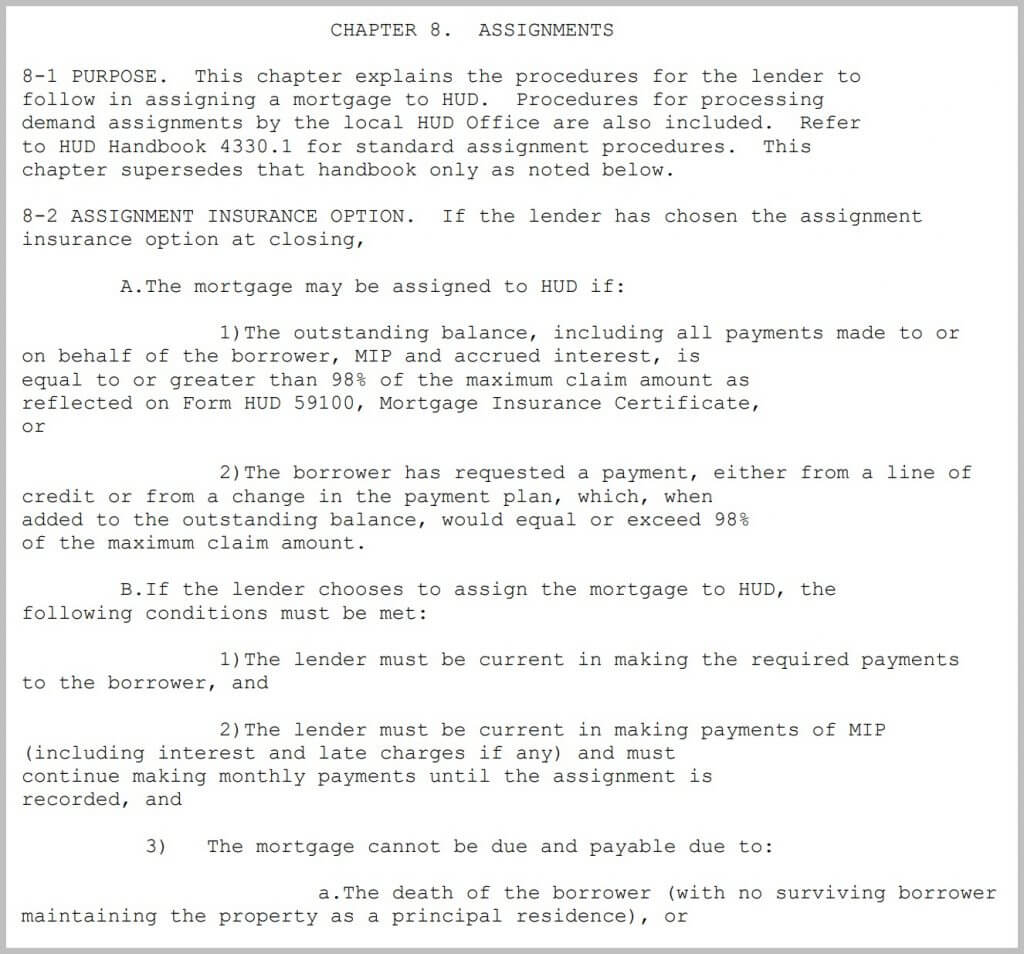
HUD assignment notice for reverse mortgage loan servicing transfer

Why Lenders Assign Reverse Mortgages to HUD

Let’s start with some background.

Reverse mortgages are typically assigned to HUD when the loan amount is very high compared to the original value or maximum claim amount. The HUD manual mentions other reasons for assignment, but this is the most common one.

Many homes that reach this point have little to no equity left because borrowers have used all the funds available to them, and the interest has accrued on the loan. This is the purpose of a reverse mortgage: it allows borrowers to live in the property without making payments.

If borrowers can afford to make monthly payments to keep equity in the property, they can do so with a reverse mortgage. However, most borrowers choose a reverse mortgage to live in their home without making payments.

Once the borrowers no longer live in the home, HUD’s servicer will move quickly toward foreclosure to minimize losses if it believes the heirs are not actively working to pay off the loan.

Timing of Reverse Mortgage Assignments to HUD

Most reverse mortgages are assigned to HUD when there is little equity left in the property. The longer they wait, the more losses they will incur. Ideally, HUD prefers that heirs pay off the loans, but this is not common when there is little equity.

HUD will contact an appraiser to assess the property’s value. If there is no equity and no one has transferred the title from the deceased borrowers, it is clear that no one is making an effort to repay the loan promptly.

Reverse mortgage lenders and servicers have been sued for releasing information to unauthorized individuals. They can only release information if they have written consent from the borrower, a court order, or a trust with a certified successor trustee.

If someone contacts them without proper authorization, they cannot release any information. This is not the lender or HUD being difficult; it is the law and a result of previous lawsuits.

To avoid issues, make sure everything is in order ahead of time. I have overseen a few reverse mortgage payoffs (including settling my own mother’s loan), and they went smoothly. Here’s what you need to do…

Setting Up Authority with the Servicer

Ensure you have the authority to speak with the lender on behalf of the loan. This can be done now by having your parents sign an authorization form, allowing the lender or servicer to communicate with the heirs they designate. With this authorization in place, the lender can discuss all loan-related matters with the designated heirs.

This applies to all heirs and must be done in advance. It’s too late to have Mom and Dad sign an authorization after they pass away or become incapacitated.

Ensuring the Trust Is in Order

If your mom has a family trust, speak to your estate attorney now and devise a plan to complete the certification of the trust as soon as possible after your mom passes. If your mom is incapacitated, the trust may contain language allowing you to be moved from successor trustee to trustee immediately so you do not have to wait.

Either way, when your mom passes, you will already be the new trustee, with the power to sell the property or take out a new loan without delay.

Neither HUD nor the servicer wants to foreclose. However, they cannot speak to anyone who is not authorized to communicate on behalf of the borrower or show proof of being the new owner. This process typically takes time, especially if you must go through probate or if heirs fail to take immediate steps to change the title after the borrower’s passing.

Often, heirs start contacting the lender without proper authorization, leading to frustration and negative comments you may have read. If you have taken the necessary steps to change the title and have the trust certification showing you are now the trustee, the servicer can and will work with you to sell the home.

If you are not recognized as authorized to communicate and act on the borrowers’ behalf, and the title is still in the borrowers’ names (the estate) with no moves being made to change that, the foreclosure action will eventually begin in accordance with the loan terms, especially if there is no equity left in the property to minimize losses.

I recommend taking the steps outlined above: obtain a signed authorization from your mom if she is capable, or position yourself as the trustee of the trust if you are the successor trustee. This will make dealing with the reverse mortgage much easier.

Consulting with an Attorney

As always, I strongly recommend that you speak to your estate attorney who handled the will and trust and get legal advice on any tax or other estate implications before taking any action.

If you ensure that your title and authorizations are in order in advance, you will likely find the process much easier than you have been led to believe.

Worried About a Reverse Mortgage Assignment to HUD? Get expert guidance from All Reverse Mortgage, Inc. (ARLO™) — America’s #1 Rated Lender with a 4.99/5-star rating! Call (800) 565-1722 or click here for your free quote — simple, trusted, 100% secure!

ARLO recommends these helpful resources:


ARLO Testimonials
America's #1 Rated Reverse Lender Celebrating 20 Years of Excellence.
Author Michael Branson
About the Author, Michael G. Branson | Mike@allreverse.com
Michael G. Branson CEO, All Reverse Mortgage, Inc. and moderator of ARLO™ has 45 years of experience in the mortgage banking industry. He has devoted the past 20 years to reverse mortgages exclusively.

Have a Question About Reverse Mortgages?

Look no further. Michael G. Branson, our CEO, brings a wealth of knowledge directly to you. With a robust 45-year tenure in mortgage banking and 20 years dedicated solely to reverse mortgages, he's the expert you want on your side.
Post your question in the comments below and anticipate a personalized response from Mr. Branson himself, typically within one business day. He's here to illuminate all angles of reverse mortgages, ensuring you're equipped with the knowledge to make informed decisions. Take this opportunity to gain insights from a seasoned professional.

Over 2000 of your questions answered by ARLO™
Ask your question now!

109 Comments on this Article
  1.   Judith N.
    March 18th, 2026
    My reverse mortgage has been transferred to HUD because it has reached 98% of its value. The balance of the line of credit is $16,000. I had requested a draw of $1000 before my mortgage was going to be transferred. How long will it take for me to get this request?
    Reply to Judith
    • Michael Branson Michael Branson
      March 18th, 2026
      Hi Judith,
      It shouldn't take long. I can't tell you exactly because we don't monitor their operations but by the terms of the loan, they only have a short time to get a payment to the borrower and stay in compliance with the terms of the loan and lenders and HUD have been working with this situation for a long time now so they've had plenty of time to get the process down.
      There shouldn't be any reason you don't receive your payment quickly but it may also depend on how you've chosen to receive your payments. If you elected to receive a paper check, it might take an extra day or two while an electronic payment to your bank account would probably be quicker.
      Reply to Michael
  2.   Rebecca M.
    February 18th, 2026
    Why is HUD involved in my reverse mortgage when my property taxes are paid?
    Reply to Rebecca
    • Michael Branson Michael Branson
      February 18th, 2026
      Hi Rebecca,
      FHA insures the loan, and FHA is a division of HUD. There is a provision in reverse mortgages that when the loan balance reaches 98% of the original value of the property, and the loan has not been repaid, servicing of the loan is transferred from the lender to HUD.
      This does not change the terms of your loan. The equity in the property is still yours, and you may sell the home at any time if you choose. HUD's involvement does not affect your loan terms, including how much money you may have available if you still have funds in a line of credit.
      The only noticeable difference is typically who sends your monthly statements.
      Reply to Michael
  3.   Mary W.
    November 13th, 2025
    I am 87, widowed for 20 years, and I have a reverse mortgage that expired after 15 years. I’ve lived in my home for several years with no additional payments, living only on Social Security. My home has appreciated a great deal over the last 10 years, from about $400,000 to over $1.5 million. I chose not to renew the reverse mortgage, so considerable interest has accrued.
    I’m in poor health and want to make settling the reverse mortgage easier for my family. I have no assets other than the house and no other debts. I have a will, have named my daughter as executor, given her POA, and added a TOD to the title so she can sell quickly and distribute the proceeds. I’m worried about how long it will take her to get a payoff amount and what she’ll need to do to satisfy the lender’s requirements.
    My home is mid-century modern and was designed by an architect who studied under Frank Lloyd Wright, as are all the houses in our neighborhood. We’re designated a historical area, and these homes usually have a waiting list of buyers. They often sell before they even reach the MLS. I’m concerned the reverse mortgage company might hold up the closing, and I want to do as much in advance as I can.
    The loan has been assigned to HUD, I suppose because they aren’t aware the value has increased so much. The balance due is now $430,000.
    I was also told recently that if you have a HUD-insured reverse mortgage, your children will never have to repay more than the original loan amount because the MIP covers the rest. I haven’t been able to confirm this. Is that true?
    My daughter is not in good health, and I want to make this as easy as possible for her. It seems like settling my estate should be simple with no assets other than the home and no debts.
    Compu-Link is servicing the loan now.
    Reply to Mary
    • Michael Branson Michael Branson
      November 14th, 2025
      Hello Mary,
      You're really asking about two separate issues. The first is whether your heirs would ever have to pay more than the home is worth to settle your reverse mortgage. The answer is no. Because the loan is FHA-insured, neither you nor your family will ever owe more than the value of the property. The mortgage insurance covers any shortfall.
      But in your case, that concern doesn't apply anyway. When a home is worth around $1.5 million and the balance is under $450,000, your family will be able to sell the property and pay off the loan with plenty of equity remaining. You and your heirs always own the home. When you or they sell, everything above the payoff amount belongs to your family. Based on the numbers you've given, that would leave roughly $1 million even after typical selling costs.
      The second issue is how to make the process easier for your family. Fortunately, that part is also straightforward: communication and preparation.
      I can't give legal advice, so you'll want to consult your attorney about whether a will or a trust is the best way to transfer title quickly. But from the standpoint of the reverse mortgage, you can make things much smoother by writing a letter to your lender now authorizing them to speak with your daughter about all matters related to the loan. Make it clear that they have your full permission to communicate with her. This alone avoids many delays, because lenders often don't know who they're allowed to speak with after the borrower passes away.
      Next, make sure your daughter knows who services the loan, the loan number, and how to contact them. A power of attorney is helpful, but be sure your attorney confirms whether it remains valid after death. If it does not, ask what needs to be in place so she has immediate legal authority to sell the home. You don't want to wait out a probate process, because interest continues to accrue and HUD's timelines don't pause.
      The sooner the home can be sold, the less interest builds. And importantly, when your family sells on their own timeline rather than under pressure, they're far less likely to feel forced into accepting a low offer.
      It sounds like you're already taking the right steps by planning ahead. Keep working with your attorney - you'll be glad you did.
      If you need clarification on the reverse mortgage side as you move forward, don't hesitate to reach out.
      Reply to Michael
  4.   Michael R.
    August 29th, 2025
    I think I understand assignment to HUD when the 98% point is reached. but why does the "potential assignment" letter say "This is an attempt to collect a debt"? We're current on insurance, occupancy reports, taxes, etc., and there has been no bankruptcy ever involved. Also, the original valuation on the house $365,000) is way below current real estate value (about $650,000), so why is the current servicer worried about equity? We're both 80, living in the house, and plan to do so for the foreseeable future. Thanks!
    Reply to Michael
    • Michael Branson Michael Branson
      August 29th, 2025
      Hello Michael,
      I understand why that wording is unsettling. That line - "This is an attempt to collect a debt” - is standard legal language many servicers include in letters that relate to a loan, even when you're not delinquent. Lawyers prefer it as a precaution under debt-collection notice rules. It isn't a sign that anyone is trying to collect from you right now, and it doesn't change your status or rights.
      On assignment: your HECM can be assigned to HUD when the unpaid balance reaches 98% of the Maximum Claim Amount (MCA), which is based on the original appraised value at closing (or the FHA lending limit at that time, whichever was lower). Later increases in market value don't change the MCA and don't change your rights.
      What this means for you:
      Your occupancy rights don't change. The home remains yours. You may stay as long as it's your principal residence and you keep taxes and insurance current and maintain the property.
      Your equity stays yours. If you sell, any amount above the loan payoff is yours. If the market ever falls below what's owed, the loan is non-recourse - you and your heirs are not personally liable.
      Why mention equity/original value? The servicer isn't trying to claim your equity. They reference the original value because assignment eligibility and claim limits are tied to that number, not today's market value.
      Bottom line: the letter's phrasing is legal boilerplate, and assignment is an administrative step between the servicer and HUD. It doesn't negatively affect you so long as you keep meeting the standard HECM requirements (taxes, insurance, occupancy, and basic maintenance). If anything in the notice is unclear, you can call the servicer for a plain-English explanation - but there's nothing in that wording that suggests a problem with your loan given you're current.
      Reply to Michael
  5.   Billie B.
    August 28th, 2025
    I need help with a reverse mortgage in California. The loan is with Finance of America.
    A close family friend wanted to leave me his house with about $300,000 in equity. He told me, my mother, and the neighbor across the street that this was set up in the paperwork and that my name was on it. After he passed, I called the lender. They told me I’m listed only as a person authorized to discuss the mortgage—not as the person who inherits the house.
    Is there anything I can do? We aren’t related. There’s no will that we know of, and if there was one, it might have been in the house (which others have gone through). Can I prove the mortgage company misled him and still get the house? He called me after signing and said it was all set up, and he was excited to leave the house to me since he never had children. Please advise. I wish he had gone through your company.
    Reply to Billie
    • Michael Branson Michael Branson
      August 29th, 2025
      Hi Billie,
      I'm really sorry to hear about your situation. I would suggest that you contact an estate attorney as soon as possible. The lender has no say in who will inherit a property, that is a function of a will, trust or court order. Lenders do not have the legal right to determine who will inherit a property after the owner passes.
      It sounds like he listed you as his "alternate contact” on his loan paperwork. Being listed as an alternative contact for the mortgage only gives the lender a person they can contact in the event they are unable to reach the borrower for any reason - it does not grant ownership rights to the home.
      At this point, the best step you can take is to consult with a real estate attorney in California who can review the details and advise you properly. They'll be able to confirm what rights, if any, you may have and whether there are any legal options to pursue.
      I wish you the best in getting clear guidance on this.
      Reply to Michael
  6.   Don R.
    July 21st, 2025
    My reverse mortgage has been assigned to HUD because the borrowing limit, including interest, has been met. Will they conduct a new appraisal and set a new limit, considering my home value has increased by 50% since the original appraisal?
    Reply to Don
    • Michael Branson Michael Branson
      July 21st, 2025
      Hi Don,
      Thanks for your question! When your reverse mortgage reaches a certain limit - usually based on your original loan balance and property value - it may be assigned to HUD (the U.S. Department of Housing and Urban Development). This is a normal part of how federally insured reverse mortgages (HECMs) work.
      Will HUD Order a New Appraisal?
      No, HUD does not order a new appraisal or adjust your loan limit when your reverse mortgage is assigned to them.
      Once your loan is assigned to HUD, the terms of your reverse mortgage stay the same as when you originally closed the loan. Even if your home's value has increased significantly, it won't change your existing loan or line of credit.
      You'll still have access to any remaining funds in your line of credit, and the growth of the credit line will continue just like before. The only real change is that a different company may service your loan on HUD's behalf, but the rules and terms don't change.
      Can You Refinance to Access More Equity?
      If your home's value has gone up by 50% as you mentioned, you may be able to refinance your reverse mortgage into a new one for a higher amount. This could give you:
      Access to additional funds
      A new, larger line of credit
      Potentially better terms based on today's interest rates and lending limits
      HUD requires that a refinance provide what's called a "tangible benefit," meaning the new loan must clearly improve your situation. If you'd like, we can run the numbers for you to see if a refinance would make sense.
      Bottom Line:
      HUD will not reappraise your home or reset your current reverse mortgage limits after assignment.
      If you want to access more of your increased home value, refinancing is the only option, and it depends on your current age, home value, and program guidelines.
      If you'd like a HECM refinance quote, just reach out! We'd be happy to show you what you might qualify for.
      Reply to Michael
  7.   Edna B.
    May 2nd, 2025
    I currently have a reverse mortgage with Compu-Link. I want to see my home to my daughter and pay off reverse mortage loan. What is the best way to handle this transaction? Thank you in advance for your response.
    Reply to Edna
    • Michael Branson Michael Branson
      May 5th, 2025
      Hello Edna,
      There is never a prepayment penalty on a reverse mortgage, so you're free to pay it off at any time.
      You'll receive monthly statements from your loan servicer, and those statements typically include instructions for submitting payments - even if you're only making a partial payment toward the balance. In most cases, this involves sending a check to the address listed on the statement, writing your loan number on the check, and including a brief note asking the lender to apply the payment to your outstanding balance according to the loan terms.
      However, if you intend to pay off the loan in full, you will need to formally request a demand statement (also called a payoff statement) from your lender. This statement outlines all amounts owed, including:
        The current loan balance
        Accrued interest
        Any amounts advanced by the lender on your behalf
        Fees for preparing and recording the final loan documents
      Once you receive the payoff demand, the full amount must usually be sent by wire. These payoff figures are typically valid for about 14 days, after which an updated payoff amount would be required if the loan isn't yet paid.
      Since you plan to transfer the property to your daughter at the same time, it would be wise to involve a title company or real estate attorney to handle the transaction. They can:
        Request the lender's payoff statement for you
        Ensure proper recording of the deed
        Provide title insurance for your daughter (which protects her interests, especially if she plans to get a mortgage in the future)
        Help document the transfer as an intra-family gift to minimize or eliminate any transfer taxes, depending on your local laws
      Because this involves both a legal transfer of real estate and a mortgage payoff, I recommend consulting your estate attorney and a reputable title company to make sure the process is handled correctly and tax-efficiently.
      Wishing you and your daughter the best with this transition.
      Reply to Michael
  8.   Jen L.
    February 10th, 2025
    My partner and I have been living in his mother's home (with her) for the past 18 years. She had a reverse mortgage and passed away several years ago. The process took a long time, but it looks like it has finally caught up with us. The loan company is selling the house to HUD at the end of February, and then HUD will put up a for-sale sign and attempt to sell the home - meaning we're getting evicted.
    My partner's mother did not have a will, and my partner just started the probate process. How long will it take before we are physically removed from the house? Will we have about two weeks after HUD puts up the for-sale sign? Do we need to clean out the house and rent a dumpster, or can we just take our belongings and leave the rest? We really don't want to spend a bunch of money cleaning a house that isn't ours and that we have absolutely no stake in.
    Reply to Jen
  9.   Abba V.
    January 24th, 2025
    My father passed away in November, leaving a $70,000 reverse mortgage on his home. My siblings and I recently decided to pay it off to make selling the house faster and easier. The wire transfer has been completed, and the reverse mortgage company has confirmed that the full payoff is complete. They have also submitted the necessary information to release their lien on the property.
    However, HUD is also involved, and I've been told it could take 30-90 days for them to release their lien. How can I expedite this process? Should I contact HUD directly? What other potential delays should I expect? The situation seems straightforward since the full amount has been paid off, and Medicaid is not involved with my father.
    Additionally, I've already filed the paperwork with our county clerk's office to transfer the deed from my father to us kids. We have a potential buyer for the home, and I don't want to lose them due to delays.
    Reply to Abba
    • Michael Branson Michael Branson
      January 24th, 2025
      Hello ABBA,
      I can't provide legal advice, but it may be best to research the legal requirements in your state or area. Many states have laws that specify the maximum amount of time a lienholder has to remove a lien once the lien has been satisfied.
      You might want to consult with an attorney to discuss this situation and the possibility of proceeding with offers in the meantime. Your attorney could help put your mind at ease if the lien must be removed within your required timeframe and may also be able to intervene with HUD on your behalf if necessary.
      I can't think of any other specific delays you should anticipate once the loan has been repaid. However, keep in mind that unforeseen delays can occur, even with the simplest transactions. It's important to remain prepared to respond quickly if any issues arise.
      I hope this helps, and best of luck with the sale of your father's home!
      Reply to Michael
  10.   Kelly
    January 2nd, 2025
    Hi Michael,
    There is a home in my neighborhood that has sat empty for almost 5 years. The owner had a reverse mortgage but no longer lives there. The mortgage has been transferred to HUD, and a company is maintaining the property. We've been waiting for it to go on the market. Can the homeowner still sell us the house, or do we need to continue waiting for HUD?
    Thank you,
    Kelly
    Reply to Kelly
    • Michael Branson Michael Branson
      January 8th, 2025
      Hello Kelly,
      It depends on who currently owns the property. Typically, the lender or HUD would have contacted the borrower or heirs long before now to present their options for repaying the debt, which became due when the borrower stopped living in the home. If no one made an effort to sell the property or pay off the loan, the lender or HUD would generally proceed with a notice of default and initiate foreclosure proceedings. Allowing the home to sit vacant for so long is not a standard practice.
      To determine the current owner, you can check public records. If a foreclosure was never completed and the owners never transferred the title to HUD or another party, the original owners (or their heirs) likely still own the property. If that's the case, you would need to speak with them about purchasing the home. However, it's important to remember that the reverse mortgage has been accruing interest over this time, and HUD or the lender may have advanced funds to cover property expenses (e.g., taxes, insurance). These amounts are added to the loan balance, which may now exceed the home's value.
      If you decide to pursue purchasing the property directly from the current owners and HUD doesn't yet own it, keep the following in mind:
      Loan Payoff Requirement: HUD or the lender would require the full loan balance to be paid off before clearing the title. This payoff amount might exceed the home's market value depending on the loan terms and accrued costs.
      Legal and Financial Precautions: Work with a real estate attorney, use a reputable title company, and ensure title insurance is in place to protect yourself.
      If HUD already owns the property, it would be marketed as an REO (real estate-owned) property through a real estate company. Given the lengthy delay and the fact that the home has not been listed for sale, there may be unresolved issues, such as title problems, other loans, or liens, which could be holding up the process.
      Regardless of the current ownership status, I recommend proceeding with caution and ensuring you have competent legal representation and a reputable title company involved in any potential transaction.
      I hope this helps clarify your options.
      Reply to Michael
  11.   Crystal W.
    September 7th, 2024
    I was a live in caretaker for a woman for 7 years. She just passed away, and she had a reverse mortgage on her home. There is no other person or heirs. Is there something I can do to take over the mortgage?
    Reply to Crystal
    • Michael Branson Michael Branson
      September 9th, 2024
      Hello Crystal,
      Unfortunately, a reverse mortgage is not assumable. Before you can consider any financing options, the first step is to determine whether you can even obtain title to the property. If the borrower passed away without a will, the state would first try to identify an heir. You mentioned there are no heirs, but does she have no family members at all - such as siblings, cousins, or extended family - who might petition the court to inherit the home?
      Since the lender does not own the property, they cannot transfer the title to you. If no one steps forward to claim heirship and repay the loan, the lender would need to foreclose on the home to gain ownership. Only at that point could they sell the property to another party. If you wish to purchase the home, you would need to secure your own financing, as you would not be able to continue living in the home under the terms of the reverse mortgage.
      Reply to Michael
  12.   Lois K.
    September 2nd, 2024
    I have a reverse mortgage in my name that is at 115% of the value of the mortgage. I am 88 years old, and my daughter-in-law wants me and my husband to move in with them because of health problems. How do I have them foreclose on the loan so that we are free and clear?
    Reply to Lois
    • Michael Branson Michael Branson
      September 3rd, 2024
      Hello Lois,
      If you must leave the home for medical reasons, the best course of action would be to move out and ensure all your personal belongings are removed from the home. Then, send the lender a letter informing them of your move and expressing your desire to sign the property over to them immediately. Let them know that the home is clear of all personal property, left "broom clean," and that you wish to participate in a Deed in Lieu of Foreclosure. Mention in your letter that the home is currently secure, but since you no longer occupy the property, you would like to deliver the keys to them as soon as possible so they can secure the home themselves. Be sure to include your new contact information so they can communicate with you.
      "Broom clean" means the house is free of all personal property and debris and has been swept out, but you are not required to scrub, paint, or make repairs. Essentially, you would secure the home (lock it up), give the lender the keys, and sign the legal documents to transfer ownership to the lender or HUD (depending on who holds the loan now). This allows you to walk away without owing anything, even though the balance owed is higher than the current value of the property. The lender and HUD will not seek to recover any deficiency amount. If the home is not broom clean, the lender can still foreclose, but they cannot accept the Deed in Lieu of Foreclosure, which could prolong the process.
      The lender or HUD (depending on who holds and services the loan now) may act quickly or slowly, depending on how efficiently their servicing department is operating. Either way, it won't be your concern at that point. You will have fulfilled all your obligations, and their only recourse would be foreclosure, which is your goal. Keep copies of all your correspondence and send everything via registered mail or another service that provides a signed receipt to confirm that the lender received your communication.
      Reply to Michael
  13.   Donna T.
    August 10th, 2024
    I have twice responded to Comp-Link regarding occupancy. I have just received yet another request. No reasonable answer when calling the number on the paperwork. I feel very threatened by the statement "no response may cause your reverse mortgage to be due and payable." How do I fix this?
    Reply to Donna
    • Michael Branson Michael Branson
      August 14th, 2024
      Hello Donna,
      The occupancy affidavit is an annual requirement. If you are receiving it every year, don't panic; that is normal. All you need to do is be sure to sign it and return it. However, if this is the third time you have had to sign and return the certificate in a short period for the same year, I recommend sending it back via certified mail with a return receipt. Also, don't hesitate to call Celink and ask to speak with a manager.
      Be honest with them about the distress these threatening notices are causing you, especially since you have returned the forms multiple times. If they do not adequately explain why they keep sending the forms and do not agree to limit the letters to once a year, you may need to take further action. While I am not an attorney and cannot provide legal advice, there are divisions within state and federal consumer protection agencies where you can request assistance if necessary. I would hope the servicer would react favorably to your concerns when you point out the duplication of letters and their effect on you, but if not, you may ultimately want to consult an attorney to explore legal options.
      Let me end with this: I honestly believe this is just a glitch in their system, and there is no reason to worry. I think that when you contact them and relay the distress they are causing, they will take steps to remedy the situation. However, I am not a fan of doing nothing and assuming everything is okay. I would personally ensure I have proof that you have returned the certificates (such as a registered mail receipt, etc.).
      Reply to Michael
      •   Jeannie
        August 28th, 2024
        Hello Michael,
        My father passed away last month. We have a trust, and we contacted HUD, sending them a letter to notify them of his passing. It has been six weeks, and we still haven't heard anything about what we can do with the property. I just received the death certificate and will send another email with it attached. We haven't heard from them since the loan was transferred in February 2023 when my dad was still alive. The loan was taken out for over $200,000 and is now at $478,000 due to interest. The house is worth around $850,000. We want to sell the house. When will we hear from them, and how long will we have to sell it? I lived in the house with my dad and am still living here. I want to know how much time I will have to stay and sell the property. My son is a realtor, and we plan to list with him. Do we need to wait for them to contact us? We don't have a loan number or any information since the transfer. Our trust is certified and in the family name. What advice can you give me? I can't seem to get in contact with them. They keep saying an agent will get back to us if needed, but it's frustrating as I can't get a hold of them, and customer service just refers us to email HUD. What are your thoughts?
        Reply to Jeannie
        • Michael Branson Michael Branson
          August 31st, 2024
          Hello Jeannie,
          My advice is to move forward with selling the property as quickly as possible and not wait for HUD. The only time you need to wait for HUD or the lender is if you need to know what they will accept as payment if the amount owed exceeds the current value of the property. In your case, since the property is worth far more than the amount owed, there's no need to wait for HUD to perform an appraisal. You will be required to pay the loan in full, so there's no reason to delay.
          You can put the home on the market immediately. You can obtain the HUD case number and servicer information by contacting the Mortgage Electronic Registration System (MERS) through their website: https://www.mers-servicerid.org/sis/?qls=QNS_20180523.0123456789 and following their process as an heir of the original borrower. You'll need the Mortgage Identification Number (MIN Number) found on the recorded Deed of Trust or Mortgage or the borrower's name and address. This will provide the information needed to contact the loan servicer directly. However, don't wait for them - start the process of selling the home now while you wait for the servicer to respond.
          If you're fortunate enough to receive an acceptable offer soon, the next step will be to send the request for a beneficiary demand for payoff to the servicer, which will be handled by the title company managing the sale. If you wait for the servicer to contact you, they may impose time constraints that aren't in your favor, pressuring you to accept an offer you'd rather not take. Typically, the servicer will give you three months to sell the home, with options for extensions depending on the circumstances. If you have the property sold before they act, you won't need to worry about their timelines.
          Reply to Michael
  14.   Mario C.
    June 26th, 2024
    I'm just wondering, my mother is 84 years old, and her home is under a reverse mortgage and now under HUD. She told me that besides paying her taxes and home insurance, they say she has to pay for separate home insurance for upkeep on plumbing, heating issues, and any other issues that may occur with her appliances for $285.00 per month! Is this legitimate, or some type of scam?
    Reply to Mario
    • Michael Branson Michael Branson
      June 29th, 2024
      Hello Mario,
      HUD does not require her to take out a policy on her appliances. I would encourage you to look at the information she received from whomever is making this claim. If it says she must take this policy, contact them and get their information. You may want to file a complaint with the state for fraud. If it is just worded so that it makes it sound like it is advisable but doesn't say it is mandatory, you can decide if you feel it is misleading and still needs to be reported, but at the least, let your mom know that HUD does not require her to have appliance insurance.
      Reply to Michael
  15.   Jacqueline W.
    June 25th, 2024
    I received notice on April 11, 2024, that my reverse mortgage is being turned over to a HUD subservicer. My loan agreement is for $184,000. My outstanding loan balance at the time I was notified was $178,900.09. My maximum claim percentage is 96.713%. I want to stay in my home, but I was notified that my hazard insurance carrier was not going to renew my policy. However, their affiliate was going to provide me with a quote. My question is: since my home is or will be under a subservicer, will it be hard to obtain hazard insurance? Can HUD foreclose on me?
    Reply to Jacqueline
    • Michael Branson Michael Branson
      June 29th, 2024
      Hello Jacqueline,
      There would not be a problem if your carrier changed. You do need to have insurance on your property, but that would be true regardless of any loan and you only need to carry sufficient insurance coverage to replace the improvements (the building) on the property or your maximum loan amount, whichever is less.
      It does not matter who the servicer is, the ability to obtain insurance should not be an issue. The location of your property and any special issues insurers may be having with risks associated with that area of the country may come into play, but that would also be true regardless of whether you have a loan or the loan type. For example, Florida is affected by hurricanes, parts of California by fires, etc. This may or may not be the reason why your current insurer is not going to renew your existing policy but along with rising rates, that seems to be the new norm.
      Reply to Michael
  16.   Martha H.
    June 8th, 2024
    My reverse mortgage has reached its maturity of $210,000. I'm 82 years old. They informed me that they have turned my loan over to HUD. My income is only $3,000 a month, and I have health problems. Will HUD kick me out? What can happen?
    Reply to Martha
    • Michael Branson Michael Branson
      June 8th, 2024
      Hello Martha,
      Your loan has not matured; it has only reached a predetermined loan-to-value ratio based on the original appraised value (the value of the home at the time you received your loan). When this happens, the lender assigns the loan to HUD. However, this does not affect you or your ability to stay in the home.
      You can remain in the home for as long as you are able to live in the property and pay the property charges (taxes, insurance, and any other charges such as HOA fees, if any). The only difference you will see is that the loan will now be serviced by HUD's servicer, CELINK. If you decide to move, your home has probably increased in value over the years. This means you have additional equity in the property that is also yours when you sell your home. The bottom line is that you have nothing to fear from your loan being assigned to HUD - they cannot just kick you out.
      Just remember to return the occupancy certificate you receive every year, pay your taxes when they are due, and keep your homeowners insurance current. Above all, enjoy your home!
      Reply to Michael
      •   Judy B
        June 12th, 2024
        I'm in almost the same position as Martha H. on all fronts except health issues. I'm 81. I just got the letter about the HUD transfer. I'm quite sure my house value has gone up & I had been hoping to maybe be able to draw out additional funds at some point. Is that likely an option when it's with HUD?
        Reply to Judy
        • Michael Branson Michael Branson
          June 17th, 2024
          Hi Judy,
          Whether your loan has been transferred to HUD or not, it makes no difference regarding your eligibility for a refinance. If you qualify for a refinance, you can certainly proceed and access any available funds. You can visit our calculator at ARLO™ Calculator, and we will be happy to inform you of your eligibility and potential loan amounts.
          Keep in mind that interest rates are one of the factors that determine how much money you can receive from your loan. Rates are currently higher, and the Fed did not lower rates today, but that doesn't mean they won't be lower in the future. If there isn't enough money available to you for a refinance right now, the interest rate environment may improve in the near future. Keep checking for updates!
          Reply to Michael
  17.   Kory M.
    June 7th, 2024
    Hi Michael,
    Thank you, and your readers for sharing. My took a reverse mortgage. It was all going well until a few years ago. My older brother moved in with my mom to help her and keep an eye on her. However, things quickly went down hill, much of which myself and my wife were not privy to. My brother started hiding mail and phone calls from lender because he was spending her money on who knows what. My mother knew nothing of this. When we were finally made aware of the situation, my mothers loan was in default and has since gone to foreclosure. She has to either pay or get out. She was dead broke. My brother had to be evicted. My wife I can't afford to help her or get her an attorney. Again she was as blindsided to what my brother had done to her as we were/are. Was is HUD listed as a defendant like my mother and why does no one show up to help her defend her and there property??
    Reply to Kory
    • Michael Branson Michael Branson
      June 9th, 2024
      Hello Kory,
      I am very sorry to hear this. When we hear of elder abuse and issues with reverse mortgages, it usually involves a family member or close friend misusing the funds. Unfortunately, some people prey on the elderly. It's often easier if the relative or friend has the senior's trust and access to their bank account where the reverse mortgage funds are deposited. Because there are no monthly payments on the loan, it can take longer for the senior homeowner to realize there's a problem, as no one is sending collection notices or knocking on the door due to missed payments. It's commendable when family members and friends want to help aging parents and relatives, but the rest of the family needs to stay vigilant when someone moves in. Living in a home with no mortgage and access to a line of credit can be too tempting for some people.
      The loan goes into default if your mom is no longer living in the home or if the taxes or insurance are not being paid. Did your brother handle the payment of these property charges? They were due, and the only other issue would be if the lender sent out occupancy certificates that your brother discarded, leading the lender to think your mom no longer lived in the home, triggering foreclosure due to non-occupancy. Otherwise, even if he spent all her money, she would still be able to live in the home. Have you checked with the lender since becoming aware of the situation to determine the reason for the default? If it was due to delinquent taxes or non-payment of insurance, that might be resolved by paying those items and repaying any money advanced by the lender or HUD, but your mom would need to pay them.
      I can't answer your questions about anyone defending her because I am not sure what action you are referring to where HUD might be listed as a defendant. Start by having your mom sign an authorization for you to speak to the lender about the loan. Without this, the lender cannot speak with you, and you might never know the real issues. Find out exactly where everything stands: if the loan is in foreclosure, if there is a completed foreclosure, and if there is still time left on a rescission period. You may need an attorney's help to decide if you still have options. If the loan is still in the Right of Rescission period, it can be brought current by curing the default. If she is beyond the right to rescind, the home can only be saved by paying the loan in full. She can only be evicted once the foreclosure is completed, the home is sold at auction, and your mom no longer owns the property. Until then, she is still the property owner, and the lender cannot evict her.
      Seek legal counsel immediately; if you cannot afford an attorney, contact the nearest free legal aid office. A quick internet search should provide options in her area. They may be able to get a stay on the foreclosure if she has been a victim of fraud, even from a family member. Don't wait until the foreclosure is finalized and the property is sold to act, as it may be too late by then.
      Reply to Michael
  18.   Cliff
    June 3rd, 2024
    I have a reverse mortgage that will reach it's 98% factor in less than 3 years at todays current interest rates. I currently have $85,000 in available line of credit that will also grow over the next 3 years. If/when my loan gets assigned to HUD will I still have access to my line of credit funds?
    Reply to Cliff
    • Michael Branson Michael Branson
      June 8th, 2024
      Hello Cliff,
      The terms of your loan do not change, and you do not lose any money available to you just because it is assigned to HUD. This is exactly why there are two Notes and two Deeds of Trust/Mortgages (depending on which instrument is used in your state), one to the lender and one to HUD. The lender is covered under one for any amounts that they advance on your loan, and the second instrument covers HUD for any amounts that they advance on your loan. The only difference you should notice is that you receive your statements from HUD's servicer. In many cases, since HUD no longer uses NOVAD as their contract servicer, HUD's servicer is now the same one used by many lenders.
      Reply to Michael
      •   Debbie D
        May 27th, 2025
        I also have elderly parents who received notice yesterday that their reverse mortgage is being assigned to HUD. They are near the 98% limit. Their cap at the origination of the loan was $210,000. They are currently at $203,000. On the lender side, which is currently Carrington, overtime and with interest their principal amount is $252,000 with a $49,000 line of credit. What happens when this is assigned to HUD? Well they lose their $49,000 line of credit? My research says yes. This would not be good as they are hoping that the line of credit would give them a few more years with other fund draws as well. Thank you.
        Reply to Debbie
        • Michael Branson Michael Branson
          May 27th, 2025
          Dear Debbie,
          Thank you for your thoughtful question - and rest assured, your parents will not lose their $49,000 line of credit simply because their reverse mortgage is being assigned to HUD.
          When a HECM loan reaches around 98% of the Maximum Claim Amount (in this case, the original $210,000), the servicer may transfer the loan to HUD. This is a normal part of the loan lifecycle and happens behind the scenes between the lender and HUD. Importantly, the terms of the loan - including the available line of credit - remain fully intact.
          The only change your parents may notice is that HUD (through their servicing agent, currently Compu-Link or "Celink”) will take over the servicing of the loan. Monthly statements will come from the new servicer, and any requests for funds will need to be directed to them instead of Carrington. But again, the line of credit amount does not disappear and will remain available as long as the loan remains in good standing.
          I hope this puts your mind at ease - and please don't hesitate to reach out if we can clarify anything else.
          Reply to Michael
  19.   Linda
    May 27th, 2024
    Would a purchaser of a tax lien have priority over a HUD-held reverse mortgage? Does HUD always redeem when there's a tax lien sale? And finally, why doesn't HUD move to foreclose on vacant properties as quickly as it can? Isn't it the servicer who benefits when a due/payable reverse mortgage doesn't move into the foreclosure process?
    Reply to Linda
    • Michael Branson Michael Branson
      June 2nd, 2024
      Hello Linda,
      To determine the lien priority of any particular lien, you should consult with an attorney and then insure your lien position with a title company. The title company will conduct a title search, inform you of any existing liens on the property, and specify their order. Typically, the first lien on any property is for county taxes, which run with the property, and there are no liens prior to that lien. This is why lenders will step in and advance funds as prescribed in the security agreements (the Deed of Trust or Mortgage) to pay those taxes if they become delinquent before a tax sale occurs. I assume that by a tax lien sale, you mean a lien created by non-payment of other taxes.
      Then the lender's First Trust Deed or Mortgage is the second lien recorded against the property, giving it the second priority lien position. This is the lien position occupied by reverse mortgages (actually, HUD HECM reverse mortgages have both a first and second Trust Deed or Mortgage, one to the lender and one to HUD to cover any advances HUD may make as well). Any other liens filed after these liens would be considered junior liens, as they would be in a junior or secondary position to the senior liens. After the property taxes and the first mortgage (and the second in the case of the reverse mortgage when it is recorded simultaneously), any other subsequent liens are usually prioritized based on when they are filed. The tax lien, therefore, would not take priority over the reverse mortgage (or other mortgages). Many investors have lost significant amounts of money buying condominiums at HOA foreclosure sales, thinking they were getting a fantastic deal, only to find that the unit had a reverse mortgage that equaled or exceeded the value of the home, causing the money they paid to the HOA to be lost when it came time to pay off the reverse mortgage. I would encourage everyone to consult and work with a title company before buying any property at a tax lien sale or HOA foreclosure, and ensure you know exactly what is owed to all creditors before purchasing.
      I am not sure what you mean when you ask if HUD always redeems. If it is a property tax situation, the servicer should advance the funds to pay the taxes before it goes to sale. Personally, I have never heard of a servicer not advancing funds to protect their lien position and then foreclosing on the home, as failure to pay the property taxes is a default under the terms of the loan. If the lender or HUD does not advance the funds, they risk losing their interest in the property as a junior lienholder to the tax assessor. If the taxes are not for property taxes, the lender and HUD have no reason to pay any other taxes, as they would be either paid with any remaining funds from the foreclosure sale (if any) or the lien is simply swept away, and the creditor receives nothing from the sale. When the foreclosure of the first Trust Deed takes place, it will include anything owed on the second, any taxes they advanced, and the starting bid will be the lender's and will be for the total amount owed, plus any interest and fees. If no one outbids the lender, the lender will own the property, and there will be nothing left to pay any other creditors. I am not an attorney and do not know if that means the tax lien is worthless; it just will not be recouped from the sale of the property. To determine what, if any, other remedy you would have as the owner of a tax lien, you would need to speak to an attorney. If the property sells at auction for more than the lender's bid, which would be the case only if other buyers entered the auction and bid higher, any amounts over and above the amount required to satisfy the lender's opening bid would be disbursed to other lienholders by the trustee conducting the sale.
      Regarding your last question, it's not really the lender who benefits or loses, as they are covered from loss by the mortgage insurance premium. It would benefit HUD, the MIP fund, and all other borrowers who now receive less money under the program due to losses if the servicers were more aggressive in moving into the foreclosure process, especially on properties where borrowers have passed away sometimes years before and the property is still sitting vacant, or for some other reason, the servicer has not yet completed the process of calling the loan. We receive numerous inquiries from neighbors, family members, and others about properties of borrowers who have long since moved out or passed and should have been called and disposed of months or years before. I can't say if the process to verify is just that difficult, if the laws are too stringent in some areas, if the servicers are not aggressive enough, or what. But we have written several times that we believe HUD needs to crack down on this area of the reverse mortgage. Some borrowers and heirs are very good about notifying HUD when the borrowers are no longer living in the homes, and this is good for the families as well when there is equity in the property. The sooner they pay the loan off and sell, the sooner the interest stops accruing and the family can use the money for whatever purpose they need. Still, others have family members living in the homes rent and mortgage-free, and those family members, or even the families if there is no equity in the home, may not be in any hurry to report. Some even commit fraud by falsifying the borrowers' signatures on the certification letters. Until HUD determines a way to clean up the servicing and minimize the false reporting, borrowers of new reverse mortgages pay the price with ever-tightening requirements and shrinking available loan amounts.
      Reply to Michael
      •   Linda
        June 4th, 2024
        Thanks very much for this detailed response!
        Reply to Linda
  20.   Debbi G.
    May 16th, 2024
    Our 89-year-old parents are getting their reverse mortgage transferred to HUD on June 6. It's at 97% of the $380,000 claim limit. Compulink will be their contracted servicer. I have four other siblings, and we are all trying to navigate through this. Your article was extremely helpful. From what I understand, it seems like the first step would be to get authorization from our parents, as all five of us are heirs, in order to communicate with the lender. Could you let me know if there's a legal form for this authorization or if it is a written agreement with our parents and our signatures?
    Thank you for your time and consideration.
    Reply to Debbi
    • Michael Branson Michael Branson
      May 22nd, 2024
      Hi Debbi,
      There is no legal form required, and none of your siblings need to sign anything. Your parents need to send a letter to the servicer authorizing them to speak with you about all matters relating to the mortgage and allowing you to get any information you need regarding the loan as you work to assist them. Your parents are the ones who need to sign the letter since they are the ones who need to authorize the lender to give you any information about the loan.
      You may also want to talk to an attorney about the title to the property. If you decide to make any changes, your parents can add you to the title at this time with no problems, as long as they are also on the title and continue to live in the home. It would create a default situation if they deeded the home solely to you or you and your siblings and were no longer on the title, but they can add anyone else to the title with them as long as they remain on the title as well. I encourage you to speak with your estate attorney to ensure you handle the transfer correctly so that there is no effect on the real estate taxes and to make sure this aligns with your parents' estate planning wishes. I can't give you legal or tax advice, so I recommend talking to your attorney for their professional opinion.
      Reply to Michael
  21.   Ed
    April 30th, 2024
    My 94 year old mother has a reverse mortgage line of credit. She was just notified that the loan will soon be transferred to HUD. She still has $200,000 available to borrow. Is she better off taking all available funds before HUD takes over?
    Reply to Ed
    • Michael Branson Michael Branson
      May 5th, 2024
      Hello Ed,
      The fact that the loan will be transferred to HUD will have no impact on the loan whatsoever. In fact, now that Celink services HUD, it may not even be transferred to a different servicer since Celink also services many lenders as well. The terms will remain the same, so your mom should have no problems other than the possibility of some ripples during the transition.
      If she needs funds or expects to need them in the next 90 days, she may wish to make that draw request to ensure there is no delay (there should not be, but it doesn't hurt to be sure). If she is on any kind of needs-based program such as Medicaid, though, you do not want to have an accumulation of funds in her bank account, so be mindful that if you draw funds for future needs, you will not use them before the end of the month.
      Reply to Michael
  22.   Jan R.
    February 11th, 2024
    I have a reverse mortgage that is being transferred to HUD soon. My concern is my line of credit that I have been saving to use for expected maintenance (new roof) in the next 2 years. Because my loan is close to the limit, will they take my existing line of credit away? That will be a personal disaster for me.
    Reply to Jan
    • Michael Branson Michael Branson
      February 11th, 2024
      Hello Jan,
      You have no cause to worry. Your loan terms, including a line of credit available, will not change when the loan is assigned to HUD. There is a predetermined loan to original value or maximum claim amount at which the lender must assign the servicing to HUD but that does not change anything for the borrower other than you will have a new servicer now. This is a common occurrence that happens continually with reverse mortgages, where borrowers have money left in their lines of credit and/or receive monthly payments. This is one of the reasons there are 2 Notes and 2 Deeds of Trust. To cover HUD for any funds they advance.
      If your old lender, HUD, and their servicer, CompuLink, all do their job well, you should not notice a change in the process other than you receive your statements from a new source. The only concern I would have been if the repair was anticipated very soon, during the transfer process. I would probably want to be sure to have the necessary draw before the loan transferred only if it was going to happen at the same time or soon after the transfer and you had no leeway in your timing on the roof repair. My only concern would be that there may be a short delay during the transfer of the servicing and if it made a difference between water coming into your home or not because of the timing of the roof repair, then I would make plans to be sure you're covered. But if you're talking about 2 years before the anticipated repair, you should have no need of concern.
      Reply to Michael
  23.   Deb
    December 20th, 2023
    What happens if HUD takes over the mortgage and the deceased owner has been on Medicaid for years and receiving Medical and other home care assistance?
    Reply to Deb
    • Michael Branson Michael Branson
      December 24th, 2023
      Hi Deb,
      I am not sure what you mean by the deceased owner, who has been on Medicaid for years. I can only guess that you mean that the owner was on Medicaid before they passed. The assistance does not affect the reverse mortgage at all. The loan on the property is a first lien, which must be repaid when the last borrower permanently leaves the residence, whether they received any assistance or not. Any eligible recovery from Medicaid or other programs would only come after repaying the loan.
      Every state administers its own Medicaid program. Medicaid is a joint state and federal program under which the federal government has general rules that all state Medicaid programs must follow, but each state runs its program. We are not experts on the program and cannot give you a comprehensive answer about the state's rights or abilities in any state, and therefore, I also can't give you any advice on this matter. To determine what the state can or cannot do in your circumstances, you would need to contact a Medicaid attorney in your state. They are usually listed online and can be found with a quick Google search for "Medicaid lawyer near me." I also found results looking in our area by searching "free legal aid for Medicaid recovery issues" that might help in your area if you cannot afford an attorney. It lists the state bar association, attorneys specializing in this law area, elder legal services, and government agencies funding legal aid. I think one should be able to assist you.
      Reply to Michael
  24.   Patricia S.
    October 17th, 2023
    Hi Arlo,
    My name is Patricia. I understand that when a reverse mortgage reaches 98%, it is turned over to HUD. We should reach that in about 4 months. My husband is 88, and I am 86. After it is turned over to HUD and we are to sell, are we required to pay the mortgage off? And if the home value is less where does that put us?
    Reply to Patricia
    • Michael Branson Michael Branson
      October 17th, 2023
      Hello Patricia,
      The 98% level is based on the original value. Except when values are flat or declining, most homes are more valuable than when the loan is closed by the time they are transferred to HUD at this point in reverse mortgage servicing. 2009 - 1015, that was not the case, as we had just been through an extremely trying time with values that had plummeted. Since we have just been through a period where values have increased steadily throughout most of the nation for the past 8 years, the loan balance, compared to the actual home value in many instances, is far lower now.
      However, keep in mind that whatever the loan to value becomes, you are not affected and can live in your property for life under the loan's original terms. If you decide to sell the home, you will pay the outstanding balance off with the loan proceeds like any other sale transaction. If, by chance, the value of the home is less than the amount you can sell the home for, you would need to contact the servicer when you had a bona fide offer, and if that offer is at least 95% of the current market value of the home, they will work with you on the sale of the home. If you sell the home when it is unnecessary and accept a lower price than needed to repay the loan in full, you would not be eligible for another HUD reverse mortgage until any shortage amount on the first loan was paid in full.
      The reasoning is that you are not required to move even if the amount owed is greater than the balance of the mortgage, so if you choose to move, it is a choice, not a requirement. If you need to move to assisted living or some such arrangement, you will not need to purchase another property anyway, so that this treatment will be a moot point.
      Reply to Michael
  25.   Terri S.
    June 9th, 2023
    A year after closing on my reverse mortgage I received a debt notice from HUD. How does this happen and who is responsible for not paying HUD?
    Reply to Terri
    • Michael Branson Michael Branson
      June 9th, 2023
      Hello Terri,
      I am sorry, but I really don't have enough information to give you a good answer to this. There isn't usually an amount owed to HUD because of the closing of a reverse mortgage aside from the Mortgage Insurance which the lender withholds from the closing and pays directly to HUD via an ACH payment (and that usually occurs within days of the closing).
      I don't know what the debt is for so I cannot tell you who should have paid it. The only letters I have seen from HUD typically do not specify the nature of the debt and only state that you have the right to inspect the Department's records related to the debt, which I personally do not agree with.
      I think if they are going to send out a notice out of the blue that you owe money, they should send you a copy of all the paperwork saying why you owe money so that you can do what you need to do to determine whether you agree with the debt quickly. They usually have a fairly short time limit (60 days or so) and you should not have to use any of that time just trying to figure out what the debt is.
      I would not delay too long if you planned to challenge the debt. Once you have the paperwork and can see what the amount owed is for, then you can see if you believe this is something you owe or if it is the result of something that someone or some company should have paid and possibly take whatever action is appropriate to be reimbursed by them.
      Reply to Michael
  26.   Susie B.
    April 29th, 2023
    We have a reverse mortgage with AAG and have reached our limit of $190,000. They are transferring to HUD. They say our mortgage with Bank of America was $83,000. We bought this house in 1991 with a rent-to-own, had one payment left, and the guy took out a second mortgage and claimed bankruptcy. We are 81 and 83 and live off social security. I am so scared about what will happen that we have not heard from a new servicer yet. Are we safe? Can we stay in our home? This is making me so sick.
    Reply to Susie
    • Michael Branson Michael Branson
      May 5th, 2023
      Hello Susie,
      The fact that the loan is being transferred to HUD will not affect you! There is a statutory limit at which the lenders must transfer the loan to HUD under the program, and now that you have reached that limit, the only thing you will notice is that you have a new servicer.
      CELINK will now service the loan and it will be under the same terms as it was before. You should have no need to worry, and the only thing you should notice is that you get your statements from a new company now.
      Reply to Michael
      •   Shirley P.
        July 29th, 2023
        You are mistaken from everything I've read about reverse mortgages and HUD. From what I've read, HUD WIIL forecloses on your house after receiving the mortgage from a lender.
        Reply to Shirley
        • Michael Branson Michael Branson
          July 30th, 2023
          Hi Shirley,
          There is no need to worry. When your balance on a reverse mortgage hits a predetermined point, the loan is assigned to HUD from the lender. Your loan is still secure, and you can remain in the property under the original loan terms for life. HUD is now your lender, and the servicer will be Celink. HUD will not foreclose on you, and you don't need to go anywhere. You are still bound by the original terms of the loan, but so is HUD.
          And remember, just because the loan balance hit 98% of the original value or HUD lending limit, whichever was less at the time you closed your loan, that does not mean that you might not still have equity in the home now. Your original reverse mortgage was based on the home's value or the HUD lending limit. It can take many years to hit that limit, depending on when you closed your loan and how much of the loan you chose to take at the start. If you take less money out of the loan in earlier years, it can take much longer to reach that point, and some loans never reach that limit. Also, the home continues to appreciate, and since it belongs to you, not the lender or HUD, as the home grows in value over the years, even though the balance on your loan grows as the interest accrues, many borrowers who live in areas that experienced strong appreciation over the past 10 - 15 years still have quite a bit of equity in their homes. If you are unsure about your situation, you can compare your balance on your most recent statement to an online estimate of your value or even with a local real estate professional.
          Any way you look at it, though, even if values have decreased and your home is not worth as much as when you got your loan, you can still stay in your home for the rest of your life as long as you keep paying your property charges on time and reasonably maintain the home. You don't have to worry about the loan being transferred to HUD.
          Reply to Michael
  27.   Chris L.
    January 15th, 2023
    The other half of my duplex was owned by a gentleman who passed away 5/2019. His property had a reverse mortgage on it, and has a HUD Case# on the door, but shows Guardian Asset management Company as the company that is managing the property. We're nearly 4 years since the owner died. I spoke to his heir, who said the property went back to the RM company. I checked, and the property is still deeded in the name of the gentleman who owned it. No foreclosure has been initiated and the property is falling into disrepair. It's affecting the value of my property. I'd actually like to buy the property for my mother to live in to be close to me, but how can I get to the property, when nobody is doing anything with the property. Have called HUD and the management company with no joy in getting any information. The fact that the property has sat for nearly 4 years, heir let go back and no foreclosure filed. Is HUD letting their properties become "Zombie Properties"? The taxes have been paid for the last 3 years by the US Treasury.
    Reply to Chris
    • Michael Branson Michael Branson
      January 22nd, 2023
      Hello Chris,
      I cannot answer regarding HUD's actions on any one specific property, but I can tell you that if they have not foreclosed yet, the property is still owned by the original owner or their heirs. Have you talked to the heirs about buying from them?
      The heirs said it went back to the reverse mortgage company but if there was no foreclosure sale and the heir did not execute a Deed to transfer the title, it did not transfer ownership.
      I would say it is worth a shot to talk to a title company to see who the actual owner is at this time and see if you can make an offer on the property that HUD will approve. It seems clear that they don't really want to take the home and you may be surprised at what they will accept.
      If you try to lowball the offer too much, they will probably reject it but if you are serious and substantiate your numbers with facts, they may allow you to pick it up on a decent offer (your offer will go to the current owner whether that is the heir or the heir as the one acting on behalf of the estate).
      If the heir never changed the title from the estate, there may be a probate required so be sure you work with a title company to ensure your title is clean but who knows, you may be able to buy the home before it ever goes to HUD.
      Reply to Michael
  28.   Greg
    December 7th, 2022
    Hi Arlo,
    We are dealing with an elder who has a Reverse Mortgage, and the direction is to give up the house. Said house is a disaster (started out as a cabin, bad plumbing, bad roof, nowhere near to code, bad heating system, nutty electrical). It's nothing more than a 1-800-backhoe call. It appears that HUD is now the RM holder as its listed as HUD and the owner are the Grantee's with HUD first on the last title action.
    This is the last in a list of transactions with an RM company, what looks like a hand off to another RM company and then the last action in 2020. How do you hand a house back to HUD? The owner needs to be removed to an assisted living facility and is deeply in debt. The owner is both elderly and memory slipping so getting details is an issue and at times a bust as memory is simply wrong. The only financial background is the first RM lists $400,000 on the title action in 2009.
    I can't imagine that was the loan based on an assessed value of roughly $260,000 now (obviously no one has ever inspected the place). The only value is the land which is about $50,000 so there is nothing there but a massive liability other than a nice hole in the ground once the house is gone.
    Reply to Greg
    • Michael Branson Michael Branson
      December 7th, 2022
      Hello Greg,
      There had to be an appraisal and the security document (Deed of Trust or Mortgage depending upon where the property is located) is recorded at 150% of the appraised value. If HUD has owned the loan since 2020, NOVAD would be the servicer now. The HUD Case Number is printed on the recorded Deed or Mortgage.
      All you need to do is move the owner out and remove all his/her personal belongings, then contact NOVAD and give them the borrower's name, Case Number, and property address and let them know the home is now vacant. Tell them the borrower has permanently left the home and that they need to take the property through a foreclosure action as the homeowner is no longer competent and cannot sign a Deed in Lieu. They will take it from there. The loan is non-recourse, and they can only take the house to repay the loan.
      It's not required, but I would send the notice to NOVAD registered with a return receipt required and I would also notify the HUD office that services your area. You can find that information on hud.gov.
      Reply to Michael
  29.   Nita
    October 29th, 2022
    I could not find any information regarding both borrowers of a reverse mortgage being deceased. The initial mortgage company is defunct, and the existing mortgage was turned over to HUD. The daughter did a quit deed illegally at 2 different times. There is a mortgage balance plus interest. The home is need of a lot of repairs, roof, windows, plumbing, electrical and chimney work. It has been 8 months since her mom passed away. The dad passed away last year. The house was listed on the HUD list but now it is not. The daughter rented it to someone, but they complained about the roof leaking and lights not working and plumbing. How can she get away with that and she has not paid any of the loan back. Why would HUD take this house off their list? Is it different for certain people?
    Reply to Nita
    • Michael Branson Michael Branson
      November 4th, 2022
      Hello Nita,
      I am sorry but I have no way to know what the circumstances are with any particular property. HUD has procedures for how they handle the loans and properties they must take through foreclosure but there is no way for me to even guess what may have come up to make they alter their actions for a specific home not knowing any of the facts.
      When you say, "illegal Quit Claim Deed", what was illegal about it? A Quit Claim Deed transfers the interest a person has or may have in a property without even guaranteeing that they have any interest in the property to begin with. When someone uses a Quit Claim Deed, they make no promises that they own the property or that the title is clear, they just transfer any interest they may have in the property.
      The mortgage to the parent(s) would remain on the property (and accrue interest) until it was paid off or until the lender or HUD foreclosed on the loan, then either they or a higher bidder won the foreclosure auction and became the new owner of the property. If HUD has not foreclosed yet and if the daughter owns it as the heir, she may be a slumlord if the property is substandard, but she would be the only party who had the right to rent it. Again, until HUD forecloses, the home still belongs to the original owners, their estate, or their heirs.
      Lastly, I cannot speak for HUD's list procedures or why they might possibly have listed the home then removed it let alone multiple times. Perhaps they listed it prematurely, perhaps there was a legal issue, maybe HUD made mistakes in the foreclosure actions and was forced to start over, I simply cannot speculate. HUD works through their servicer, and this was probably done through NOVAD if HUD owns the loan now, but there is nowhere I can go to get any information even if I had a property address and unfortunately, I just do not have any source of answers for the questions you are asking.
      Reply to Michael
      •   Shirley P.
        July 28th, 2023
        Should I get a quit claim deed before HUD forecloses ON my house so I'm not left homeless? I have a reverse mortgage and got a letter from the mortgage company stating it's outgrown the original loan amount and is being turned over to HUD.
        Reply to Shirley
        • Michael Branson Michael Branson
          August 10th, 2023
          Hello Shirley,
          When a loan is assigned to HUD, it does not alter the legal terms of the loan. In fact, loans are assigned every day. Not just reverse mortgages but all types of loans. They are bought and sold, lenders go out of business, and in the case of reverse mortgages, loans are assigned to HUD from lenders when the loan balance reaches a predetermined level. But that does not alter the terms of the loan with the borrower. Just like any loan assigned from one lienholder to another after it is already closed and recorded, HUD cannot "change the deal" after they get the loan. That is a legal agreement between two parties, and the borrower didn't agree to any other terms, so if HUD tried to alter the terms of the agreement, they would be subject to lawsuits every time.
          The deal you make with the lender when you close the transaction, the whole deal, is the same one that HUD must honor when they get the loan later. That would be the truth if that lender were to sell the loan to another before it is assigned to HUD. A new lender could not change the deal with the borrower if they bought the existing loan. The documents state exactly the terms under which the loan may be accelerated (called due and payable). If the borrower defaults in some manner, then the lender can issue a demand for the default to be cured if possible (i.e., the taxes to be paid if they are delinquent) or call the loan due and payable if the default is incurable (i.e., the last borrower on the loan has passed, and no more original borrower are living in the property). HUD has the same rights to issue the defaults and ultimately foreclose if the loan has been assigned to them based on the terms contained in the legal documents. Still, they cannot foreclose solely because the loan has been assigned to them. The loan must be in default as defined by the legal documents.
          I don't know what you have read about reverse mortgages or HUD or who wrote it, so countering an argument with no basis is challenging. If you read the legal documents, you will find no call provision for when the loan is assigned to HUD. If the legal documents (the agreement between you and the lender) do not give the lender the right to do something, the right does not exist. The fact that the loan is assigned from one lender to HUD does not give HUD the right to call the loan due and payable and then foreclose unless you agree to that provision at the onset. That language is nowhere in the contract.
          Reply to Michael
  30.   Lou W.
    September 27th, 2022
    Celink my reverse mortgage management notified me that they were assigning my loan to HUD because my balance is greater than 98% of the maximum claim. Can I prevent this by paying enough to bring the balance above that percentage? Celink is terrible to work with and according to internet comments the HUD administrator NOVAD is even worse. I have at least $160.000.00 in equity. I do not want to sell the house. Can HUD force me to sell or refinance the loan? What else could happen? Help, I do not know what to do Arlo, thank you!
    Reply to Lou
    • Michael Branson Michael Branson
      September 27th, 2022
      Hello Ms. Webb,
      I would not do anything drastic just yet. Firstly, loan assignment to HUD does not change anything in the terms of the loan. HUD will not force you to sell or refinance and you can continue to live in the home for life under the same terms if the home remains your primary residence and your pay your taxes and insurance (plus any other property charges you may have like HOA dues) on time. Nothing will change except who you need to contact if anything comes up and who will be sending your statements.
      Secondly, HUD just signed a contract with CELINK and they will soon be contract servicing for HUD as well. They will not take over all of HUD's seasoning from what I have read but there is a possibility that CELINK could end up being your servicer even after the loan is assigned to HUD. If that is the case, any principal reduction payments you make might be in vain if the loan is already transferred or if you just stayed with CELINK anyway.
      If you want to make a principal reduction to lower the interest that accrues on the loan, that is completely up to you. I just would not do it out of concern for something that might not happen or that would not help anyway.
      Reply to Michael
  31.   Jerry G.
    September 5th, 2022
    Our maximum claim balance of 98% has been reached ($230,000). Does this mean the monthly interest can no longer be added to the $230,000?
    Reply to Jerry
    • Michael Branson Michael Branson
      September 10th, 2022
      Hello Jerry,
      No, you can continue to live in the home, and you will accrue interest for as long as you do. The 98% is based on the original value so your home may be worth much more now. At any rate, regardless of how much interest you accrue, your heirs can never be made to pay more than the home's value to repay the obligation after you pass, and the lender can never look to any other assets of yours if the home is not valued high enough to pay off the loan when you leave it.
      Reply to Michael
  32.   Billie
    August 16th, 2022
    Hi Arlo,
    I just received a letter like all the other people that mine is at 98% and being sent to HUD. We have upgraded our home inside and out and I had it listed with a realtor but now I'm listing it with another realtor. Will they foreclose on my home before it sells?
    Reply to Billie
    • Michael Branson Michael Branson
      August 16th, 2022
      Hello Billie,
      HUD does not foreclose when it hits 98% and you can continue to live in the property long after it hits 98% or higher for that matter without concern. There is a contractual arrangement between HUD and lenders that the lender will transfer the servicing of the loan to HUD when the loan to value based on the original value reaches 98% and based on the appreciation of value many properties have seen in recent years, your actual loan to value now may be well under 98% of the current home value.
      The fact that HUD is taking over the servicing of the loan doesn't affect you or your ability to remain in the home or sell it as you wish. HUD will only foreclose if you violate the terms of the agreement (in other words if there is a beach of the legal agreement that is spelled out in your loan documents) and some examples of that would be if you fail to live in the property as your primary residence, let the property fall into serious disrepair or fail to make timely payments of taxes, insurance or other property charges.
      Selling your home is not a breach of the contract and you can choose to do that any time you wish and can pay off the loan at any time you choose without penalty.
      Reply to Michael
  33.   Don
    August 10th, 2022
    I am 91 years old, my reverse mortgage company has informed me that the mortgage is in the process if being transferred to HUD. I am the sole owner on the mortgage and none of my children nor I are interested in keeping the house when I am gone. The value of the home is less than the amount of the mortgage. When HUD takes over, can I just stay here, pay the taxes, insurance and maintain the property and just let HUD have it when I am gone. If so, do my children just notify them and be done with it.
    Reply to Don
    • Michael Branson Michael Branson
      August 16th, 2022
      Hello Don,
      Reverse mortgages are assigned to HUD when the loan to value reaches a certain point based off the original value.
      Yes, your kids can choose to just walk away and owe nothing, but I would encourage you to have them contact a senior real estate agent in your area at that time and just have them do an analysis of current sales in the area. If the value is still less than the amount owed, they can just let HUD take the property and owe nothing at that time.
      However, if the values have risen and there is equity in the property then, they might as well have the agent sell the home and keep the equity. The agent can do all the leg work on the sale, and it is relatively easy for family members to handle, even from a distance if that is what they choose to do.
      It's worth a phone call to the agent. It doesn't cost anything and really doesn't take much time to complete.
      Reply to Michael
  34. Michael Branson Michael Branson
    June 13th, 2022
    Hi Arlo,
    I did a reverse mortgage of $98,000 couple weeks ago and now my I get a paper is the mail stating my loan is $337, 500 the appraisal came back at $217,000 , can they up the value like that, because for that number my taxes and home insurance is going to fly through the roof and with an income from SSS is will pay for those amounts - but I won't have no money left to live on - what to do. I was not told this information or I would have not agreed at the closing.
    Reply to Michael
    • Michael Branson Michael Branson
      June 13th, 2022
      Hello Norma,
      Your originator should have explained to you that HUD requires the lender to either leave the loan amount blank if the state where the property is located allows (which very few do) or record the loan amount at 150% of the maximum Principal Limit or appraised value, whichever is less. In this case, the appraised value is below the maximum Principal Limit so the amount that is recorded and shown on the loan documents is 150% of the appraised value.
      The reason for this is because the loan allows you to never make a payment for as long as you live in your home if you choose not to and so HUD and the lender do not know how high your loan balance will rise over the years if you borrow the maximum amount available to you, never make a payment and accrue interest for what could be 20 or more years before the loan is repaid.
      However, you do not need to worry. Just like a credit card or other open-ended credit program, you only owe what you borrowed and the interest that accrues on that amount. For example, if you used the adjustable rate line of credit and only took a draw of $35,000 which included your costs to get the loan, then the interest only accrues on the amount of money you actually borrowed and when you repay the loan (when you sell the house, refinance the loan, permanently leave the home or when your heirs sell after you pass), the amount you repay is the amount you borrowed, plus any interest accrued and any money advanced on your behalf by the lender or HUD and minus any repayments (if any) you made during the time you had the loan.
      Again, think about how it works if you have a credit card with a line approval of $50,000 but you only spent $2500 on that card and you want to pay it off and close it. You only need to pay the $2500 plus the interest that accrued on that amount and not the $50,000 just because the line was available to you. Your documents may say $337,500 to cover HUD and the lender for any amounts you draw plus interest over the years but that does not mean that is what you will need to repay.
      If you are curious as to what you will owe, there was an amortization schedule included in your package that will help you to see how the loan will progress. Just remember though, that if the loan is an adjustable rate, future rate changes can affect that schedule and also if you borrow more against that line in the future or make repayments it would change the numbers (you are not required to make any mortgage payments while you live in the home but you can make any payments you wish without penalty at any time).
      Reply to Michael
  35.   Guy T.
    May 2nd, 2022
    We took out a reverse mortgage about 16 years ago. We now owe over 98% of the loan and it is being turned over to HUD. Our loan is $198,000; homes around us are selling for $300,000 to $400,000. We can and will maintain the house; pay insurance, etc. we just paid for a new roof - no loan. I am 90; my husband is 86. Will they let us remain in our house? Do we have to do anything?
    Reply to Guy
    • Michael Branson Michael Branson
      May 10th, 2022
      Hello Guy,
      Every loan is assigned to HUD when it reaches 98% of the original loan to value but it does nothing to you.
      You can remain in the home, you still own the home and if you decide to sell it, if you were able to sell for that $400,000 that they are selling for in your area, the difference between the $198,000 you owe and the $400,000 you can sell for today is still yours. You don't need to do anything except continue to live in the home and pay the taxes and insurance in a timely manner.
      If you have not already done so, you should make sure you have your wishes known so that whichever heir(s) you want to receive the home after you are done with it can do so by making sure your will or trust is up to date while you are both still able to direct your affairs (assuming you don't sell it before then and use the equity for something else).
      Reply to Michael
  36.   Gina
    January 27th, 2022
    Who's responsible for tenants on a multi family with a reverse mortgage after the borrower has dies.
    Reply to Gina
    • Michael Branson Michael Branson
      February 2nd, 2022
      Hello Gina,
      After the last borrower on the loan passes, the borrower's heirs still own the property unless there are no heirs or they decide they do not want the property and choose to let the property go to the lender or HUD through a foreclosure action.
      Until such time as the title to the home is transferred to the lender or HUD though, the home is still owned by the estate or the heirs of the borrower.
      A reverse mortgage is loan and does not transfer ownership to the lender, it merely uses the property as security for the repayment of that loan.
      If the heirs choose not to repay the loan (i.e., they do not want the property or there are no heirs) then the lender or HUD would need to procure the title to the home through the foreclosure action just as a lender would on a foreword or traditional mortgage.
      Until then, if you are having issues with tenants and you do not know who the owner is or even if there are heirs who will be taking title to the home, I would suggest you contact an attorney in your area to see what legal rights you have depending on their actions.
      Reply to Michael
      •   Thomas G.
        April 1st, 2022
        What if the property owners both died and house is foreclosed via an HOA and the note is still outstanding and no one trying to recoup the lien for HECM? Title is with a third party buyer but mortgage still shows for the last ten years. Property Tax is being paid by unknown party. Please give your best scenario for third party to clear lien.
        Reply to Thomas
        • Michael Branson Michael Branson
          April 12th, 2022
          Hello Thomas,
          The only way I know to clear the lien is to pay off the loan. The person who bought the property at HOA foreclosure auction bought it subject to all existing liens at that time that were senior to the HOA lien position on which they foreclosed. This is why we always suggest getting title insurance and having the title company do a title search before buying any HOA auctioned property.
          Reply to Michael
  37.   Bridgette T.
    January 12th, 2022
    My mom got a reverse mortgage years ago without our knowledge, but she is 86 now. She received notice that her house is going to hud. My question is, is it best to leave before hud takes over, and deal with the reverse mortgage company? One of my siblings may be interested in buying, would it be better for him to wait for hud to takeover?
    Reply to Bridgette
    • Michael Branson Michael Branson
      January 20th, 2022
      Hello Bridgette,
      The loan is being transferred to HUD (NOVAD is their servicer) pursuant to the terms of the loan and it is only being based on the loan reaching a preset loan to value based on the original value of the home. Theoretically, there should be no difference in what you can do now with your current servicer or what you can do later with NOVAD after it is assigned to HUD.
      Now, the reason I say "theoretically" is because the loan terms do not change after the loan servicing is transferred is because while the loan and its terms are the same, unfortunately, NOVAD is not an easy entity with which to deal! If you intend to pay the loan off anyway, it may be better to do so before you need to work with NOVAD but in all honesty, it you have already received the notice that it is being transferred, it may already be too late. You may need to work with NOVAD now if they are already in the process or have already transferred the loan to HUD/NOVAD.
      However, you do still have the same rights. The property still belongs to mom and she can sell it or give it to anyone she wishes but remember that if she transfers all of her ownership to another party, that loan becomes due and payable. So, if a family member were to get the property by gift or purchase from mom, then you can handle the transaction like any other sale or transfer of ownership.
      I would recommend that you use a title company or closing attorney so that the transfer is an insured transaction and no possible cloud on title later but then they will send a request for a Beneficiary's Demand to the servicer when the loan is ready to be paid in full (either because a new loan is ready to replace it or with funds available by the family member), pay the loan off and that will complete the transaction.
      Reply to Michael
  38.   Bob
    June 2nd, 2021
    Hello ARLO,
    My mother-in-law passed in January 2021 and she had at the time of her death a Champion reverse mortgage. At that time my wife was told by Champion she had 90 days to clean out the house and that it had to be insured until Champion took it over. My wife, who is executor, was told that it was not necessary to probate the will since MIL had no other assets. Apparently though Champion has allowed HUD to assume the reverse mortgage and their rep is telling my wife the will must be probated, likely costing $2,000, and the process of taking back the house may take up to 2 years, during which time the house must be insured by us. What we thought was to be a simple process had turned somewhat nightmarish. We have obtained legal counsel but I was hoping you might have other suggestions on dealing with HUD (who interestingly told my wife we do not have a reverse mortgage).
    Reply to Bob
    • Michael Branson Michael Branson
      June 2nd, 2021
      Hello Bob,
      I cannot give you legal advice and I would wholeheartedly suggest that you do contact an attorney for that advice. The loan is a non-recourse loan. That means that the lender has only the property for security for their loan. I would suggest that you look for mom's loan documents so that you have them available when you speak with the attorney and if you cannot find them, request a copy from the lender.
      Not insuring the property is considered a default on the loan and the lender (or Champion the servicer), would then order insurance of their own and their remedy for this is that they can call the loan due and payable. I cannot tell you what to do with the will, but I would ask the attorney what happens if you do not probate the will.
      The lender's only recourse is to foreclose on the loan and take the property which it sounds like you have already made the decision that you are going to allow the lender to take the property anyway and do not wish to keep it or sell it, is that correct?
      If so, then I would ask the attorney what the lender could do if you chose not to probate the will or pay the insurance. Foreclose and take the property? Sounds like they are already going to do that. You have no personal liability in this transaction and the terms of the loan give the lender no option to seek repayment from any other assets of your mother-in-law or her estate. The attorney can verify this with a review of the loan documents.
      There are other considerations you should speak with the attorney about though that may influence your decision as well. Any insurance the lender purchases is known as "force-placed" coverage and only covers the dwelling. It would not cover any contents or liability in case someone was hurt on the property. You may not care about contents if the dwelling is empty, but the liability may be a concern.
      I do not know what liability your mother-in-law's estate or your wife as a successor might have if someone were to go onto the property and get injured if there was no insurance that covered against such accidents. Your attorney would need to answer that question. And finally, I question Champion's 90-day deadline to you.
      Until a foreclosure is complete, and the bank owns the home, the home still belongs to your mother-in-law, her estate, or her heirs if the title is passed through a probate or other action. Unless the property is abandoned and is not secure therefore requiring the lender to step in and secure the vacant property to protect their security for their lien, I do not see how the lender can dictate to the owners that they must vacate the property they still own.
      Your attorney can advise you fully on foreclosure laws and owner's rights in your state, but I believe the direction you received from Champion may be wrong in many areas and I would strongly urge you to check with legal counsel. One $300 session with a knowledgeable property attorney may save you thousands.
      Reply to Michael
  39.   Dana
    May 15th, 2021
    Arlo,
    I need some help on a reverse morgage but its a little confusing. Is 800 565 1722 still a good number to talk to someone in person?
    Thank u
    Reply to Dana
    • Michael Branson Michael Branson
      May 16th, 2021
      Hello Marchrista,
      The reverse mortgage is a loan and just like any other loan, your mom has total ownership now but has a lien on the property in the form of a loan against the title.
      After she pays the loan in full, the lender will record a reconveyance which removes the lien and indicates that the lender is no longer a lienholder against the property. She will receive a Reconveyance Deed from the county recorder's office after recording.
      Reply to Michael
  40.   Marchrista B.
    May 13th, 2021
    Hi Arlo,
    My mom has a reverse mortgage, she has requested a payoff. My question is once the payoff is done will she have total ownership will the lien be lifted how will she know that's been done? Hud now has it.
    Reply to Marchrista
  41.   Robin
    April 21st, 2021
    Hi- my mom has a reverse mortgage which has been given to HUD. Her house is worth much more than the amount owed for the loan. Can you tell me if we need a new driveway and a deck? Can we apply for a loan to get that done? Not sure who to call!
    Reply to Robin
    • Michael Branson Michael Branson
      April 21st, 2021
      Hi Robin,
      The answer to your question is yes, the reverse mortgage allows other loans to be obtained after the loan is in place. The terms of the reverse mortgage do not prohibit other financing.
      The question of who to call to get the loan is one I cannot answer. I am not involved in other loan types and many lenders will not lend behind a reverse mortgage since there are no payments required and they do not know if borrowers or their families will pay the loan off at the end of the loan or walk away and let the lender foreclose.
      If the lender forecloses, any lenders in junior lien positions would be required to pay the loan off to protect their position and then perform their own foreclosure and most are unwilling to do this. If you do an internet search, you may find lenders willing to make the loan, but they will probably be short term loans with higher rates and fees.
      With the excess value in the home, this would be a great spot for a family loan if that can be arranged but if not, I would suggest an internet search for a loan source.
      Reply to Michael
  42.   Daisy
    April 6th, 2021
    I have a reverse mtg. Insurance sent me a check to repair my home. I sent check and they keep giving me the run around. I need to repair my home How can I get my check.
    Reply to Daisy
    • Michael Branson Michael Branson
      April 7th, 2021
      Hi Daisy,
      I don't know what your issues are so it is very difficult for me to give you any advice that might be of use.
      If the damage sustained is substantial, the lender is going to require that the work be completed before they sign over the check because that is their assurance that the home will be repaired and that borrowers will not just take the money and leave.
      You may need to get a manager involved to discuss the damages, the repairs, and a schedule for disbursement of the funds. There are also repair companies who are experienced working with repairs for lenders and FHA loans who can work with borrowers and lenders to have the repair approved in advance and then will agree to be paid after the work is done.
      You may need to look for that arrangement with your repair company, but I would suggest you first contact a manager at the lender and find out exactly what they will need so that you can have the repairs completed.
      If you go into the conversation with just the thought that they need to send you the money so you can order the repairs, just know that probably will not happen so be open to other suggestions that will protect both you and the lender with the goal of repairing the home.
      Reply to Michael
  43.   Kelly L.
    December 9th, 2020
    My dad's home, reverse mortgage, held w Champion Mortgage, burned to the ground a year ago. My brother and I are working with my Dad and Champion on a rebuild. We just found out that HUD must approve building plans, we had never heard about this until roughly 3 weeks ago...I cannot get an answer from anyone at Champion as to where we are in the approval process and how long this will take. It's like pulling teeth to get ANY answers from them. Very frustrating.... who can I call at HUD to get answers?? Please help!
    Reply to Kelly
    • Michael Branson Michael Branson
      December 10th, 2020
      Hello Kelly,
      Champion can be very difficult to work with at times, but this is one time when it may not be all their fault. Do not forget that when a house is destroyed, the lender must get HUD to approve the plans because otherwise the property owner could rebuild a lesser home that does not have the same value, pocket the difference from the insurance money and create a larger loss to the lender/HUD later.
      I am not sure what engineers or cost estimators HUD needs to involve with this procedure but any time you work with government agencies, this is not going to be the fastest process let alone now that we are neck deep in this Covid Pandemic and offices throughout the nation keep opening and closing.
      I do not know where you are located or even if your local HUD Home Ownership Center (HOC) is even working and if so, with what percentage of their staff reporting. It also could be affecting their ability to obtain the third-party services they need to complete their assessments. I know that is not what anyone wants to hear, especially when you are trying to get your home rebuilt, but that is what reality is at this time.
      At any rate, here are the location and contact information for all the areas serviced by those HOC offices.
      I wish you the very best and hope that the delays will soon be a thing of the past.
      Reply to Michael
  44.   Shirley
    November 23rd, 2020
    Hi Arlo,
    My sister and I have been trying to pay off the reverse mortgage on my mother's home for 4 years now (she died in Sept., 2016).
    Novad has acknowledged us as the legal heirs and we have been pre-approved by a lender.
    Novad has ordered 2 appraisals during this time -most recently in August 2020.
    The first appraisal, we were told, was lost with our entire file!
    We have not been able to communicate with anyone at Novad since August.
    Over these past years, we have called and emailed regularly (at LEAST twice a month - many months, more).
    EVERY time we call, someone at HUD (not Novad) answers, and more often than not, when we ask to speak to our assigned representative, we are told that person has been transfered to a different department, no longer works at Novad, or no person by that name exists!!!
    The HUD person will then take a message to be forwarded to Novad, and we are told we will be contacted within 48 hours. Our phone calls have NEVER been returned.
    Emails are sometimes returned, but upon trying to call the sender, we go through the same old game of leaving a message that is never returned.
    I can site other incredulous encounters, but suffice it to say, this has been the most bizarre, confounding, and frustrating ordeal I have ever experienced!
    Can you suggest a course of action for us to finally put an end to this fiasco?
    Reply to Shirley
    • Michael Branson Michael Branson
      November 24th, 2020
      Hi Shirley,
      I would suggest at this point you seek legal counsel.
      I would ask the attorney what rights you have to seek payoff at the interest before it continued to accrue over the past 4 years if you are paying off the loan at the amount owed.
      Also, if you are paying for the home based on the current appraised value and not the amount required to repay the obligation, you may wish to have the attorney look at the value of the home 4 years ago as that is what you would have had to repay at that time if Novad had acted in a competent and expedient manner when you first requested it and not at today's higher value due to their incompetence.
      I don't know if there is any remedy prescribed by law for their failure to act but the attorney can tell you and can also send the necessary registered letters citing the laws to both Novad and HUD that just might get their attention.
      Reply to Michael
  45.   Carolyn C.
    November 10th, 2020
    Hi ARLO,
    My home has increased at least $150,000 in value since the origination of my reverse mortgage 16 years ago, but my lender sent me a notice that they may be assigning the reverse mortgage to HUD in 20 days since "the outstanding loan balance is equal to or greater than 98% of the maximum claim amount."
    Should I try to find a new lender first? I have been receiving a flurry of "your home has increased in value" solicitations from other mortgage companies for over 18 months now.
    Your advice would be most appreciated.
    Carolyn
    Reply to Carolyn
    • Michael Branson Michael Branson
      November 11th, 2020
      Hello Carolyn,
      All HUD HECM reverse mortgages operate the same way and one of the provisions is that if the loan reaches 98% of the original value, the loan is assigned to HUD.
      The terms of the loan remain unchanged and you do not need to do anything. The servicing will be taken over by Novad (HUD's servicer) but other than that, your loan will remain exactly as it is today.
      If you want a new loan, you can certainly apply to see if there are more benefits available to you if you wish to do so but there is no need for it if you are happy with the loan you have now.
      Reply to Michael
  46.   Susan
    October 14th, 2020
    Can you tell me whether HUD can foreclose on a house when: 1) the value of the house is less than the loan (and therefore the reverse mortgage has been assigned to HUD), and 2) the borrower is still alive and living in the home (but has no funds to pay on the loan or the interest)? Thank you.
    Reply to Susan
    • Michael Branson Michael Branson
      October 15th, 2020
      Hello Susan,
      HUD (or the lender for that matter) can only foreclose or call the Note due and payable, for the reasons stated in the loan documents, the value being less than the amount owed is not one of them. As long as you live in the home, pay your taxes and insurance and maintain the home in a reasonable manner, HUD will not make any attempt to take the home. Each loan must be assigned back to HUD when it reaches a certain point in the original terms and that is normal. It does not trigger any actions to foreclose on the part of HUD.
      Reply to Michael
  47.   Carla P.
    October 6th, 2020
    I need some help on a reverse mortgage can you call me tomorrow
    Reply to Carla
    • Michael Branson Michael Branson
      October 7th, 2020
      Hi Carla,
      It's hard to call you if you don't leave a number. ;>) Fortunately though, we can be reached toll-free at 800-565-1722.
      Reply to Michael
  48.   Betty
    September 26th, 2020
    My father had reverse mortgage. a year and half ago he passed away. I've called and called to let them know house is empty since papers said we had 6 months to vacate or sale. I cannot get ANYONE to answer me. keeps sending to another person. Never calls back. home empty now since last dec. probably run over by mice by now. Lawn grown over. not my responsibility but he keeps getting property tax bills. Make sure you tell relatives how to get under it if you pass away PLEASE. It's no fun working with HUD.
    Reply to Betty
    • Michael Branson Michael Branson
      September 28th, 2020
      Hello Betty,
      HUD is not overly speedy during normal times, but I do know that during this whole pandemic, everything has slowed down tremendously.
      For a while, they had no workers in their facility and then they had only a small staff and I do not know how they are staffed today.
      Part of their procedure is to procure an appraisal and that alone is taking so much longer than it ever has even in urban and suburban markets where appraisers are normally plentiful.
      If the home is in an area where appraisers are few, that will also definitely add to the time. I would tell you to keep your correspondence and keep forwarding everything to Novad as you receive it.
      Reply to Michael
  49.   Henry P.
    December 13th, 2019
    Am interested in understanding HUD's role in reverse mortgages and the dynamics involved for a property owner's association and its collection/foreclosure options re: delinquent homeowners. Thank you.
    Reply to Henry
    • Michael Branson Michael Branson
      December 14th, 2019
      Hello Henry,
      HUD insures lenders and others against the risk of loss on the loan (as well as insuring the borrower against loss if something happens to the lender). I am not sure what you are referring to when you ask about the "dynamics involved". HUD insures the lender and the borrower against losses on the loan, but the HOA is not part of the loan. Therefore, I cannot give you any assurances that an HOA does not have any recourse against a borrower or their estate. For that type of answer, I would encourage you to contact a real estate attorney to determine the rights and remedy of all parties.
      Reply to Michael

Leave a Reply to This Article