
A+ BBB Accredited
★★★★★ 4.9/5 from 1,200+ reviews
HUD-Approved · NMLS #13999
X
ARLO See Your Principal Limit →
See Your Principal Limit →
Explore All Reverse×
Programs
How It Works
Calculators
Resources
Why All Reverse
HUD-approved direct lender · NMLS #13999
4.9/5 from 1,200+ reviews
ARLO

America's #1 Rated Reverse Mortgage Lender*

See your exact principal limit — free quote with real-time rates, no obligation.
Michael G. Branson Michael G. Branson, CEO of All Reverse Mortgage, Inc., and moderator of ARLO™, has 45 years of experience in mortgage banking, with the past 20 years devoted exclusively to reverse mortgages. A Forbes Real Estate Council member, he developed the industry's first fixed-rate jumbo reverse mortgage and has been featured in Forbes, Kiplinger, the LA Times, and Yahoo Finance. (License: NMLS# 14040)
Cliff Auerswald Cliff Auerswald, President of All Reverse Mortgage, Inc., and co-creator of ARLO™ — the industry's first real-time reverse mortgage pricing engine — has 27 years of experience in mortgage banking, with 20+ years focused exclusively on reverse mortgages. A recognized expert in reverse mortgage technology and consumer education, he has been featured in Kiplinger, Yahoo Finance, Realtor.com, and HousingWire. (License: NMLS# 14041)

Reverse Mortgage Principal Limit & Maximum Claim Amount — How Your Loan Amount Is Calculated

Michael G. Branson, CEO of All Reverse Mortgage
CEO · 45 yrs in mortgage banking
Cliff Auerswald, President of All Reverse Mortgage
President · All Reverse Mortgage Inc.
7 min read Fact Checked HUD-Lender #26031-0007 20 comments

I am 87 and received a HECM Loan. The maximum claim is $250,000. Due to age and other factors, the credit limit was expected to reach the maximum claim limit. Withdrawals were denied when the balance was around $225,000, and no withdrawals have been allowed since the servicer has been getting compound interest each month. HUD has been assessing fees and premiums. Maybe I’m delusional, but something doesn’t add up here. Am I wrong?
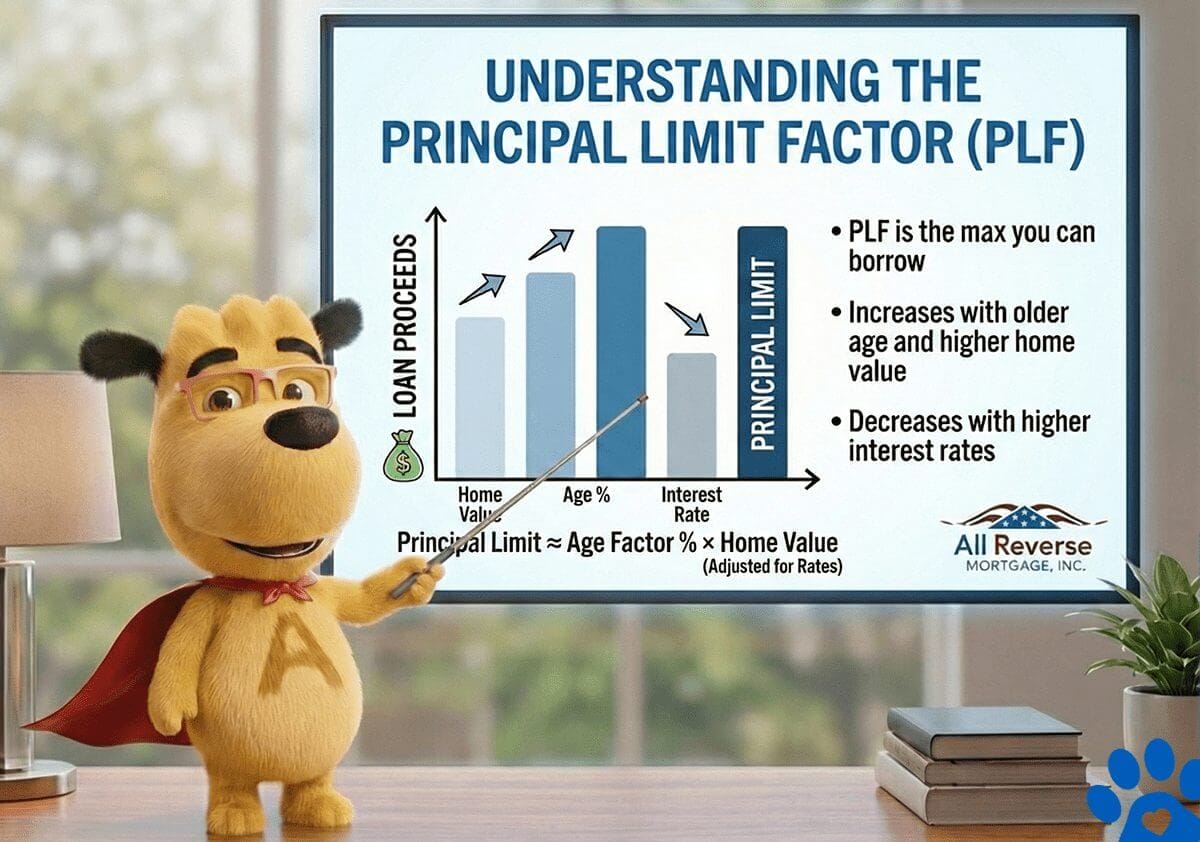
Understanding the reverse mortgage principal limit factor showing how age, home value, and interest rates affect loan proceeds

Understanding the Maximum Claim Amount

The Maximum Claim is used to determine your reverse mortgage benefits or loan proceeds, which is known as the Principal Limit. The Maximum Claim Amount is determined by the lower of one of three things: the appraised value of the property, the purchase price on a purchase transaction, or the HUD lending limit in effect at the time.

Once the Maximum Claim Amount is determined, the HECM calculator then considers other factors, age(s) of the borrower(s), value, and current interest rates at the time to determine the Principal Limit or proceeds available for the borrower(s) under the reverse mortgage program.

Borrowers need to remember, though, that the Maximum Claim Amount that they see at the start of their loan is defined by the CFPB as:

The lesser of the appraised value of the home, the sale price of the home being purchased, or the maximum limit HUD will insure. The maximum claim amount is one factor used to calculate how much a homeowner can borrow with a reverse mortgage loan. -CFPB

Maximum Claim Amount in Principal Limit Calculations

The Maximum Claim Amount is just one of the factors used in the calculation to determine how much money the borrower will receive in the Principal Limit or loan amount. It is not a maximum benefit to be paid out to the borrower with the loan.

The Maximum Claim Amount will usually be the appraised value of the property but, at times, can be less if the transaction is a sale when the home is sold at a price that is less than the appraised value or when a property is valued higher than HUD’s stated Maximum Claim Amount for the program.

When a borrower’s home is valued above the Maximum Claim Amount, it doesn’t mean they cannot get a reverse mortgage. It means they will not receive further proceeds when the home is valued above that limit.

A borrower with a home valued at $1,500,000 with all the same factors (age, rates, etc.) would receive the same amount of money as a borrower with a property valued at $1,249,125 due to the Maximum Claim Amount, but depending on how they draw their funds and how they allow their lines of credit to grow, either one could far outlast the other based on their borrowing patterns.

HECM Lending Limits and Benefits by Age (2026)

Age of BorrowerPrincipal Limit FactorCurrent Lending Limit
6237.6%$1,249,125
6338.3%$1,249,125
6439%$1,249,125
6539.7%$1,249,125
6640.5%$1,249,125
6741.2%$1,249,125
6842%$1,249,125
6942.8%$1,249,125
7043.3%$1,249,125
7143.3%$1,249,125
7243.5%$1,249,125
7344.3%$1,249,125
7445.1%$1,249,125
7546.1%$1,249,125
7646.7%$1,249,125
7747.7%$1,249,125
7848.8%$1,249,125
7949.4%$1,249,125
8050.5%$1,249,125
(Source: HUD.gov PLF Tables. Subtract ~3% for upfront mortgage insurance and standard fees.)

Curious About Your Principal Limit? Get a clear quote from All Reverse Mortgage, Inc. (ARLO™) — America’s #1 Rated Lender with a 4.99/5-star rating! Call (800) 565-1722 or click here for your free quote — simple, trusted, 100% secure!

Understanding the Growth Feature of Your Reverse Mortgage Line of Credit

You have the line of credit program (if you had the fixed-rate program, you would have been required to take a full draw at the start of the loan, and no additional funds would have been available for subsequent payments).

It has a growth feature that allows the funds remaining in the line to grow at the same percentage as your interest plus your Mortgage Insurance Premium (MIP) combined.

So, for example, if the interest on your loan was 2.5% and your MIP is .5%, the unused funds in your line of credit would grow in availability at 3%. Each year, that rate changes as your interest accrual rate changes.

Therefore, your Principal Limit, or the loan proceeds available to you, will fluctuate based on the draws you take (your Principal Limit is reduced by the amount of draws you take from your line) and the growth of your credit line (your line increases by the amount of the growth on the line based on the unused portion).

Initial Disclosures and the Importance of Monthly Statements

Borrowers receive initial disclosures with amortization schedules that give examples of the relationship between the Maximum Claim Amount and the Principal Limit, but unfortunately, they are only estimates and cannot possibly accurately foretell future interest rates or borrowers borrowing habits.

They are only examples and can vary significantly once borrowers begin taking draws and interest rates change. This is why borrowers need to pay attention to the monthly statements they receive from their servicer.

The statement breaks down everything that happens on the loan each month. We have an article online to help people read and understand their statements at: https://reverse.mortgage/understanding-statement.

Steps to Take If You Have Questions

If this general explanation doesn’t answer all your questions or if your servicer’s statement is different and doesn’t look the same, don’t hesitate to contact them and have them explain it to you.

If you need further assistance, there are attorneys and counseling companies that advertise low-cost assistance who can advocate for you so that you don’t wait until after you are out of funds to find out there was a misunderstanding of the Maximum Claim Amount and Principal Limit.

Also, if you received your loan that long ago, you might benefit from refinancing now under the new values and Maximum Claim Amounts, and that’s worth looking into.

FAQs

Q.

What is the principal limit on a reverse mortgage?

The principal limit is essentially the loan amount on a reverse mortgage. It is the total amount of money available to borrowers based on their specific loan parameters.
Q.

Who sets the principal lending limit factors? (PLF)

HUD determines the principal limit factors if it is a Home Equity Conversion Mortgage (HECM). The lender only sets the principal limit factor if it is a Non-HUD insured Proprietary reverse mortgage.
Q.

How is the reverse mortgage principal limit calculated?

3 pieces of information determine the principal limit factor. For a Home Equity Conversion Mortgage (HECM), those are the Home Value (or Max Claim), whichever is less, the expected interest rate, and the age of the youngest borrower or spouse. The higher the value and the older you are, the higher the percentage of the principal limit factor will be. However, the higher the expected rate, the lower the principal limit factor. For proprietary products, the same 3 items factor into the calculation. The only difference is the higher the interest rate, the higher the principal limit factor on proprietary products.
Q.

What percentage of equity can you get on a reverse mortgage?

The percentage of equity you can access with a reverse mortgage depends on the age of the youngest borrower or eligible spouse, current interest rates, and the type of reverse mortgage. The older you are, the higher the percentage generally becomes. With an FHA insured Home Equity Conversion Mortgage (HECM), homeowners today typically qualify for about 38% at age 62 and up to roughly 72% for borrowers in their mid to late 90s, based on current interest rate levels and HUD’s Principal Limit Factor tables. If interest rates move lower in the future, these percentages can increase, as they did in 2021 when access was closer to 52% at age 62 and into the mid-70% range for borrowers in their 90s. If there is a spouse younger than 62 who is not listed as a borrower, the available percentage may be reduced to account for that younger age. Proprietary or jumbo reverse mortgages, which are privately funded and not FHA insured, vary by lender but generally range from around 30% at age 55 to roughly 50%–55% for borrowers in their late 80s or older.
Q.

What is a reverse mortgage maximum claim?

The reverse mortgage maximum claim is the cap on the value used to calculate your principal limit. The maximum Home Equity Conversion Mortgage (HECM) claim is currently $1,249,125. If you have a home value of $1,249,125 or higher, the principal limit will be determined using a value of $1,249,125. For proprietary products, the maximum claim is simply the home value, as the HECM limit does not cap them; therefore, these products are popular among those with home values above the government limit.

ARLO recommends these helpful resources:


ARLO Testimonials
America's #1 Rated Reverse Lender Celebrating 20 Years of Excellence.
Author Michael Branson
About the Author, Michael G. Branson | Mike@allreverse.com
Michael G. Branson CEO, All Reverse Mortgage, Inc. and moderator of ARLO™ has 45 years of experience in the mortgage banking industry. He has devoted the past 20 years to reverse mortgages exclusively.

Have a Question About Reverse Mortgages?

Look no further. Michael G. Branson, our CEO, brings a wealth of knowledge directly to you. With a robust 45-year tenure in mortgage banking and 20 years dedicated solely to reverse mortgages, he's the expert you want on your side.
Post your question in the comments below and anticipate a personalized response from Mr. Branson himself, typically within one business day. He's here to illuminate all angles of reverse mortgages, ensuring you're equipped with the knowledge to make informed decisions. Take this opportunity to gain insights from a seasoned professional.

Over 2000 of your questions answered by ARLO™
Ask your question now!

20 Comments on this Article
  1.   Paul S.
    December 28th, 2025
    The maximum claim amount I am now told is $120,000. It was not shown on my original loan agreement nor has anyone ever told me about that, not even my required RM loan counselor. Is this fraud?
    Reply to Paul
    • Michael Branson Michael Branson
      December 28th, 2025
      Hello Paul,
      The HUD maximum claim amount is the property value or the HUD limit in effect at the time of application, whichever is less. For example, in 2026, the maximum claim amount is $1,249,125. If you were doing the loan after January 1 2026 and your home is worth $200,000, your maximum claim amount would be $200,000. If your home was worth $1,500,000, your maximum claim amount would be $1,249,125 (the lesser of $1,500,000 or $1,249,125). That limit is reviewed annually and is subject to change with Case Numbers assigned on or after January 1st. Prior to 2008, there were regional limits that were different throughout the nation instead of one national limit as became the case at that time. Many of those regional limits were much lower than the national limit prior to the increase to $417,000 in 2008.
      If your maximum claim amount on your loan is $120,000, that must have been the appraised value of your home at the time you obtained your home unless your loan predates 2008 and had a Regional or Metropolitan Statistical Area (MSA) limit of $120,000 at that time and I have no way of knowing that. All of the program disclosures reference the terms and their meaning but I can't begin to comment on what the lender or the counselor may or may not have done or said.
      My personal opinion is that it would be a steep hill to climb to prove that anyone committed "fraud” unless you could show they took steps to mislead you or deceive you in some way. But I'm not an attorney and I can't give you legal advice. If you feel you were misled or that the lender acted inappropriately, you can contact the state department responsible for the oversight of lenders in your state, your state attorney general, the Consumer Financial Protection Bureau or the Federal Trade Commission for punitive action against the lender. Or you could try a private attorney if you wish to see about civil recourse. I wish you the best.
      Reply to Michael
  2.   Pat
    July 31st, 2024
    I currently have a reverse mortgage with the current principal limit
    of $153,387 with a loan balance of $125,345. The interest is
    astronomical. On the current market, the house is worth $235,000.
    Would it be feasible for me to re-negotiate the loan? Or is that even possible?
    Reply to Pat
    • Michael Branson Michael Branson
      July 31st, 2024
      Hello Pat,
      There really is nothing to "renegotiate." The interest is a product of the index plus the margin, so when rates rise for the index, the interest that accrues rises. Part of the problem is that interest rates have risen a lot lately. If you have a lender that gave you a 2.75% or 3.00% margin (or in some cases even higher) when you closed your loan, your interest now is accruing at a much higher rate than a loan that came with a 1.5% or lower margin. I also don't know if your loan was closed at a time when mortgage insurance renewals accrued at 0.50% or 1.25%. If you are at the higher accrual, the only way to change that would be to refinance the loan (more about that in a moment).
      Available margins are a function of the value of the loans, the profit margin the lender sets for itself, and what it costs lenders to originate those loans. The value is pretty much universal, but not all lenders have the same costs to originate or have decided to originate loans making the same amount of money on a per-loan basis. I always advise borrowers to compare several proposals from different lenders because something like a higher margin can cost you much more in the long run than, say, a slightly higher appraisal fee. I've seen people pay as much as a 1.75% higher margin to save $100 on their appraisal fee. That higher interest rate will cost them tens of thousands of dollars over the life of the loan in many cases.
      While you cannot renegotiate your current loan, you can repay the loan at any time without penalty. You can also choose to make payments at any time, even though none are required. I don't know your age, so it's probably not an option without having to bring cash in based on today's rates, but you can refinance the loan if it makes sense to do so when the rates decline. At that time, you would want to be sure to get the lowest margin possible so that the interest on the new loan accrues as slowly as possible. Rates have not come down enough yet to make it feasible for most borrowers to refinance, but the word coming out is that we may see the first rate reduction in September. One reduction alone won't be enough to bring the rates down to help most borrowers, but it's a start, so you should definitely watch the interest rate announcements.
      Reply to Michael
  3.   Steve
    June 28th, 2024
    Let's say you draw $100,000. Then pay that back in 30 days. How does that affect the line of credit?
    Reply to Steve
    • Michael Branson Michael Branson
      June 29th, 2024
      Hello Steve,
      If you draw money and pay it down, it not only makes the funds available again, but the unused portion of the line of credit will grow in availability. But that's assuming you do not pay the line down to a zero (-0-) balance. If you ever pay the entire outstanding amount and the balance owed is down to zero, the loan is paid in full and would be closed. You cannot keep the loan open with a zero balance.
      If you plan to pay the loan down soon after you open the loan and want to keep the loan open, you need to be sure to keep a small balance outstanding and not repay the entire amount. The interest that would accrue on a balance of under $10,000 is pretty nominal and ensures your loan is available to you in the future if that is your goal.
      Reply to Michael
  4.   Jim B.
    April 2nd, 2024
    Is a reverse mortgage possible for a 79 year old applicant on a home valued at $450,000 with a current mortgage of $280,000?
    Reply to Jim
    • Michael Branson Michael Branson
      April 17th, 2024
      Hello Jim,
      The factors that determine how much money a borrower receives with a reverse mortgage are the age of the youngest borrower on the loan (or eligible non-borrowing spouse), property value, and interest rates at the time. In today's rate environment, you would be short to close by a little over $77,000.
      Contrast this to a few years back when interest rates were below the HUD floor, and you still would have been short to close. At the HUD floor of 3%, you would be less than $4,000 short to close and would be able to bring that money in to close if you still wanted to do the loan.
      My point is that interest rates make a huge difference to reverse mortgage borrowers, as does your property value. Whereas it may not work for you today, a few rate cuts and some appreciation of your property may make it feasible more quickly than you might think. I would suggest that you consider going to our calculator at https://reverse.mortgage/calculator, and if you would like to have us contact you when rates decline, you can leave your email address, but that's entirely up to you.
      Reply to Michael
  5.   John
    October 23rd, 2023
    Mr. Auerswald, I am still a little confused about MCA. We all know that once 98% of MCA reached, investor can assign the mortgage back to HUD. However, what is MCA really mean here? I know on mortgage document, the maximum principal amount usually 1.5 times of appraisal value. Is this maximum principal amount MCA? Would you mind clarify for me? Thanks, John
    Reply to John
    • Michael Branson Michael Branson
      October 26th, 2023
      Hello John,
      98% of the Maximum Claim Amount referred to is the maximum amount that HUD will insure on the loan before the lender must assign the servicing and the loan to HUD. That Maximum Claim Amount is the cap on the value that HUD will allow the lender to use to determine the loan amount for borrowers on a reverse mortgage. So when the outstanding balance of a reverse mortgage approaches 98% of the original Maximum Claim Amount, the loan is assigned back to HUD. For example, HUD uses the property value or the maximum claim amount to determine the amount of money the borrower will receive based on the calculator for their circumstances. The loan amount available is known as the Principal Limit and is only a percentage of the Maximum Claim Amount that rises as borrowers age. That maximum claim amount now stands at $1,089,300. This means that if your home is worth up to $1,089,300, the maximum claim amount is the value of your home at the time the property is appraised, but if your home were worth more than $1,089,300 (i.e., $1.200,000), the HUD cap on that maximum claim amount would be $1,089,300 and that would be the amount that would be used in conjunction with the borrowers age(s) and interest rates to determine how much money the borrower(s) would receive with their reverse mortgage.
      For argument's sake, let's say the borrower receives $400,000 on a $1,000,000 property due to their age in today's market. The Maximum Claim Amount is $1,000,000; the Principal Limit is $400,000, and the loan documents will show a face amount of $1,500,000. The 98% rule is a rule that HUD has for lenders that says that the lender must assign the servicing to HUD if the loan to value reaches 98% of the original loan to value to protect their ability to receive claim payment. This is strictly between HUD and the lender, and lenders routinely make the assignment to HUD to avoid risking their insurance against the risk of loss. This loan must be assigned to HUD only when the outstanding balance reaches $980,000.
      The 1.5 times the value or 150% that you see on your loan documents is what HUD requires for states that require an amount to show on the loan documents. HUD would prefer that there is no mortgage amount on the loan documents because they do not know in advance what your balance may be in the future. After all, the balance can rise with interest accrual, and you have access to more money over time with the line of credit growth. However, most states require that an amount be shown to account for future interest accrual and possible line of credit growth. HUD instructs lenders to use 150% of the property value/maximum lending limit (whichever is less) on the Note and Deed of Trust/Mortgage.
      The face amount on the Deed of Trust differs from what you owe and has nothing to do with when the loan will be assigned to HUD. You only owe what you borrow and the interest that accrues on that amount plus any MIP that accrues, plus any fees accrued but not paid, and finally, any money that the lender may be required to advance on your behalf (i.e., if you do not pay your taxes and the lender is forced to advance this cost). Some borrowers never reach the 98% threshold because they borrow slowly, and the balance remains low. Some borrowers borrow more quickly, the balance rises faster, or their loans are much older, and their loans are assigned to HUD when their balance reaches 98% of the home's original value (or 98% of the maximum lending limit if that was lower). However, the 150% has no bearing on the assignment to HUD.
      Reply to Michael
      •   Russell P.
        February 5th, 2026
        In October, 2015, we purchased a home using a reverse mortgage. The mortgage has changed services a couple times since then. We did not use a line of credit and have never received any funds since then.We recently received a letter from the current servicer, telling us that we are approaching 98% of the maximum claim amount and they are about to assign it to HUD's servicing contractor. At the bottom of the first page it states:This is an attempt to collect a debt. However, if the loan is currently, or was previously involved in a bankruptcy where the case was discharged and/or you are surrendering the real property in which *** Mortgage Services LLC has an interest, we are not seeking personal liability against you. (That last sentence does not pertain to us as far as we know) We are pursuing our rights as they relate to the real property under the terms of the Deed of Trust or Mortgage.We are trying to locate our copies of the deed etc, to see what it says about reaching the MCA, and what it means to us, but we were moving at the time and are having a hard time finding it. Is this something we need to worry about? That line about attempting to collect a debt has us concerned. We have been fulfilling our requirements to maintain the home, real estate tax payments and insuring it, while living in it 100% of the time. We are willing to seek legal advice locally, if need be. Hopefully we will find our documentation or won't need it either way.
        Reply to Russell
        • Michael Branson Michael Branson
          February 6th, 2026
          Hello Russell,
          I hate that little blurb but it's just a disclaimer that is required by law. All the notice is telling you is that the loan is being assigned to HUD as is required by the terms of the contracts between HUD and lenders offering the program. The terms of your loan will not change and this will not affect you other than you now how CompuLink as your servicer (if they weren't before) because they are the contract servicer for HUD.
          When using the reverse mortgage for purchasing a new home, most borrowers do opt for a fixed rate since they are taking a full draw of all the funds available to buy the home. Since you need the full draw to buy the house, there are no further draws available anyway so many people don't opt for the line of credit adjustable rate loan because the line would be fully drawn from the start of the loan with no further draws available anyway.
          The 98% is based on the value when you closed your loan. You might still have a lot of equity in the home if your home has experienced significant appreciation over the past 11 years and the appreciation still belongs to you. If you wanted to, you could sell the home and the equity is still yours. If you qualify, you might be able to refinance and get more money on a new reverse mortgage. Or you can just remain in you home and there is nothing you need to do at this time except keep abiding by the terms of your loan. You must live in the property as your primary residence, maintain the home in a reasonable manner and pay your property charges on time (taxes, insurance, HOA dues if any, etc.). Answer any requests for annual occupancy certifications. The only change you should notice is who sends you your monthly statements.
          Reply to Michael
  6.   Sergio S.
    March 19th, 2020
    What is the highest growth rate and what would PLF be for a 62-year-old?
    Reply to Sergio
    • Michael Branson Michael Branson
      March 19th, 2020
      Hello Sergio,
      The growth rate is equal to the interest rate plus the annual mortgage insurance premium (MIP) renewal being charged on the loan. Therefore, your growth rate would be dependent on the margin you received at the origination of your loan and that rate would change annually as the rate changes.
      For example, for ease of illustration, if your initial index rate started at 1% and your margin was 1.5% for an initial rate of 2.5%, you would add the annual MIP of .5% and your growth rate would be 3% in the first year. The growth rate in year 2 would depend on the index during that year to which the margin is added (plus the MIP). The higher the margin, the higher the growth rate on the unused funds but you also have to keep in mind that the higher the margin, the more interest you will accrue once you do start borrowing the funds.
      Also, once you exceed the HUD floor rate of roughly 3% on the expected rate, the higher the rate the less money you receive in your loan. The expected rate is based on a different 10-year index and is higher than the rate at which you accrue interest. HUD uses the 10-year index for the expected rate for only two functions; to determine how much money you will receive on the loan and for illustrative purposes on the initial documents (i.e. amortization schedule).
      Borrowers can sometimes benefit from a higher margin, especially when the goal is to experience the highest growth possible for many years before using the line. A higher margin will also give most borrowers a higher monthly payment if they are on the monthly payment plan and that is their goal.
      Bumping up against the maximum principal limit or even getting a slightly lower principal limit (loan amount) for a higher margin and more growth in the line over the long run may be in your best interest, especially when maximum funds in later years are what you seek. This is where it is best to compare the amortization schedules of different options to see which works best for you.
      The Principal Limit Factor (PLF) is the amount of money a borrower receives as a percentage of the value of their home. But again, the PLF is dependent on the interest rate. If the interest rate exceeds the floor, the PLF is affected and goes down. Also, if you are closer to 62 and a half, you will receive the benefit for a 63-year-old borrower.
      The best thing to do is to visit a calculator like the one we offer an online calculator to compare the different options available. We do not require your personal information such as your social security number, etc. and it is entirely your choice if you want us to contact you or not -it is not required to receive the information about the loan.
      We do need your date of birth as the calculator requires this to run the correct numbers but even then, if you don't want to give out that exact information, just use the first day of the month you were born and that's close enough! We are here to make it easy for you and then if you have any further questions, we look forward to being of assistance.
      Reply to Michael
      •   Jamie B.
        May 28th, 2020
        I have had my reverse mtg. Since I was 62. I am now 71. My current net principal is $403.86... does this mean I have no more money left to receive? Can I redo the loan? My home has been appraised at $495,000.00. I owe current loan balance $290,906,00. Thank you
        Reply to Jamie
        • Michael Branson Michael Branson
          June 2nd, 2020
          Hello Jaime,
          The only way to know for sure if you qualify under HUD's rules for a refinance is to run the numbers when we have the actual statement and all the information (don't need your social security number or anything like that). We will need to know the information for your current loan and then we can check to see if the recent sales will support a refinance based on HUD rules. Try giving us a call at (800) 565-1722 and ask to speak with a licensed loan officer in your area.
          There is no obligation and if you do qualify under the HUD requirements, we will let you know and then it is up to you to decide if you want to go any further.
          Reply to Michael
  7.   Josephine C
    January 9th, 2020
    My current loan balance exceeds the original principal limit. What happens to my line of credit in this instance?
    Reply to Josephine
    • Michael Branson Michael Branson
      January 9th, 2020
      Hello Josephine,
      You retain access and full use of your line of credit for as long as you have funds remaining and you continue to abide by the terms of your loan. As long as you continue to occupy the property, pay the taxes and insurance in a timely manner and reasonably maintain the home, it doesn't matter what the balance rises to as that is all factored into the original HUD calculations.
      Reply to Michael
  8.   R. Hodnett
    November 20th, 2019
    How is the loan principle determined?
    Reply to R.
    • Michael Branson Michael Branson
      November 20th, 2019
      Good Afternoon,
      The Principal Limit (also often referred to as the benefit amount or the loan amount) is determined by a calculation which considers several pieces of information.
      The calculation uses the age of the youngest borrower on the loan, the value of the home or the HUD maximum lending limit, whichever is less, the age of the youngest borrower on the loan and current interest rates.
      The calculator then determines the benefit amount for each applicant (borrower or borrowers) based on the parameters and the benefit availability based on his/her/their ages.
      For example, if the Principal limit for two separate single borrowers is an equal $200,000 based on their circumstances, and their goal in each case is to get the tenure option, or payment for life, there can still be drastically different payments to each.
      Suppose the first borrower is 62 years of age. The $200,000 must last much longer than if the second borrower was 87 years of age, actuarially speaking. Therefore, the monthly payment to the 87-year-old borrower would be much higher each month than to the 62-year-old borrower.
      For the same reason the monthly payment is higher, if the two borrowers with the two different ages had the same valued home, the benefit to the older borrower would be much higher than to the younger borrower. A borrower 25 years older statistically will not live as long and accrue as much interest over the life of the loan as someone 25 years younger. The HUD calculator takes these factors into consideration when determining the benefit amounts.
      The calculator will only take so much information into consideration. It does not determine variances for married vs single borrowers, male vs female, healthy vs those with illnesses, smoker's vs non-smokers, etc.
      Rather than try to account for all circumstances, HUD's calculator will only use the one factor of age, and then it uses the age of the youngest borrower on the loan (it does not try to average, etc.).
      Reply to Michael

Leave a Reply to This Article