


A+ BBB Accredited
★★★★★ 4.9/5 from 1,200+ reviews
HUD-Approved · NMLS #13999
Explore All Reverse×
Programs
How It Works
Calculators
Resources
Why All Reverse
HUD-approved direct lender · NMLS #13999
4.9/5 from 1,200+ reviews
ARLO

See What Your Home Could Do for You

Your instant quote includes eligibility, real-time rates
Michael G. Branson Michael G. Branson, CEO of All Reverse Mortgage, Inc., and moderator of ARLO™, has 45 years of experience in mortgage banking, with the past 20 years devoted exclusively to reverse mortgages. A Forbes Real Estate Council member, he developed the industry's first fixed-rate jumbo reverse mortgage and has been featured in Forbes, Kiplinger, the LA Times, and Yahoo Finance. (License: NMLS# 14040)
Cliff Auerswald Cliff Auerswald, President of All Reverse Mortgage, Inc., and co-creator of ARLO™ — the industry's first real-time reverse mortgage pricing engine — has 27 years of experience in mortgage banking, with 20+ years focused exclusively on reverse mortgages. A recognized expert in reverse mortgage technology and consumer education, he has been featured in Kiplinger, Yahoo Finance, Realtor.com, and HousingWire. (License: NMLS# 14041)

What is the Government’s Role in Reverse Mortgages?

Michael G. Branson, CEO of All Reverse Mortgage
CEO · 45 yrs in mortgage banking
Cliff Auerswald, President of All Reverse Mortgage
President · All Reverse Mortgage Inc.
3 min read Fact Checked HUD-Lender #26031-0007 6 comments

An estimated 99% of of reverse mortgages offered today are insured by the Federal Housing Administration (FHA), according to the agency. While the government does insure these reverse mortgage products, it does not offer the loans directly to consumers.

Since they are insured by the federal government, the vast majority of reverse mortgages come with additional benefits that you won’t find from any private reverse mortgage product.


FHA Protections

FHA provides borrowers with the comfort of knowing that they will never owe more than the home is worth. In other words, if you obtain a reverse mortgage and later decide to move, you’re protected even if your home has lost a significant amount of value. This is the FHA’s “non-recourse” policy.

Borrowers are also protected if the lender that is servicing the loan goes out of business. In the unlikely event that happens, FHA guarantees that you will receive any remaining payments or money available from the reverse mortgage, as agreed upon under the terms of your loan.

Before borrowers take out a reverse mortgage, they should understand that they pay for these protections. All FHA-insured reverse mortgage products include an upfront mortgage insurance premium as well as one that is charged annually.

Depending on the product you choose, these costs vary.

Read more about mortgage insurance premiums.


Government Regulation
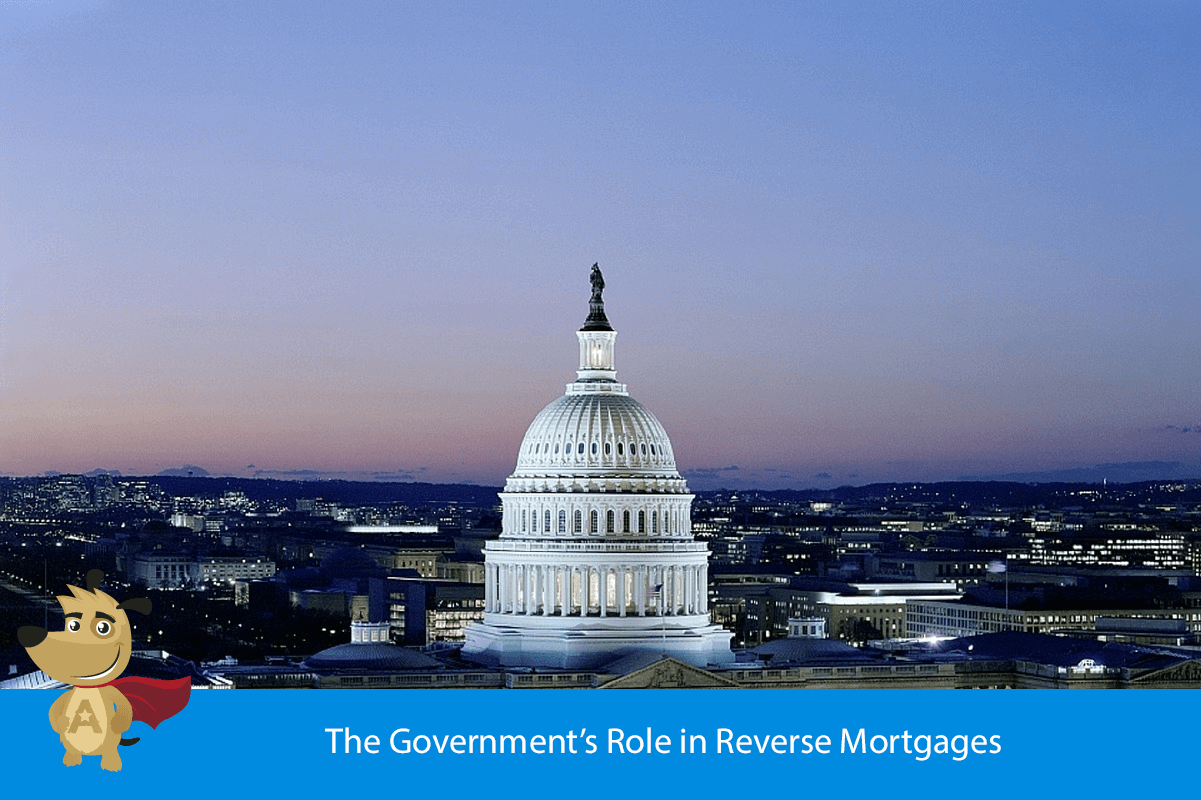
The Government’s Role in Reverse Mortgages

While the government may not offer Home Equity Conversion Mortgage (HECM) reverse mortgages directly, borrowers can rest assured that the government is involved in the origination of the loans.

This is done through a government agency called the Department of Housing and Urban Development (HUD). The agency manages the product and requirements of the program, essentially holding authority over its rules.

While HUD manages a wide variety of issues related to its reverse mortgage program, the counseling requirement is one of the most important.

Prior to obtaining a HECM loan, all borrowers are required to receive reverse mortgage counseling from a HUD-approved agency. HUD is responsible for developing guidelines for the counselors on what they need to discuss and explain to borrowers during the meeting.

The agency also requires that the people who provide counseling are trained to a certain standard and have passed a test to ensure they understand the details of the program.

In addition to the reverse mortgage counseling, HUD is responsible for oversight of the lenders that offer reverse mortgages to consumers. If a lender fails follow the rules put in place by HUD, that lender will not be allowed to offer the loans.

The agency will also take actions against reverse mortgage lenders who violate the guidelines of the program. While this doesn’t happen very often, the agency has made it clear that it won’t allow lenders to take advantage of senior citizens.


Ginnie Mae

The government also plays a role in the investor market for reverse mortgages through the Government National Mortgage Association (GNMA).

As a government agency, GNMA, or “Ginnie Mae,” does not buy or sell loans or issue mortgage-backed securities (MBS). However, it does guarantee that investors who buy the bonds will receive principal and interest payments. Ginnie Mae only backs MBS that are made up of loans insured by government agencies like FHA and or the Department of Veterans Affairs (Reverse Mortgage for Veterans).

By offering this guarantee to investors, the loans are less expensive for consumers since the end buyer knows the government will step in and make sure they’re paid.

At the end of the day, the government remains very involved in reverse mortgages and is doing everything it can to make sure it’s a safe option for seniors who wish to age in place.


Government’s Role in Reverse Mortgages

AgencyRoleBenefit to Borrowers
FHAInsures 99% of reverse mortgages (HECMs)Non-recourse protection; payment security
HUDManages HECM rules, mandates counselingEnsures education, lender oversight
Ginnie MaeGuarantees MBS payments for investorsLowers loan costs via investor confidence

Curious About Government-Insured Reverse Mortgages? Get a custom reverse mortgage quote from All Reverse Mortgage—America’s #1 with a 4.99/5-star rating! Call (800) 565-1722 or click here for your free quote —simple, trusted, 100% secure!

ARLO Testimonials
America's #1 Rated Reverse Lender Celebrating 20 Years of Excellence.
Author Michael Branson
About the Author, Michael G. Branson | Mike@allreverse.com
Michael G. Branson CEO, All Reverse Mortgage, Inc. and moderator of ARLO™ has 45 years of experience in the mortgage banking industry. He has devoted the past 20 years to reverse mortgages exclusively.

Have a Question About Reverse Mortgages?

Look no further. Michael G. Branson, our CEO, brings a wealth of knowledge directly to you. With a robust 45-year tenure in mortgage banking and 20 years dedicated solely to reverse mortgages, he's the expert you want on your side.
Post your question in the comments below and anticipate a personalized response from Mr. Branson himself, typically within one business day. He's here to illuminate all angles of reverse mortgages, ensuring you're equipped with the knowledge to make informed decisions. Take this opportunity to gain insights from a seasoned professional.

Over 2000 of your questions answered by ARLO™
Ask your question now!

6 Comments on this Article
  1.   Virginia W.
    June 3rd, 2022
    We are seniors, 81 & 82 y/o. We tried to secure a reverse mortgage but because we refinanced before, we were told we had no working equity. Our appraised value: $435K, what we owe: $255K. We could possibly have $180K in equity. However, we were told no. In addition, we were expected to pay all costs such as appraisal and counseling fees. $9600, FHA/HUD fees, origination fees, $6000, other fees, $3516. Interest rate 3.93%. Since we have no equity, we must wait for our monthly payments to accrue to give us money to improve our home. Our present payment is $1270/ month. We could accrue $15,400 per year in savings to use for repairs at a later time. Nothing to us from our equity. We wanted to discuss this as a couple but, the agent said we should not waste another day talking as interest rates are moving up fast. I watch the Federal Reserve every day and see what the current rates are and know when they plan to raise the interest rates. This agent was trying to scare us into signing right away that day. I am a female but, I am not stupid or gullible. Why were we told we had no useable equity? Another company told us we had $28K in equity. I feel we can't trust anyone. Thank you. Virginia Withall
    Reply to Virginia
    • Michael Branson Michael Branson
      June 9th, 2022
      Hello Virginia,
      I don't know what you were told or why but you obviously do have equity in your home. HUD has a rule that if you just refinanced the home within the last 12 months, you cannot use the reverse mortgage to pay that loan off if paying that loan off would get around the HUD rules of not allowing more than 60% of the loan proceeds at closing or in the first 12 months. Perhaps that was the issue at the time if the other refinance was less than 12 months seasoned? I don't know.
      I would definitely suggest that you speak to a different reverse mortgage professional to see what they say and see how they explain your situation to see if they have the same concerns. I can't say for sure, but I don't think it is a matter of the agent not being trustworthy but maybe not being able to explain the issue well enough - if that is even really the roadblock you hit.
      At any rate, if it has been over 12 months since you last refinanced your existing mortgage, I would suggest that you visit our calculator on our website at https://reverse.mortgage to see if a reverse mortgage is still something you would want to consider. We would be happy to look at your circumstances and let you know if there are any issues that would prevent you from beginning an application based on HUD's requirements if that is your decision.
      Reply to Michael
  2.   Wayne J.
    April 19th, 2022
    Hi Arlo,
    I have several questions that I cannot find a simple direct answer to. Maybe you can help? I need to borrow some money for a short-term venture (1 to 5yrs) I have a great margin and do not want to disturb my existing RM. My friend will lend me the money but wants the following: a Note to be secured upon address of the property by a Deed of Trust and go through escrow and title insurance policy insuring my friend, a 2nd behind any 1st Trust Deed. A promissory note and deed of trust insured by a reputable title insurance company will be recorded on the property. Is any of this possible give my existing reverse mortgage?
    Reply to Wayne
    • Michael Branson Michael Branson
      September 22nd, 2022
      Hello Wayne,
      I can answer some of your questions and send you in the right direction for the other answers but whether the answers I have are exactly what you and your friend want to hear or to the degree of specificity you want, I cannot say. Firstly, there is no provision in your reverse mortgage that prohibits you from getting another loan behind your reverse mortgage loan so if your friend is ok with placing a lien in secondary lien position behind a reverse mortgage, there is nothing to stop him. But you need to remember that his mortgage will be in third lien position, not second, if you have a standard HUD HECM reverse mortgage. FHA/HUD reverse mortgages already record a first and second Deed of Trust to cover both the lender and any amounts that HUD may need to advance over the life of the loan. Because the loan has a provision whereby the lender may need to assign the loan to HUD under several circumstances, HUD must also be covered. So, about your existing reverse mortgage loan, there is no problem, it is firstly a matter of whether your friend is willing to go into third lien position behind a negatively amortizing loan.
      Also, when you pull the existing Deeds, if you have not done so already and you do not remember, the Deed face amount is 1.5 times the HUD lending limit or the property value at the time you closed the loan, whichever is less. This is because the loan requires you to make no monthly mortgage payments and therefore the balance can grow significantly over the life of the loan. That doesn't mean you owe that much but if your friend is not expecting that, it could come as quite a shock when he sees the amount. But aside from the fact that your friend would be in third lien position and the Deed Face Amounts would be much higher than the amount you borrowed, the amount of the reverse mortgage owed at any given time would be the amount you borrow plus the interest that accrues on that amount. Perhaps he may need to see your monthly statement from the servicer at this point? If your loan is ever assigned to HUD by your current lender, the amount of interest that accrues does not change, it just accrues to HUD rather than to the lender who previously held the loan.
      Now as far as the escrow services and the title insurance, that would be completely up to those providers. And in most cases, a title company can also handle the escrow services through their escrow division so it most likely would not need to be two separate companies IF you find a title company willing to insure a private title transaction. My advice, if the answer to the first part of the question is acceptable to your friend, would be to start contacting title companies to see if they will work with private parties on such a venture because I honestly cannot answer that part of your question. We are a lender and not a private party lender so I do not know how they would react to such a request. Never hurts to ask. But if they will handle the transaction for you, there would be no reason you would need to do anything with your existing reverse mortgage.
      Reply to Michael
  3.   Ronald W.
    January 27th, 2022
    I am having severe problems getting any information or results in getting approved damage money from State Farm, regarding 2021 Hurricane IDA in Louisiana. I was informed that the first payment check was mailed through USPO on 1/10/22,as of 1/26/22 I have not received the check and can get no answer from HUD, not even an email. I have lost 5 contractors and have a signed contract with a company. I am a 74-year-old Senior Citizen with extreme health problems. I need an immediate answer to solving this MESS created by HUD.
    Reply to Ronald
    • Michael Branson Michael Branson
      February 2nd, 2022
      Hi Ronald,
      I am truly sorry and I wish I could be more assistance but I honestly do not know where the problem lies. I know there are several government entities that are backed up still from illness and Covid concerns and our mail is often delayed by more than a week so that only adds to the timing delays (not that I am excusing the lack of communication, but I don't know what kind of staffing they have in their offices).
      I would advise you to be persistent and send things registered mail with return receipt requested in addition to any other contacts you attempt so you have record of when they receive your requests. And you may want to consult an attorney. I don't know the laws regarding their responsibilities to you and it may be best if you had someone in your corner who does.
      Reply to Michael

Leave a Reply to This Article