

A+ BBB Accredited
★★★★★ 4.9/5 from 1,200+ reviews
HUD-Approved · NMLS #13999
Explore All Reverse×
Programs
How It Works
Calculators
Resources
Why All Reverse
HUD-approved direct lender · NMLS #13999
4.9/5 from 1,200+ reviews
Michael G. Branson Michael G. Branson, CEO of All Reverse Mortgage, Inc., and moderator of ARLO™, has 45 years of experience in mortgage banking, with the past 20 years devoted exclusively to reverse mortgages. A Forbes Real Estate Council member, he developed the industry's first fixed-rate jumbo reverse mortgage and has been featured in Forbes, Kiplinger, the LA Times, and Yahoo Finance. (License: NMLS# 14040)
Cliff Auerswald Cliff Auerswald, President of All Reverse Mortgage, Inc., and co-creator of ARLO™ — the industry's first real-time reverse mortgage pricing engine — has 27 years of experience in mortgage banking, with 20+ years focused exclusively on reverse mortgages. A recognized expert in reverse mortgage technology and consumer education, he has been featured in Kiplinger, Yahoo Finance, Realtor.com, and HousingWire. (License: NMLS# 14041)

Reverse Mortgage Property Requirements – New for 2025/2026

Michael G. Branson, CEO of All Reverse Mortgage
CEO · 45 yrs in mortgage banking
Cliff Auerswald, President of All Reverse Mortgage
President · All Reverse Mortgage Inc.
7 min read Fact Checked HUD-Lender #26031-0007 134 comments

I would like to know the exact reverse mortgage property requirements, such as central heating, water wells, septic systems, etc.  To hear these reverse mortgages advertised, one might get the impression that getting one is very simple.  However, after some preliminary inquiries, it’s beginning to look like everything else involving the government can become incredibly complicated.
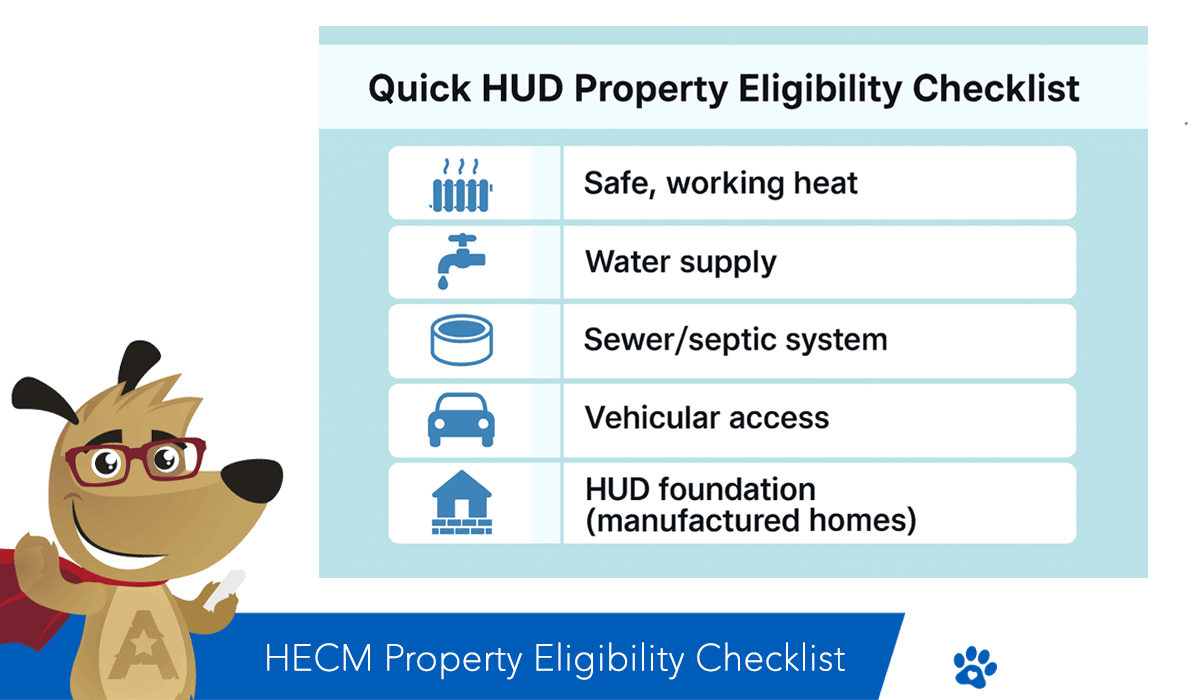
ARLO teaching the minimum HUD property checklist

Updated September 2025 with the latest HUD 4000.1 rules on ADUs, manufactured homes, and PACE liens

Understanding HUD’s Property Standards

When applying for a reverse mortgage, your home must meet specific property standards set by HUD.  These requirements ensure the property is safe, sound, and secure, but they can vary depending on your specific situation.

For instance, a home does not need central heating, but it must have a permanent, working heat source that HUD considers acceptable.  Acceptable heat sources vary by region.  For example, a simple wall heater might be suitable in Hawaii, but not in Maine or Massachusetts, where a complete heating system is required.  Portable plug-in space heaters aren’t acceptable.

For water, city or approved private wells are acceptable, but may require additional tests or agreements with others (as is the case with shared private wells) when the source is from a private or shared well.  Cisterns or untreated river water typically won’t qualify.  This is where we get into all the differences we can’t possibly discuss here, so if your water source is anything other than city water, you should bring it up to your loan officer right away for discussion.

Because the rules can be detailed and sometimes confusing, it’s not practical to list or explain every possibility here.  Fortunately, HUD makes its complete manuals available to the public, allowing homeowners to review the official guidelines as needed.  This will give every homeowner a good idea if their home meets HUD’s requirements and what might be needed if they have alternative water sources.


Property Types That Work for Reverse Mortgages

Loan TypeEligible HomesKey Things to Know
HECM (FHA-Insured)Single-family homes; FHA-approved condos; Manufactured homes (built after June 15, 1976 with HUD certification tags); 1–4 unit properties (borrower must live in one unit)Must meet FHA property standards; Home must be your primary residence (not a vacation home or rental)
Proprietary (Jumbo)Single-family homes; Some condos (even if not FHA-approved); Certain 2–4 unit properties (borrower must live in one unit)Not government-insured; More flexible than FHA rules; Designed for higher-value homes; Must be primary residence

HUD Property Requirement Manual

If you would like to review the official property standards yourself, HUD now publishes all information in one place, the Single Family Housing Policy Handbook (HUD Handbook 4000.1, last revised August 13, 2025).  This handbook combines and supersedes many older manuals, including 4155.2 and 4150.2, and serves as the current rulebook lenders follow for FHA-insured reverse mortgages.

The handbook outlines minimum property standards for safety, soundness, and security, as well as appraisal rules and specific requirements for features such as manufactured homes, accessory dwelling units (ADUs), and septic systems.  HUD sometimes issues Mortgagee Letters to add or clarify details, so checking the latest version is important.


FHA’s Property Requirements for Septic and Sewer Systems

FHA requires that homes be connected to a public sewer system whenever feasible.  If that’s not possible, the property may instead rely on an individual septic system or a community sewage system, provided they meet HUD/FHA standards.

Community Sewer Systems

HUD no longer maintains a list of approved systems.  Instead:

  • The appraiser must record the name of the community system on the appraisal report.
  • The lender is responsible for confirming that the system is properly licensed and capable of servicing the property.

Individual Sewage Systems

If a property cannot connect to public sewer and instead uses an individual system that is acceptable to the local health authority, HUD/FHA will accept it.

  • This may include septic tanks, cesspools, pit privies, and mound systems.
  • Inspections aren’t automatic unless there’s a local rule, signs of failure, or the Direct Endorsement underwriter decides it’s needed.  For example, if the home’s been vacant for more than 30 days.

When inspections are required, they must be completed by:

  • The local health authority
  • A licensed sanitation professional, or
  • Another qualified party, as determined by the Direct Endorsement (DE) Underwriter.

If the home has been vacant for more than 30 days, the underwriter must determine if an inspection is necessary, even if there are no signs of failure.

Did You Know? – FHA allows septic and community systems when public sewer isn’t available, but lenders and appraisers have the final say on inspections and approvals.  Always confirm with your lender if additional requirements (overlays) apply to your property.


What’s New for Reverse Mortgage Property Requirements in 2025/2026

HUD made several important updates to its Single Family Housing Policy Handbook (4000.1 — August 13, 2025) that can affect whether a home qualifies for a reverse mortgage.  Here’s what homeowners should know:

Accessory Dwelling Units (ADUs) More Clearly Defined

HUD now spells out how homes with one Accessory Dwelling Unit are handled.

A single-family house with one ADU can still qualify for a HECM if:

  • The ADU is subordinate to the main home, meets local zoning and safety codes, and the borrower must live in the main unit.
  • The appraiser reports the ADU separately, including its size, features, and whether it’s legally rentable.
  • HUD allows lenders to request market rent information from appraisers for an ADU, but it’s optional.  Don’t assume the income will count.

Stricter Manufactured Home Standards

Manufactured homes remain eligible, but HUD reinforced key requirements:

  • Must be at least 400 square feet and built on or after June 15, 1976, with the original HUD certification label intact.
  • If there’s any doubt about where the home came from, your lender may require transport and installation paperwork to prove it wasn’t previously set up elsewhere.
  • Must sit on a permanent foundation that meets HUD’s PFGMH standards and be titled and taxed as real property.

These updates are based on the latest HECM property standards from HUD.  They help keep borrowers safer and give clearer expectations for unusual home types or features.

Did You Know? – HUD sets the baseline property standards, but many lenders add their own “overlays.”  For example, some require septic inspections even when HUD doesn’t, or may not allow certain private road or easement setups.  Always ask early about lender overlays so you’re not surprised later.

Other Important HUD Updates

While not strictly property standards, HUD also made changes that affect how your property is appraised and whether certain liens need to be cleared:

PACE and Clean Energy Liens Must Be Cleared

Properties with unpaid Property Assessed Clean Energy (PACE) or similar “green energy” liens no longer qualify until those obligations are paid off.  Borrowers can often use proceeds from the reverse mortgage itself to pay off the PACE balance at closing.

Appraisals: Better Review and Flexibility

  • HUD has added a formal Request for Review of Value (ROV) process, allowing you to request that the lender correct clear errors before the value is finalized.
  • Limited remote observation technology may be used in special cases, such as disaster follow-up or certain final inspections, but not to skip a full on-site appraisal.
  • HUD allows homes with unusual construction (log, dome, earth-sheltered, etc.), but the appraiser must prove there’s a market for the property by finding recent sales of similar homes to support both value and marketability.  If there are no comparable sales, the property is unlikely to qualify.

Curious If Your Property Qualifies?  Find out with a custom reverse mortgage quote from All Reverse Mortgage—America’s #1 with a 4.99/5-star rating!  Call (800) 565-1722 or click here for your free quote —simple, trusted, 100% secure!


Property FAQs

Q.

What types of properties are eligible for a reverse mortgage?

1-4-unit residential properties that meet HUD requirements are eligible for the reverse mortgage program, including condominiums, townhomes, and eligible manufactured homes.
Q.

Can a reverse mortgage be done on an investment property?

No.  A reverse mortgage may not be used on investment properties or second homes.
Q.

Does HUD need to approve my home for a reverse mortgage?

Your appraisal is submitted to HUD’s FHA system for quality review and may be flagged for a second appraisal.  However, HUD doesn’t directly approve or reject your home; it relies on the lender and appraisal review process to ensure the property meets minimum standards.
Q.

How does the appraiser value my property?

The appraiser determines the value of your home based on the sales comparison method.  This means the appraiser must first inspect your home, taking note of its size, condition, upgrades, amenities, etc., and then find recent sales as close to your property as possible that are as similar to your home as possible at that time, and then make market-based adjustments for the differences between your property and each comparable.

Q.

Can you get a reverse mortgage if your home needs repairs?

You can obtain a reverse mortgage if the repairs are not considered to be health and safety concerns, functional inadequacies, or those affecting the home’s livability.  Some repairs may be completed after the loan closes, with funds set aside for repair completion.


ARLO recommends these helpful resources: 


ARLO Testimonials
America's #1 Rated Reverse Lender Celebrating 20 Years of Excellence.
Author Michael Branson
About the Author, Michael G. Branson | Mike@allreverse.com
Michael G. Branson CEO, All Reverse Mortgage, Inc. and moderator of ARLO™ has 45 years of experience in the mortgage banking industry. He has devoted the past 20 years to reverse mortgages exclusively.

Have a Question About Reverse Mortgages?

Look no further. Michael G. Branson, our CEO, brings a wealth of knowledge directly to you. With a robust 45-year tenure in mortgage banking and 20 years dedicated solely to reverse mortgages, he's the expert you want on your side.
Post your question in the comments below and anticipate a personalized response from Mr. Branson himself, typically within one business day. He's here to illuminate all angles of reverse mortgages, ensuring you're equipped with the knowledge to make informed decisions. Take this opportunity to gain insights from a seasoned professional.

Over 2000 of your questions answered by ARLO™
Ask your question now!

134 Comments on this Article
  1.   Lisa M.
    February 22nd, 2026
    My home has no central heat, no furnace or ductwork. Can I qualify for a HECM mortgage?
    Reply to Lisa
    • Michael Branson Michael Branson
      February 22nd, 2026
      Unfortunately, this would make your current property ineligible under HUD's property requirements.
      To qualify for a HECM, the home must meet FHA minimum property standards. One of those requirements is that the property must have a permanent heat source capable of adequately heating the home.
      If the home does not have a permanent heating system installed, it would need to be added before the property could be considered eligible for a reverse mortgage.
      Reply to Michael
  2.   Roberta P.
    January 12th, 2026
    My dad is 91, has a reverse mortgage and needs a lot of repairs done to his home. He's got leaks in the pipes, the bathroom walls have a leak, he needs his pool resurfaced and a pump replaced, and he needs pipes replaced in the restroom that connects to the toilet, causing water damage to the home. What can he do if he can't afford it? Can he get money out of his equity without them defaulting on the home if maintenance wasn't kept up?
    Reply to Roberta
    • Michael Branson Michael Branson
      January 12th, 2026
      Hello Roberta,
      If he still has money available on his current reverse mortgage, all he needs to do is make a request for funds. There are companies available that for a small fee will work with your father and the contractors and will require the contractors to meet certain measurements before approving payments to them so that they cannot be paid until the work is completed and they will help approve the contractor in advance. You may want to help your father choose such a reputable company to assist with any repairs in the future.
      If there are no funds available in his current loan, he can try getting a refinance of his reverse mortgage. I can't tell from what you're saying if the work required would prevent him from getting the loan and it may take an appraisal to know for sure but a lender would be able to give you some preliminary numbers so you would know if it was worth looking into.
      Reply to Michael
  3.   Rosemarie
    October 29th, 2025
    Does an appraiser look at my electrical system and plumbing when getting a reverse mortgage? My electrical system is old but it works. I have all new pipes, but one bathroom needs a new mixing valve, so we don't use that shower. We also need to trim a tree in our yard. The garage has a crack, and the garage door needs to be fixed, but I can't afford to do it right now. Can I still get a reverse mortgage?
    Reply to Rosemarie
    • Michael Branson Michael Branson
      October 29th, 2025
      Hello Rosemarie,
      The appraiser is required to turn on the water in each bathroom sink to confirm that the plumbing works, but they are not expected to check every faucet in the home. It's important to remember that an appraiser is not a home inspector. They will not, for example, plug an electrical tester into every outlet.
      The appraiser will note any visible maintenance issues that do not affect the health and safety of the property. These items may influence the appraised value when compared to similar homes that do not require repairs.
      Cracks are usually part of a home's normal aging process unless the appraiser believes they could indicate a larger structural problem. If a crack is unusually large or in a location that suggests other issues, the appraiser or lender may require an inspection by a licensed professional.
      As for the garage door, that would generally be considered deferred maintenance. It would likely be addressed in the appraiser's final valuation unless it prevents access or presents a safety concern, which is uncommon.
      In some cases, the lender can allow for a repair set-aside so the work can be completed after the loan closes. While no one can say for certain whether you will qualify without seeing the appraisal, your situation does not sound unusual. Based on what you have described, your chances of qualifying for a reverse mortgage still sound positive.
      Reply to Michael
  4.   M. Klein
    April 26th, 2025
    Hi Michael,
    I understand a reverse mortgage requires a house to be in good shape. Would a 45 year old roof that does not leak pass inspection for a reverse mortgage? Thanks!
    Reply to M.
    • Michael Branson Michael Branson
      April 26th, 2025
      Hello,
      The appraiser will conduct a visual inspection while walking the grounds and inspecting the interior of the house. If there are no signs of leaks and the roof appears to be watertight and in good condition, the appraiser should not make any negative comments about the roof, and it should be acceptable. However, if the roof appears to have missing shingles or other areas of concern, or if there are visible signs of leaks (such as water damage) on the ceilings or other telltale signs of roof problems, the appraiser can call for a roof inspection by a licensed roofer.
      The appraiser cannot determine by visual inspection whether a roof is 10 years old or 30 years old, nor can they accurately assess how much longer the roof will last. They can only identify visible signs of damage or indications that the roof has reached the end of its useful life. If such issues are observed, it is their responsibility to call for a roof inspection.
      Reply to Michael
  5.   Susan T.
    March 20th, 2025
    My dad had a reverse mortgage and has passed away. We are planning to auction his personal property in April and then turn the deed over to HUD.
    Can we sell the appliances in the house as well?
    Reply to Susan
    • Michael Branson Michael Branson
      March 20th, 2025
      Hello Susan,
      I can't provide legal advice, so if you're unsure about specific items, I recommend consulting a legal expert in your area to determine what qualifies as real or personal property.
      Whether you can sell certain appliances depends on how they are classified. Some may be considered personal property, while others are real property, depending on how they are attached to the home.
      Personal property includes items that are not built-in and can be removed without damaging the home. These can typically be sold or taken.
      Real property includes items that are attached or built into the home. These are considered part of the real estate and usually cannot be removed, as doing so could lower the home's value.
      For example, washers and dryers are usually personal property if they are freestanding. Refrigerators are personal property if they are not built into the cabinetry. Dishwashers are typically real property unless they are freestanding, which is rare. A microwave sitting on the counter is personal property, while one built into the wall is real property.
      If you're unsure about a specific item, you can do a quick online search like "Is [appliance name] real or personal property in [state]?" While not always 100 percent reliable, it can be a good starting point.
      Reply to Michael
  6.   Kathleen F.
    January 12th, 2025
    Can I keep my reverse mortgage if my home becomes a national historic landmark?
    Reply to Kathleen
    • Michael Branson Michael Branson
      January 12th, 2025
      Hello Kathleen,
      I am not aware of anything that would impact the existing loan, except in cases where the designation leads to a change in the nature of the property or ownership rights. The designation itself shouldn't be an issue, but if the county or state alters the property's nature or legal description as a result, it could potentially affect your ownership rights, your ability to sell the property, or the lender's rights in the event of a default.
      I'm sorry that I cannot provide a definitive answer. While I am not aware of any instances where a loan was called due and payable due to this type of action, I cannot rule out the possibility that certain circumstances might impact the lender's security and require action. However, if the property remains a single-family home, you continue to live in it as your primary residence, and the designation does not change the property's nature or salability, I do not believe the lender would even be aware of the designation.
      I recommend consulting with a professional to review your specific situation and confirm any potential implications.
      Reply to Michael
  7.   Yvonne Z.
    December 29th, 2024
    We have a reverse mortgage on our home, which includes 7 acres and outbuildings. Can we board a couple of horses on the property?
    Reply to Yvonne
    • Michael Branson Michael Branson
      December 29th, 2024
      Hello Yvonne,
      This is a challenging area to comment on definitively. Typically, reverse mortgages include an agreement not to use the home for commercial purposes, but what exactly constitutes a "commercial use" can vary.
      For example, if you board a couple of horses on your property and collect a fee, chances are good that your lender may not even be aware of it, and it likely wouldn't become an issue. However, if you were to open a more intensive business, such as a boarding and care operation that alters the primary use of the property or could cause excessive wear and tear or a decline in the property's value, the lender might consider this a violation of your loan agreement. In such cases, they could file a notice of default, giving you 30 days to resolve the issue or risk the loan being called due and payable.
      The bottom line is that as long as you're not changing the character of the property or engaging in activities that could be deemed as significant commercial use, you're likely fine. However, it's essential to understand that any violation of your loan terms could lead to the lender initiating a default process.
      Since I'm not an attorney, I can't provide legal advice, and my comments are based on what lenders are most likely to do, which can vary. If you want certainty, it's a good idea to have an attorney review your loan documents to determine whether your intended use complies with your reverse mortgage agreement. Asking your lender directly is also an option, but be aware that you might receive a "textbook answer" that may not align with your specific situation.
      If your attorney confirms that your intended use doesn't violate the provisions of your loan, then you should be in the clear!
      Reply to Michael
  8.   Linda
    December 13th, 2024
    Is there an age requirement for a home to qualify for a reverse mortgage?
    Reply to Linda
    • Michael Branson Michael Branson
      December 13th, 2024
      Hello Linda,
      There is no specific minimum or maximum age requirement for a home to qualify for a reverse mortgage. However, there are requirements related to the home's remaining life expectancy and the condition of its major components.
      For example, while HUD does not set a maximum age limit for properties, they would not approve a reverse mortgage on a home with a remaining functional life expectancy of only 10 years if the loan is expected to last for over 20 years. Similarly, if a property was built before sewers were available in the area and it isn't connected to the sewer system - despite sewers now being accessible and affordable to connect - HUD may require the property owner to make that connection for the home to be eligible.
      Other factors, such as a lack of a permanent heat source or reliance on water systems that HUD deems unacceptable, could make a home ineligible. These restrictions are based on the property's functionality and safety, not its age.
      On the other hand, many older homes that have been modernized to meet HUD guidelines are structurally sound and fully eligible for HUD/FHA-insured financing. Another potential challenge for older homes may be the ability of the appraiser to find comparable recent sales to support a reliable appraised value.
      If you have an older home, it's a good idea to discuss your situation with your lender. They can provide a preliminary assessment and let you know if there are comparable sales in your area to support a solid appraisal value. While they can't guarantee the final appraised value, they should be able to give you an idea of what to expect and identify any potential issues.
      Reply to Michael
  9.   Yas
    August 23rd, 2024
    Hi! My grandmother owns her house, which is worth at least $400,000, but it needs significant home improvements/repairs. My dad, younger sister, and I currently live in the house with her. Would a reverse mortgage be a good option for us to get repairs done? It would remain a primary residence. Also, if we wanted to repay what was borrowed while still remaining in the house, is that an option? Thank you.
    Reply to Yas
    • Michael Branson Michael Branson
      August 23rd, 2024
      Hello Yas,
      I can't say for certain in your case because I don't know the extent of the repairs needed. However, if the updates and repairs are not deemed by HUD to be necessary before the loan can close, or if they are not considered health and safety hazards, a reverse mortgage could be a great option for your family. Many people use reverse mortgages to update or improve their homes.
      There is no monthly payment required with a reverse mortgage, but there is also no prepayment penalty. This means that if you choose to, you can make payments of any amount at any time. You can opt to start repaying the loan while you are still living in the home, refinance the loan at any time by paying it in full, or sell the home and pay off the loan - all without incurring a prepayment penalty.
      Reply to Michael
  10.   James L.
    January 5th, 2024
    Hello Arlo,
    I am about to get an appraisal for a reverse mortgage refinance. On an old house (1912 & 1947 on building and safety records) near the Muir Woods just north of GG Bridge. I have rehabbed the place; the question is - I contracted for an electrical service upgrade to be completed before the. If the contractor is still completing the service upgrade, would that nullify the appraisal? Thanks!
    Reply to James
    • Michael Branson Michael Branson
      January 5th, 2024
      Hello James,
      It would not nullify the appraisal but would require the appraiser to make a second trip to the home to reinspect it for completion. This will enable him/her to issue a notice of completion and recertification of value. There is a cost associated with this. Or if the work is close to completion now, you can wait and have the appraisal completed after the work is done.
      Reply to Michael
  11.   Leon
    December 8th, 2023
    Hi Arlo, my mother lives in a home with a Reverse Mortgage. The house is very large, and my mother is on a low income. Can my mother divide the property with a wall to rent part of the property and collect rent to help herself with the property taxes, insurance, and maintenance of the property, and if so, can she open an LLC to deposit the rent money or does it have deposited in her personal bank account?
    Reply to Leon
    • Michael Branson Michael Branson
      December 8th, 2023
      Hello Leon,
      Putting up a wall could be a reason to call the loan due and payable. There are provisions in the loan that prohibit borrowers from altering the use of the property (primarily if the property is not zoned for that purpose). Would the lender even know if the wall was in the home? Maybe not, but who can say? I would assume that your mom would need a new insurance policy for the property if it were divided into two units. Then, the lender would be alerted, at which time they could call the loan due and payable if they felt that their security was impaired.
      If it was a temporary structure/wall requiring no permits and no changes to the zoning, etc., chances are the lender would never be notified of the changes. In that case, your mom would still be subject to the other loan terms. She must be the majority owner/occupant of the property. If she began living in a tiny portion of the home and renting out most of the property, she would not comply with her loan documents. I cannot give you legal advice. If you are considering significant changes, I would suggest you have them reviewed in consideration of the loan terms before any changes to the property by your attorney.
      The lender does not monitor or direct your mom's income or bank accounts. There is no provision in the loan documents that, as far as I am aware, states that if your mom collects any rent on the subject property, it must be deposited into her checking account or any other account.
      Reply to Michael
  12.   Erika B.
    October 26th, 2023
    Hi Arlo,
    I'm in the very final stages of getting a reverse mortgage on my 2- story home and detached 2-story garage/office, but my underwriter is suddenly requiring that I remove my 8x24 2-wheeled travel trailer from the property or strip the interior so that it can only be used for storage. It is not lived in or rented out. It occasionally houses personal overnight guests and I sometimes use it as my shed. It has RV hookups for its power and water, which are sourced from the main house. It is not a mobile or manufactured home. It is only 212 sq. ft and has no permanent foundation - it sits on its wheels and tongue jack. It has a sink with a counter, a refrigerator, an RV style small bath/shower, and seating that converts to a queen size bed. I have built a deck in front for easy access and outdoor seating. I do not want to remove it from the property as I use it and enjoy it, nor do I want to destroy its usability and function by stripping it. I can find nothing in the FHA/HUD HECM property eligibility requirements that states I can't park a small travel trailer or RV on my 12 acre rural property. Is my lender/underwriter justified in suddenly requiring I remove it from the property or strip the beautiful interior? It seems completely illogical and very unprofessional, bordering on unethical, that they should spring this on me at the last minute, having gone through thorough documentation, an appraisal, and a re-appraisal confirming the construction of an additional porch railing. Please help!
    Reply to Erika
    • Michael Branson Michael Branson
      October 26th, 2023
      Hello Erika,
      Typically, a travel trailer on wheels that you hook up to a truck and take off in would not be considered one way or the other when appraising real property. Trailers and RV's that are mobile and used for traveling but are just parked on your property between trips would normally not even come into the equation, but it sounds like your trailer is much more sedentary, and with the built on deck, is being considered an Accessory Dwelling Unit (ADU), and not a travel trailer. You're partially right that HUD has no rules about parking a car, truck, or RV on your property, but they address potential living units. HUD has definite rules for properties with ADUs, including zoning compliance, size requirements, and other considerations. The ability of the lender to allow the full kitchen in an ADU such as yours and not require the homeowner to strip the insides of the unit for it to be eligible for the HUD HECM reverse mortgage loan often depends on the zoning as well. Many times it is the local municipality that that has jurisdiction over the property that determines what is legal for the area.
      Remember that the lender cannot require you to strip it, remove it, or remove anything from the trailer. All they can do is tell you under what terms they are willing to complete the loan, and then it is up to you to decide if you are willing to accept the loan based on those terms. I do not know how long they have had the information they have before they gave you this condition. Typically, the determination is only made at underwriting, and that happens after all information is collected and the loan is submitted for underwriting (particularly the appraisal). Before receiving the appraisal and all other documentation, the lender's underwriter cannot render an underwriting decision. I am certainly not defending or condemning the lender in this action because I don't know how long they had your loan or when they received your appraisal. But if they have had your appraisal for longer than a few weeks, it is a fair question to ask them why they did not bring this up to you sooner, especially if they had your complete repairs and did an inspection for that work. If they had other appraisal concerns (as it sounds like they did if they had your complete repairs), then all concerns should have been addressed at the same time.
      Reply to Michael
  13.   Mike C.
    October 5th, 2023
    Hi Arlo,
    I signed an oil and gas lease in 2012, receiving royalty income from PDC Energy from directional drilling. PDC Energy placed a UCC lien on my property for the lease. I'm currently working on obtaining a Reverse Mortgage loan, but the lender is requiring the UCC lien to be subordinated. My question is, does the UCC lien require to be subordinated since I receive royalty income and it's not a debt? I live in Colorado, so I was not sure if this is state specific or not.
    Reply to Mike
    • Michael Branson Michael Branson
      October 5th, 2023
      Hello Mike,
      The requirement is a nationwide requirement, not just applicable to Colorado. We often see UCC filings for solar equipment as well. The preferred treatment is for the UCC lien to be removed long enough for the reverse mortgage to be recorded and then rerecorded after the reverse mortgage has closed and recorded. If that is not possible, it must be subordinated to both the First and Second Trust Deeds/Mortgages of the reverse mortgage in order for the property to be eligible for the reverse mortgage loan.
      Reply to Michael
  14.   Kevin
    September 28th, 2023
    My parents are in their mid-70's and have a reverse mortgage where they get a monthly payment. They just found out from their homeowners insurance company that they need to replace their roof due to it being beyond it's reasonable life. My father was going to contact the servicer to request an additional lump sum payment or line of credit be added to the reverse mortgage to cover the cost of the new roof.
    Can the servicer call the loan due to the roof requiring replacing? We don't want to open a can of worms if we don't have to.
    Reply to Kevin
    • Michael Branson Michael Branson
      September 29th, 2023
      Hello Kevin,
      Lenders and HUD know that homes are still subject to wear and tear and need maintenance and replacement of different components from time to time. It is not a reason to call the loan due and payable. If they lost their insurance because no one was willing to insure the home because of the roof's age, that would be a reason to call the loan due and payable (lack of insurance), so you want to be sure you have the insurance in place.
      You can contact the servicer at any time and request a change in how the available funds are sent to you, and if you have funds still available on a line of credit, that isn't even a change. It's just a draw request. If you need to change the way the funds are disbursed (i.e., lower the payment amount to allow for a line of credit draw), you don't even need to explain why you want to make the change, it is within your right to do so, but you may need to pay a one time minimal fee to change the loan payout from the monthly payments to the new option.
      Any way you look at it, the loan funds are available to mom and dad for whatever purpose they need/want, and there is no problem using them to improve or maintain the home.
      Reply to Michael
  15.   Tami
    September 24th, 2023
    Hi Arlo,
    I live in an old beach bungalow. I moved in with plans for a complete remodel, but those plans changed after my husband passed away. Now that I'm retired with a fixed income, the extensive renovations we envisioned are no longer feasible. I'm concerned the house's value might be appraised lower due to the needed repairs, even though it's just two minutes from the beach in California. While I understand location plays a significant role in property value, the age and condition of the house must be addressed. Part of my reason for seeking a reverse mortgage is to address some major issues.
    Reply to Tami
    • Michael Branson Michael Branson
      September 24th, 2023
      Hi Tami,
      If there is anything about which you are concerned that you think might disqualify you for the loan, by all means, let your loan officer know and give them a chance to work with you to either take possible steps to determine what can be done now so that a closing is not delayed or see what can wait until after closing to compete.
      It also could be that while there are some deferred maintenance items you want to update/remodel, they are not required to close the loan. It may be that the appraiser will consider them with the final estimate of value. I honestly can't say because I don't know what specific work needs.
      We give borrowers a list of the most common items that need to be corrected if the appraiser notes them to be present when he/she performs the appraisal. Most items can be completed after the loan closes if the needed repair does not present a health and safety issue.
      It's always better for borrowers to have the home in top condition at the time of the appraisal because it helps the value and can lower the number of required trips to the home from appraisers, which saves the homeowners trip costs. Still, it's not always possible to have the house perfect when the appraiser visits.
      Your loan officer is not the appraiser, but they should be able to help you determine most of the items that need to be corrected before closing the loan. Hence, it is always a good idea to let them know what issues they may encounter during the appraisal process.
      Reply to Michael
  16.   Sara
    August 22nd, 2023
    Hi Arlo!
    I am considering getting a reverse mortgage, but my house is really old and in not so great shape. Will I need to make improvements before I can be approved?
    Reply to Sara
    • Michael Branson Michael Branson
      August 22nd, 2023
      Hello Sara,
      You can be approved if your house is older and the condition is comparable to other older homes in the area, and there are no repairs such as health and safety concerns. Many repair items can also be completed after the loan has been closed. Things like chipping and peeling paint, exposed wiring, stairs with no railings, etc., are health and safety hazards. They must be repaired before closing but allows borrowers to set funds aside to complete many other repairs aft the loan closes. And suppose the condition is just a little old and not so great. In that case, the value will be considered when the home is compared to other sales in the area. It may affect the appraiser's final value estimate but may not require repair to complete the loan. The only way to know what will be required is to complete the appraisal and see what items the appraiser reports.
      If there are specific repairs you know are necessary, you can always point them out to your lender in advance. They can usually tell you if it will need attention before the loan can close. Here again, most items can be completed from loan proceeds after the loan closes with a set aside where the lender puts money aside to complete the repairs (assuming you have the proceeds available after any current loans on the property are paid off). It never hurts to check, and I always advise borrowers to let your lender know everything you can in advance because the appraiser will most likely find it when they make their physical inspection of the property. If there is an issue, better to find out before you pay for an appraisal than after if you could have known all along.
      Reply to Michael
  17.   Bonnie
    July 25th, 2023
    Do you have to purchase a home warranty?
    Reply to Bonnie
    • Michael Branson Michael Branson
      July 25th, 2023
      Hello Bonnie,
      There is no requirement to purchase a home warranty if you obtain a reverse mortgage. In fact, I am not aware of any lending program that requires the borrower to purchase a home warranty as a condition of the loan. Depending on the age of the home and the appliances, etc., it might not be a bad idea, but it is your decision as to whether or not you want that warranty/insurance against possible future repairs.
      Reply to Michael
  18.   Phil H.
    July 8th, 2023
    Hello Arlo,
    I am a 75-year-old with an extensive collection of cars and other curios. I am contemplating buying a warehouse to store and live where it is allowable. I intend to sell my residential property to help fund the warehouse. My question is:
    1. Given that I intend to live in the unit, is taking out a reverse mortgage using the unit's security possible?
    2. If the answer to the above question is positive, given my age, what would the % of the property value would be a maximum for an RM?
    3. Would the RM % of the warehouse value above be any different from securing an RM over residential property and if so what would be the maximum % of the property that could be lent under an RM? The answers above should be indicative and may assume a range. e.g., max % of RM on a warehouse unit that is being lived in is between 40 and 55% of the QV depending on factors a, b, c, etc
    Reply to Phil
    • Michael Branson Michael Branson
      July 8th, 2023
      Hello Phil,
      I am unaware of any reverse mortgage program that would accommodate such a property. Properties must be zoned residential and readily marketable, which means that even if they are zoned residential (not industrial warehouse), you would still need adequate recent sales of similar properties for the appraiser to justify the conclusion of valuation. HUD would not insure a loan on this type of property. I do not know of a private reverse mortgage investor who allows such properties in their programs either.
      Reply to Michael
  19.   Randall
    May 16th, 2023
    Can an occupant with an FHA reverse mortgage be evicted if the interior of the house is in major disarray and with major wall and floor damage?
    Reply to Randall
    • Michael Branson Michael Branson
      May 23rd, 2023
      Hi Randall,
      One of the reverse mortgage terms is that you must maintain the home in reasonable condition. If an inspection of the home reveals conditions that would indicate that the lender's security is impaired due to the deterioration of the property, they can give the borrower a notice to correct the breach in the terms of the contract (repair the damages) and if that is not done, then yes, they can call the loan due and payable then foreclose on the loan for repayment of the loan if you do not pay the loan off after it is called due and payable under the terms of the Note and Deed of Trust/Mortgage.
      I am concerned about your use of the word "occupant" and not owner. If the home is not owner-occupied, the lender can call the loan immediately due and payable and begin foreclosure proceedings for that reason, as the owner not occupying the home as their primary residence is also a breach of the terms of the loan. As for eviction of a tenant, if you are a renter of the property, I cannot give you legal advice. You would need to consult with an attorney or some other source licensed to give legal advice to renters regarding the renter's rights and obligations under the laws of the state in which you live.
      Reply to Michael
  20.   Cordelia N.
    May 11th, 2023
    Hi Arlo,
    My reverse mortgage company is pressuring me to buy a home warranty. I have paid my property taxes, and my homeowner's insurance is paid monthly by me. Can they make me buy a home warranty? They are making it seem like if I don't do all three of the above things, I will be in default on my reverse mortgage, and they will foreclose. Please answer as quickly as you can.
    Reply to Cordelia
    • Michael Branson Michael Branson
      May 11th, 2023
      Hello Cordelia,
      A reverse mortgage can never be contingent upon a home warranty policy. Are you sure it is even your company sending you the notices? You do not have to buy a home warranty. If you feel you are being threatened to do so by a lender or third party posing as your lender, you can contact your state regulators or the CFPB and send them copies of the notices you've received, asking them to help you stop the harassment.
      I suspect it is a separate company trying to sell you a policy and that they are not associated with your lender. If so, they may be posing as a company you already dealt with when you did not, and in that case, you should seek assistance from the regulatory authorities who can stop this abuse.
      Reply to Michael
  21.   Terry
    April 21st, 2023
    Can a reverse mortgage underwriter require deferred maintenance to be repaired?
    Reply to Terry
    • Michael Branson Michael Branson
      April 21st, 2023
      Hello Terry,
      That all depends on the nature of the deferred maintenance. If it is something that will warrant a lower condition rating by the appraiser but does not make the condition lower than acceptable by HUD or is not considered to be a health and safety hazard, the underwriter will typically not require the condition to be repaired.
      However, if the deferred maintenance lowers the condition of the home below HUD's minimum requirements or creates health and safety issues then yes, the underwriter will require the item(s) to be repaired or the loan would not be able to be closed with an FHA/HUD-insured mortgage.
      Reply to Michael
  22.   Lela
    April 4th, 2023
    Hello Arlo,
    I have a reverse mortgage. My place sits on a double lot, and I want to move into a tiny home for my aid. Is that legal with a reverse mortgage?
    Reply to Lela
    • Michael Branson Michael Branson
      April 4th, 2023
      Hello Lela,
      Your reverse mortgage agreement does not forbid you from using your property in a manner that is allowable by law if the loan security is not impaired. In other words, if you still live in your property as your primary residence, bringing in a tiny home for your caregiver to live in that does not alter the structure.
      So, if it is permitted by the local ordinance (zoning laws), there would be no reason you could not have the structure on your property. There are provisions in your Deed of Trust/Mortgage (you will have either one or the other - a Deed of Trust or Mortgage depending on where the property is located, which secures the Promissory Note for your loan) that call for the occupancy, preservation, maintenance, and protection of the property.
      The Deed/Mortgage states (among other things) that you cannot substantially change the property. A tiny house would be considered an Accessory Dwelling Unit (ADU) that would not usually be considered a substantial property alteration, especially if it is not even attached to the main dwelling. Still, it could create issues depending on the circumstances if you let it.
      If you plan to bring in a temporary structure, if it conforms to zoning laws and does not in some way create an excessive amount of wear and tear to the main structure or devalue the property (and most ADUs would not, but a dilapidated structure might), there should be no issues whatsoever.
      If the ADU created additional governmental charges to you, you would be responsible for paying those charges, and failure to do so would be the same as failing to pay property taxes in a timely manner. It could ultimately result in the loan being called due and payable if you allowed those charges to go into default. Again, probably not something you are planning to do but just something you need to be aware of.
      Reply to Michael
  23.   Liz
    February 14th, 2023
    Hello Arlo,
    In terms of appraisals for a reverse mortgage, how picky are FHA appraisers for things like stained walls and naughty cats? I am "house rich/cash very poor" - own home free and clear. Thank you.
    Reply to Liz
    • Michael Branson Michael Branson
      February 14th, 2023
      Hello Liz,
      If the items you describe are not health and safety concerns, the appraiser will take them into consideration while determining their influence on the value as compared to the other sales, he/she uses to assess the value. In other words, if those items are from situations that are not causing or the result of other, more serious issues (such as the stained walls are not the result of a leak in the roof or the naughty cats have not built up so much feces and urine so that it has become a health and safety issue), then the appraiser would just adjust the value for the condition and as long as the condition met HUD's minimum requirements, it would not prevent you from getting the loan.
      If the issues are torn draperies due to the cats' nails and scratches, etc., that probably would not hinder your attempts to get the loan, but it probably would affect the value and the amount you would receive in the loan. Stains on the walls can come because of several different issues and it will be up to the appraiser to determine if there would be any further work required due to them being there. If he/she felt that it was due to a leak in the plumbing or roof, etc., they would probably call for the appropriate inspections and possibly repair prior to close but I can't tell you that for sure.
      Reply to Michael
  24.   Maria L.
    January 12th, 2023
    For reverse mortgage for seniors in an area with foundation problems, how does the appraisal determine if a house is accepted or not? There is also a method to apply for a free appraisal before you know if your house is denied or accepted?
    Reply to Maria
    • Michael Branson Michael Branson
      January 12th, 2023
      Hello Maria,
      Let me start with your last question first. You can always shop around to see if a lender will allow you pay for your appraisal at closing. This is a double-edged sword though.
      If you compare not only the appraisal arrangements but also the costs and interest rates for the loan (the costs and rates will determine what you might receive with the loan as well as the total costs to get the loan even if they are added to the loan balance and the interest accrued over the life of the loan), you may find that the "better deal" for the appraisal which is not one of the higher costs ultimately for the loan can cost you tens of thousands of dollars in the end.
      If you pay a higher margin, interest rate and higher fees to get a lower appraisal fee or one that the lender allows you to pay later, it could easily mean you get thousands of dollars less money available to you when you close the loan based on the way HUD determines the available funds with the expected interest rate. And if the margin is higher, you will accrue more interest on the funds you borrow which, depending on your borrowed amount, could mean tens of thousands of extra dollars of interest accrued over the life of the loan.
      If you do not plan to ever leave the home to heirs or move and sell the house later, maybe the interest accrual is not a concern to you, but most people get the loan because they need the money and o I would caution everyone to look at all the numbers and not just the appraisal cost. The appraiser is the eyes of the lender and HUD in the field and the appraiser does not make the determination as to when repairs are too extensive to not make a loan, the lender makes that call. The appraiser will call out certain issues though that must be corrected for his/her appraised value to be used and in those cases, the appraiser will make the report "subject to" repairs.
      Otherwise, the appraiser will note the needed repairs and adjust the property's value accordingly in the report based on the condition of the properties to which he/she compares the home during the appraisal process to determine a value. Some foundation issues are normal with aging and are to be found in many properties in certain areas. Some are serious and many not be acceptable as is but can be if repaired. My suggestion is to take pictures of your property issues and let your lender know of all the issues from the start.
      Let them see what they are working with so that they will know exactly what the appraiser will see when they do their inspection. Are their cracks in the driveway or is there major damage to walls and chimneys, etc.? Have you had a contractor give you any estimates for work to correct it? If so, show that to the lender as well to get their opinion before you pay for an appraisal.
      There are also some companies who specialize in FHA repairs, and you may be able to find one that will do the work knowing you are going to get a reverse mortgage and allow you to pay for the work after the loan closes.
      I caution you if you choose to go this route though because if the work needs to be done before the loan can close, you need to find a licensed contractor who is familiar with the whole process and who will not be looking to be paid in a week after the work is done and one you feel comfortable with. The construction work is between you and the contractor and if you do not like the work, the lender is not involved so they cannot help you with any disputes, so I advise that you make certain you understand fully all terms before you undertake this kind of action.
      But if the work can be done after the loan closes or is not severe enough to stop the loan from closing, the lender may be able to tell you that before an appraisal is performed with the pictures (remember, they are only looking at one aspect if you send them pictures of the foundation issues and that is no guarantee that there are no other possible impediments not known to them at that time).
      If the cost of the appraisal up-front is so great a factor to you and outweighs other concerns, you can certainly shop around until you find a lender who is willing to advance this fee for you and chances are pretty good you may find one. It will probably cost you more in the long run but if it is the only way you think you will get the loan and that is more important to you that anything else, that is a call that only you can make. I would just advise you to still compare as many as possible.
      Reply to Michael
  25.   Barbara B.
    December 31st, 2022
    Hi Arlo,
    I have a reverse mortgage and I may need a new roof or just replace some shingles. I have no money. A recent Texas windstorm had a rep take some photos. How would Reverse Mortgage handle this situation? I am a nervous wreck. No family and live on Social Security. Thanks!
    Reply to Barbara
    • Michael Branson Michael Branson
      December 31st, 2022
      Hello Barbara,
      I would suggest you contact your servicer to determine your options. I don't know if you have any funds available on your line of credit or what. The line grows on any available funds so there may be money left available to you and they would be best at explaining your options to you.
      I do know that some have told us of other avenues they have taken that didn't even include their reverse mortgage lender. I would also encourage you to investigate any possible programs in your area for senior homeowners that may be available that would include grants, low or no interest loans, etc.
      Often HUD and their approved counseling organizations are aware of programs for this type of assistance so if the lender is not able to help you, perhaps they can. A quick internet search for senior home improvement programs in your area may turn some up, and HUD has information listed at https://www.rd.usda.gov.
      If you belong to a church, they may even have a program to help members. I know it is a stressful time but stay as calm as possible and start searching the internet for options open to seniors in your area.
      Reply to Michael
  26.   Joanne M.
    September 18th, 2022
    We are going to be getting our appraisal soon for a reverse mortgage, but what happens if God forbid we get a fire and it takes out our house and or out buildings and sheds?
    Reply to Joanne
    • Michael Branson Michael Branson
      September 18th, 2022
      Hello Joanne,
      If the property was damaged prior to the loan closing, the property would need to be repaired prior to closing. If the repairs could not be made before the appraisal expires, the home would need to be reappraised at that time.
      If the damage was done after the loan closed, the home would be repaired with the insurance proceeds and the lender would also be named as a loss payee on the insurance policy to be sure that their interest was covered.
      Reply to Michael
  27.   Dan J.
    September 10th, 2022
    Hi Arlo,
    What condition does the roof on a detached garage have to be in to pass inspiration?
    Reply to Dan
    • Michael Branson Michael Branson
      September 10th, 2022
      The roof on a structure generally must be leak free and have at least one year remaining economic life. Appraisers and underwriters are not roof inspectors and either can, ale the decision to call for a roof inspection from a licensed roofer based on visual inspection. Some repairs may be required even if the minimum requirements are met overall depending on the condition of the roof.
      Reply to Michael
  28.   Kathleen W.
    September 6th, 2022
    Hi Arlo,
    How are terms of reverse mortgage decided? I have mandate for new roof for insurance.
    Reply to Kathleen
    • Michael Branson Michael Branson
      September 6th, 2022
      Hello Kathleen,
      HUD has specific parameters that must be followed and then different lenders offer different terms according to their lending guidelines. To see what you can and cannot get from the loan, you should visit several online calculators to see what various lenders will offer.
      The HUD program will ultimately decide how much money you can take and when, but the interest rates charged by the lender may affect those numbers so it is important to compare. Also, don't forget to check with third-party, non-interested review sites like the Better Business Bureau to verify the ratings of the lenders you want to possibly work with.
      Reply to Michael
  29.   Alisa B.
    August 17th, 2022
    Hi Arlo,
    If my landlord has a duplex and has a reverse mortgage and rent out the first floor, is it legal if he doesn't have a rental license for the property?
    Reply to Alisa
    • Michael Branson Michael Branson
      August 17th, 2022
      Hello Alissa,
      Reverse mortgage borrowers often rent out rooms and parts of their homes and HUD is find with that if it is not a transient type of rental situation (nightly rentals such as an Air BnB arrangement).
      Your landlord may need to worry about zoning laws and the city or other enforcement agency if they do not allow the rental arrangement but the question of whether it is legal is completely up to the city and zoning laws, not the lender.
      Reply to Michael
    •   Sherry C.
      August 26th, 2022
      If you have paid your taxes and insurance can you stay in your house with a reverse mortgage do you need copies of these in order to stay in your house?
      Reply to Sherry
      • Michael Branson Michael Branson
        August 30th, 2022
        Hello Sherry,
        Your lender will receive verification from your insurance company and the taxing authority that the insurance and the taxes are paid current so you most likely will never even need to supply this to them after the loan closes.
        There may come a time when something happens that they don't receive verification so I would advise you to always keep copies of the paid receipts or cancelled checks in case there is any question later, but aside from making these payments on time, you must also life in the home as your primary residence and maintain the home in a reasonable manner.
        Other than that, yes, you can remain living in your home whether you still have funds available on your reverse mortgage or not for as long as you live.
        Reply to Michael
  30.   Deborah B.
    July 12th, 2022
    Hi Arlo,
    I have been a widow for over a year and struggling to make ends meet. I have been talking with a rep from a top-rated reverse mortgage lender for 2 days. I finally decided to move forward with the application when she threw me a zinger. For extra income I had started renting my cabin behind my main house though Vrbo. She immediately said that would disqualify me. Does this rule apply to all reverse mortgage lenders?
    Reply to Deborah
    • Michael Branson Michael Branson
      July 12th, 2022
      Hello Deborah,
      When you use the home or property for commercial uses (which would be the case with VRBO or Airbnb), the home does not meet the eligibility guidelines for the HUD reverse mortgage program.
      HUD will allow you to rent out a room or legal units on your property that conform to zoning for minimum periods of month to month or longer tenancy so that the occupancy is not transient.
      However, nightly rental is considered hotel or hostel type usage and therefore more along the lines of commercial usage and not allowed by HUD. The lender was correct that HUD would not have allowed it under the program.
      You can rent the home as long as it meets zoning requirements to a more permanent tenant if you prefer and still get a reverse mortgage but it would need to be removed from all rental marketplace listings and no longer rented as a short-term rental.
      Reply to Michael
  31.   Nancy M.
    June 28th, 2022
    Hi Arlo,
    Our property is considered non-conforming and it has been hard to find a lender that will do a reverse mortgage. We have two residences on one lot. One is a 2017 modular and the other is a small totally rehabbed frame rental. The problem is finding comparable comps. Who will work with this situation?
    Reply to Nancy
    • Michael Branson Michael Branson
      June 28th, 2022
      Hello Nancy,
      With the absence of similar comparable properties that have sold, it is very difficult to determine a value that HUD will accept and that's why they won't insure loans on properties like yours.
      It doesn't mean that the home is not nice or that it has no value, it just means that it doesn't fit into their acceptable property parameters for the reverse mortgage program. Private programs have recently undergone massive changes just in the last few weeks due to the secondary market and are becoming more restrictive, not loosening up at this time.
      Assuming that your home meets all the zoning and city requirements for the improvements and the rental, if it does not meet HUD program requirements and there are no sales of similar properties available for an appraiser to use to determine a value, I would not have a good source to suggest for a reverse mortgage loan at this time.
      Reply to Michael
  32.   Patricia D.
    May 2nd, 2022
    I have reverse mortgage and need new roof on my home. Is it ok go ahead and get that done to update my roof per insurance requirements in Florida? My roof is 22yrs old.
    Reply to Patricia
    • Michael Branson Michael Branson
      May 2nd, 2022
      Hello Patricia,
      Not only is it ok, it is encouraged. You agreed in your loan documents to maintain your home and that includes replacing or repairing your roof and other components of your home as needed.
      The only time you need your lender's input is if you plan to substantially change the home and it might alter the value of the property. But you have not obligation to check with your lender first before doing maintenance or repairs on your home.
      Reply to Michael
      •   David
        October 18th, 2022
        I'm in a similar situation. 22 year old roof and HECM loan. Accumulated wind damage over the years resulted in a new roof claim. I'm out the deductible, but ready to move forward. Insurance company adjuster's report and reputable roofing company estimate in hand and received first partial check. However, payees are myself, my wife and department of HUD. Now I have to endorse the check, send it to the management company for the HECM loan and wait. Also noted all sorts of details about periodic inspections of the work and payments in thirds. What do they have to do with it if they encourage upkeep? It's not costing them a cent and of more benefit to them than to us. I'm out the insurance premiums every year and the deductible. I'm also likely to have to wait well into next year to move forward because of their delays. Will this proceed as provided by my insurance company (one check now, another upon contract with the roofer and then my deductible) or do they insert themselves in this process? I have more than 20 pages of documents ready to go and they insist I endorse the check and send it to them. That could be a disaster. Anybody else go through this process?
        Reply to David
        • Michael Branson Michael Branson
          October 30th, 2022
          Hello David,
          Every lender will operate in the same manner with a major repair to protect their security in the home. This is nothing new for the lender/servicer and with a little communication, you should be able to get them to handle it in an expeditious manner.
          Reply to Michael
  33.   Greg M.
    April 2nd, 2022
    Do I have to replace an in-ground pools pump and filter system if it was working when we took out the reverse mortgage?
    Reply to Greg
    • Michael Branson Michael Branson
      April 2nd, 2022
      Hello Greg,
      Your reverse mortgage documents state that you will maintain the home in a reasonable manner. Your lender will not inspect all your systems on a regular basis to ensure they all are in working order but some things would constitute a health and safety hazard and this might be one of those items that would meet that definition and might be determined quicker than you know. Let me explain.
      If you have an inground pool and the filter system is not operable while the pool has water in it, the water will not circulate and the chemical levels can quickly become unsafe. Algae will begin to grow quickly and in many areas of the country un-treated pools can become breeding grounds for mosquitos and other pests.
      A dry pool becomes a hazard if someone falls into it so merely emptying the water is not a good option either. Both an untreated pool and a pool without water can become health and safety hazards which can be actionable items for a lender looking to protect their security not to mention neighbors can call city/county abatement departments and complain if it becomes an issue for them (I have seen that exact thing happen when pool equipment was left in disrepair on a property and the pool became a "swamp" where mosquitos began to breed) and when that happens, the city generally posts notices.
      The lender could have reason to require you to make needed repairs and if you do not, they are empowered to advance funds and then, if need be, either add them to your balance owed or even begin foreclosure at some point to protect their security in the property.
      Reply to Michael
  34.   Philip G.
    March 8th, 2022
    My mom has had a reverse mortgage for years and the house needs a new roof, ac unit, plumbing issues. Her previous reverse mortgage company didn't do home inspections. Will PHH require and if the home fails then what? Also is she required to have a home warranty insurance?
    Reply to Philip
    • Michael Branson Michael Branson
      March 8th, 2022
      Hello Phillip,
      It is very unusual for a lender to do physical home inspections of the condition of the home unless they are conducting another inspection and something pops out (i.e., an occupancy inspection and while there it is clear the roof is collapsing).
      The lender would work with HUD to determine what steps should be taken to alleviate the deferred maintenance and since I honestly do not know anyone who has been in this situation, I cannot say what they would do.
      I know there are programs and grants available for seniors in need of home repairs and would suggest you look into the possibility of something like that in your area. The program does not require borrowers to purchase and maintain a home warranty so it would be completely up to the borrower as to whether or not she ever got one.
      Reply to Michael
  35.   Dana H.
    September 9th, 2021
    I bought new windows for my house and instead of making monthly payments they tack it on to my property tax at the end of the year. It's over $2,500. Well, I can't pay it on I was thinking that if I got a reverse mortgage, I could pay it off so my property tax would only be about $400 a year Which I can afford. Do I have to have my property tax up to date before I can get a reverse mortgage? Also, I live in a mobile home, do they let you get a reverse mortgage if you live in a mobile home?
    Reply to Dana
    • Michael Branson Michael Branson
      September 9th, 2021
      Hello Dana,
      True mobile homes do not fit in the HUD program but manufactured homes that are permanently affixed to the land that you own and meet the HUD requirements will fit in the reverse mortgage program.
      The taxes must be current and if you have been late on the payments anytime in the past 24 months, HUD's financial assessment guidelines will require the lender to set funds aside from your loan to pay for the future installments of taxes and insurance so if the taxes currently include the payments for the window improvements, that would be the amount that the set-aside would be computed to include.
      If you wanted the lender to withhold less money to pay a lower tax amount, that would need to be the amount currently being reported from the tax authority at the time the loan closed.
      Reply to Michael
  36.   MaryAnn
    August 9th, 2021
    Hi ARLO,
    My sister is considering building onto our mother's home so she & her husband can live there. My mother has a reverse mortgage. Can my sister take out her own loan to build on even though she is not an owner? Are there any rules with a reverse mortgage that would prohibit her from doing this?
    Reply to MaryAnn
    • Michael Branson Michael Branson
      August 9th, 2021
      There are three issues here:
      1. Alterations to the property
      2. The ability to take a loan out using a property you do not own as collateral
      3. The reverse mortgage becomes due and payable when the borrower no longer lives in the home so would these changes improve the value
      As part of the Deed of Trust or Mortgage, the loan documents say this about building on the property:
      Borrower shall not commit waste or destroy, damage or substantially change the Property or allow the
      Property to deteriorate, reasonable wear and tear excepted.
      This means that borrowers can make minor alterations to their property as they see fit but if the building your sister would like to do is considered a substantial alteration, your mom could be in violation of the terms of the loan and the lender could call the loan due and payable if they were to conduct an inspection and deem the alterations a substantial change of the property that could impair the lender's security. The changes could be deemed an impairment because of too little insurance, substandard construction, lack of conformity to other properties in the area that rendered the home less salable or other issues that one might not even consider. Most people think "more square footage = more value" but that is not always the case and if the zoning or the property no longer meets HUD's guidelines, the documents do allow the lender to call the loan due and payable. This is standard verbiage for most loans.
      About the ability to take out a loan to complete the construction, I am not aware of any lender who would grant a loan to someone who is not the title holder on the property. Most lenders do not like the idea of going into junior lien position behind a reverse mortgage because the loan has no definite payback date, and the balance can continue to increase. Add to that the fact that your sister doesn't even own the home and I think it is safe to say that it would take some sort financing other than a standard construction loan to complete such a project. Perhaps a personal loan to your sister without using the property as collateral. But that leads me to the third item on the list above that would make the personal loan riskier.
      The reverse mortgage becomes due and payable when the borrower permanently leaves the residence. If your mom passes or must move to permanent assisted living/nursing facility, the loan becomes due and payable. If the home does not sell for enough to pay off the reverse mortgage balance plus any other loans your sister takes to build on the property, she if she uses other financing secured by her personally, that debt would stay with her even after they had to sell the home and move.
      Reply to Michael
  37.   Ron
    May 10th, 2021
    My mother in law has a reverse mortgage that is turned over to HUD. A communication company has approached her to lease a portion of her land for a communication tower for a long-term contract. Can she lease the land out for extra income?
    Reply to Ron
    • Michael Branson Michael Branson
      May 10th, 2021
      Hello Ron,
      The borrower can rent or lease a portion of her property if she meets all the requirements of the loan, but you need to remember that depending on proximity to the residence, etc., the construction of a cell tower may or may not meet the agreement she signed when she got the loan.
      Also, any new liens she enters would be junior to the existing reverse mortgage. Are they aware of the fact that she has a reverse mortgage on the home? If something were to happen and your mother-in-law was no longer able to occupy the home as her primary residence (if she had to move to assisted living or passed), that loan becomes due and payable, and the lease could become void if the lender had to foreclose on the loan. It would surprise me if the communication company wanted to enter a lease and erect a tower under those circumstances.
      If they are aware of the reverse mortgage and still want to proceed, I would suggest that you contact the servicer and present them with the circumstances to verify that the terms and location of the tower would not be a reason for them to call the loan due and payable.
      Reply to Michael
  38.   Walter O.
    May 4th, 2021
    What happens if a home was built by the mother's son on the property 10 years prior, before a reverse mortgage loan was taken out? And then she passed? Can the sons home also get taken?
    Reply to Walter
    • Michael Branson Michael Branson
      May 4th, 2021
      Hello Walter,
      Any loan that is secured by real property encompasses the legal description of the property and any real property improvements thereon. It does not include any personal property, but real property is anything that is attached to the land which includes additional buildings that are not temporary buildings that are not affixed to the land.
      If there is more than one structure on the property that is also a permanent structure, it is considered real property and is also covered by the lien since you cannot separate real property. In other words, you cannot foreclose on part of the property and not the whole so if the lender did need to foreclose to protect their lien position, that would include the entire legal property and all buildings attached to the land.
      However, mom's heirs have the right to keep the home by paying off the loan at either the amount owed or 95% of the current appraised value, whichever is less after mom passes and that includes the son. If there are other heirs, they may also have rights to the property though so that would be something the son would need to work out with any other heirs. But the lender would not be involved in that.
      If the heirs, any of the heirs, repaid the obligation when the loan became due and payable, the property would remain with the family. The heirs could also choose to sell the property and that would also be their right, but the loan would become due when mom passes and that since that loan encompasses the entire lot, it would affect all improvements on the land.
      Reply to Michael
  39.   JJ
    October 8th, 2020
    I have a neighbor who has a reverse mortgage and has done a lot in my opinion to destroy the property and is in violations of multiple code violations. Once these code violations are confirmed by the county, is her reverse mortgage company automatically notified?
    Reply to JJ
    • Michael Branson Michael Branson
      October 8th, 2020
      Good Morning,
      One of the requirements of the loan (and really on any loan) is that the borrower must reasonably maintain the property.
      A lender would not automatically be notified of any code violations unless the county or city recorded some sort of lien because of the violations or other recorded notice of action to be taken.
      Upon such recorded notice, the lender would receive communication of the action because of their interest in the property. At that point, the lender may schedule an inspection under the terms of the loan.
      If the property condition is bad enough, the lender could issue a demand for repair or begin action to call the Note due and payable in extreme circumstances if its security were impaired by the deferred maintenance.
      Reply to Michael
  40.   Fred
    September 1st, 2020
    Can I build an in-law apartment addition and move into it and have my son live in the main part of the house with his family and still keep my reverse mortgage?
    Reply to Fred
    • Michael Branson Michael Branson
      September 1st, 2020
      Hello Fred,
      The terms of your reverse mortgage state that you would not make major changes to the home and that you would continue to occupy the property as your primary residence.
      I would advise you to contact your lender to verify that the changes you would like to make would satisfy these requirements.
      Reply to Michael
  41.   Patti K.
    August 26th, 2020
    We have reverse mortgage. We have 9 acres most of which is forest. Can I sell any portion of my property while on a reverse mortgage?
    Reply to Patti
    • Michael Branson Michael Branson
      August 26th, 2020
      Hello Patti,
      The loan encompasses the entire parcel and so if all 9 acres are part of the same parcel that the reverse mortgage covers, you would not be able to sell any of the existing land without a partial reconveyance and a lot split.
      I do not know if that is possible or not. If it is just one parcel now and the appraiser considered the entire lot in the valuation, the lender would probably not be able to release a portion of the property now.
      However, you never know until you ask. I would suggest that you contact your lender and give them a plan of the proposed split and see what they say. If the land is considered "excess land" and was not given any value in the consideration, you never know.
      Reply to Michael
  42.   Richard K.
    August 16th, 2020
    Can I get a reverse mortgage for my mixed-use property? I rent out the first floor as a retail store or restaurant and I live in the rest of the building. So it is 36% commercial and 64% my residence.
    Reply to Richard
    • Michael Branson Michael Branson
      August 16th, 2020
      Hello Richard,
      HUD will allow some mixed use as long as the property is zoned for it, the property conforms to the marketplace, is primarily residential in nature and there are adequate sales of similar properties to support the value and marketability of the home.
      However, the maximum that HUD will allow is 25% commercial usage.
      Reply to Michael
  43.   Carmen M.
    June 29th, 2020
    Is there a chance to do a Reverse Mortgage on an apartment?
    Reply to Carmen
    • Michael Branson Michael Branson
      June 29th, 2020
      Hello Carmen,
      The definition of an "apartment" is: "A room or suite of rooms forming one residence, typically in a building containing a number of these." This sounds a lot like a condominium but if you are really referring to an apartment as the term is typically used, they are not the same. The difference between an apartment which HUD will not insure loans against and a condominium which is an eligible property type is summed up nicely by Rent.com as:
      The main difference between a condo and an apartment is ownership. This also impacts the management of the property. While condos are usually managed by a Homeowners' Association (HOA), each individual unit has a separate owner. ... Individual apartment units cannot be purchased separately.
      If you are referring to an apartment in the traditional sense of the word, apartments are not eligible for reverse mortgages because you do not own the property. If you purchase a 1-4 family residence including HUD approved condominiums and manufactured homes, HUD will insure reverse mortgages on eligible homes in those categories.
      Reply to Michael
  44.   Gina M.
    June 15th, 2020
    Is my Mom able to convert a Powder Room bathroom into a full bath (shower) under the terms of a Reverse Mortgage? (current balance of loan exceeds value of home, but we would be renovating so she can move to the main floor of her home instead of going up stairs now that she has had a hip replacement (and needs another one).
    Reply to Gina
    • Michael Branson Michael Branson
      June 15th, 2020
      Hello Gina,
      To protect the lender's and HUD's interest in the property, they have the following language in the Deed of Trust or Mortgage:
      "Occupancy, Preservation, Maintenance and Protection of the Property; Borrower's Loan Application; Leaseholds. Borrower shall occupy, establish, and use the Property as Borrower's Principal Residence after the execution of this Security Instrument and Borrower (or at least one Borrower, if initially more than one person are Borrowers) shall continue to occupy the Property as Borrower's Principal Residence for the term of the Security Instrument. Borrower shall not commit waste or destroy, damage, or substantially change the Property or allow the Property to deteriorate, reasonable wear and tear excepted.
      Borrower shall also be in default if Borrower, during the loan application process, gave materially false or inaccurate information or statements to Lender (or failed to provide Lender with any material information) in connection with the loan evidenced by the Note, including, but not limited to, representations concerning Borrower's occupancy of the Property as a Principal Residence. If this Security Instrument is on a leasehold, Borrower shall comply with the provisions of the lease. If Borrower acquires fee title to the Property, the leasehold and fee title shall not be merged unless Lender agrees to the merger in writing."
      If you notice, the clause does not state that you cannot improve the home by making a ½ bath a full bath or that you cannot improve the borrower's ability to live in the home.
      The concern is that if a borrower were to make major changes to the home or alterations done without permit and with inferior workmanship and materials, the property would become less valuable and therefore a greater risk to HUD and the lender. Simply remodeling the bathroom is usually not a substantial change in and of itself.
      But let us look at this from another angle. If by enlarging the downstairs bathroom it would remove a bedroom and the home would become a 2 bedroom home instead of a 3-bedroom home, that could be a substantial change in some markets causing a large loss of value. In that case, it would be considered a substantial negative change.
      If enlarging the bathroom means more than taking a little space from a closet or two and would alter the bedroom/bathroom count, I would suggest you submit your plans to the loan servicer for approval in advance to be certain you are not in violation of your loan terms as agreed to in your loan documents.
      Reply to Michael
  45.   Steven Y.
    May 17th, 2020
    My neighbor has a reverse mortgage and has had his property lines resurveyed and subsequently shifted his property lines slightly giving him more property is this an issue for his reverse mortgage he currently has?
    Reply to Steven
    • Michael Branson Michael Branson
      May 17th, 2020
      Hello Steven,
      The loan covers the parcel and the parcel is defined by the legal description. If that survey now shows the lot lines are different than what was once believed, it does not change the legal description of the property or affect the lien on the property based on that legal description (the reverse mortgage).
      His neighbor may or may not have an issue with the new, corrected boundary lines and may even challenge it with a survey of his/her own but it doesn't affect the loan on the property as it is still valid no matter where the lot lines are finally determined.
      The only time that a situation like this might cause issues is if the error was so egregious that the lot was severely and negatively affected, and the lender's security was impaired as a result.
      Reply to Michael
  46.   Ramon
    March 16th, 2020
    Can you convert your home into a daycare center while still living there, with a reverse mortgage?
    Reply to Ramon
    • Michael Branson Michael Branson
      March 16th, 2020
      Hello Ramon,
      Your question is a very good one and, in all honesty, I cannot give you a straight yes or no answer.
      The terms of your loan require the borrower to live in the home as their primary residence but in addition to that requirement, the borrower is not allowed to substantially change the property or allow the property to deteriorate.
      If by this question you mean can you watch children and you do not substantially alter the home while still living in the property as your primary residence, I would have to say that you probably would have no issues even though you would not be able to get the loan to begin with if more than 25% of the property was used for commercial purposes.
      However, since you are using the term "convert" the home, that indicates that you are considering making changes to the home to make it more daycare friendly and less like the single family residence on which the reverse mortgage was approved.
      In that case, the lender could call the loan due and payable if they did an inspection and determined that you were not in compliance with the terms of the agreement.
      Reply to Michael
  47.   Keith
    February 13th, 2020
    Can I make an offer on a reverse mortgage home because of a radon gas issue?
    Reply to Keith
    • Michael Branson Michael Branson
      February 13th, 2020
      Hello Keith,
      I am not quite sure what you mean. Are you asking if you can make an offer on a home that had a reverse mortgage with Radon issues or are you considering purchasing a home with a reverse mortgage with known issues?
      Radon is a radioactive gas that is a naturally occurring substance and affects as many as 1 in 15 homes. Radon has been found to be the second leading cause of lung cancer, behind smoking. It is said that all houses have some level of Radon, but it is a problem only when the levels reach a high enough point to be harmful.
      Radon can be remediated if levels are higher than recommended. I say remediated and not removed because it is a naturally occurring substance and you cannot eliminate the gas, but you can take steps to prevent it from entering a home in high enough concentrations to be harmful.
      HUD recommends and most states recommend that buyers obtain all tests and inspections prior to purchasing and if the results show that there are unhealthful levels of any substance, the proper remediation steps be taken to make the home safe.
      Just the presence of Radon gas would not make a home ineligible for purchase from HUD or purchasing using HUD insured financing if the proper steps were taken so that the home did not represent a health and safety hazard. You can read more on HUD's website at: https://www.hud.gov/program_offices/healthy_homes/healthyhomes/radon
      Reply to Michael
  48.   Kristi
    February 13th, 2020
    Do I have to replace my service door to the garage with a fire-proof door in order to get a reverse mortgage loan?
    Reply to Kristi
    • Michael Branson Michael Branson
      February 13th, 2020
      Hello Kristy,
      Unfortunately, I can't give you a yes or no answer for absolute sure but I would tell you that this is a requirement of most state codes and most appraisers will call this out if the door is not a rated fire door or even if the door is there if an owner has cut a hole in it for a "doggy door".
      You can always choose not to do anything until after the appraisal if you want to wait and see if the appraiser requires it though. The appraiser is the eyes and ears for the lender in the field and he/she will be the one who tells the lender if the local code requires the property to have any changes or updates in order to meet all health and safety codes, but as I stated, it is a common requirement.
      If knowing that the door might have to be replaced would be the difference of whether or not you did the loan, that might be a decision you have to make before you allow the appraisal because the chances are very good that if you don't have one now, the appraiser will make this a requirement. If you would go through with the loan even if you had to get the new door, my advice to you would be to consider replacing the door before the appraisal, but that would be your call.
      There is obviously a cost to replace the door and many people want to be sure the loan is approved, and everything is set before they do any repairs. There is merit to this school of thought if you think you might not want to do the loan or may not be approved but if you are fairly sure you will ultimately be going through with the loan, all you would be doing by waiting in most instances is cause additional delay while the door must be installed and then the appraiser would have to be rescheduled to do the inspection of the installation.
      And there is an additional cost of $175 - $200 in most instances for the reinspection and the additional completion form for the appraisal (almost as much as the cost of your new door). But that call would be yours to make. Aside from the safety aspect of having the correct fire protection by putting in the fire door whether you do the loan or not, almost doubling the cost of the project by making the appraiser make a second trip usually isn't in your best interest.
      Reply to Michael
  49.   Bonnie A.
    January 28th, 2020
    I live in a designated flood plain area at the lowest point. Fema has come out and we always flood. If I get a reverse mortgage and we flood badly again, can my loan go into default if I don't have the $ to make repairs. Fema already said they would not pay again. Would I be required to have flood insurance with the rm? I don't have it now because I don't have a mortgage- I own the house free and clear. Thank you.
    Reply to Bonnie
    • Michael Branson Michael Branson
      January 29th, 2020
      Hello Bonnie,
      If you are in a flood hazard area, you must have flood insurance to get a reverse mortgage. If coverage is not available, you would not be eligible for the reverse mortgage program.
      Reply to Michael
  50.   Heather J.
    January 16th, 2020
    My moms home needs some work. (Roof and wiring) What are the requirements to do a reverse loan? The money she gets she would put into the property.
    Reply to Heather
    • Michael Branson Michael Branson
      January 16th, 2020
      Hello Heather,
      For the most part, the home must meet the HUD minimum requirements at the time the loan is closed. If the roof is currently leaking or if the wiring is such that it is a health hazard (exposed or non-functional), that would be required to be repaired before the loan would be allowed to close.
      In some cases, borrowers can get a repair set-aside approved wherein the lender can put one and a half times the cost of the repair aside from the loan proceeds for a period (usually 90 days to 180 days) to allow for some repairs such as a worn roof. Again though, if the roof is currently leaking and causing further damage or if the needed repairs are such that they impair the habitability of the home or cause a health and safety issue, those repairs would be required to be completed prior to the closing of the loan.
      There are some construction companies that bill themselves as FHA friendly companies that will do repairs and accept the payment after the loan closes. If you choose to investigate this work, remember that the work is between you and the contractor, the lender is not involved and cannot help you if you are not happy with the quality of the work completed.
      You typically have to sign a contract that if you cannot complete the loan within a set period of time, the contractor can place a lien on the property and there are various provisions that could come into effect for repayment of that lien. Just make sure that you have done your homework on verifying the references of the contractor, that you have a loan approval first so there is no doubt you and your property qualify (other than the needed repairs) and you fully understand the terms of the work.
      We have seen some very happy borrowers who have used this type of scenario but also some who were very unhappy, especially if they entered into a contract to have the work completed and it turned out that their property was not eligible to begin with.
      Reply to Michael
  51.   Ferguson
    November 11th, 2019
    My 90+ year old Mother has a reverse mortgage (being held by HUD) on her house. The house is getting a new roof (mostly insurance covered) by a roofing contractor whose contract obligates her to be responsible for a large number of items the bottom line of which is that every other section ends in "the Owner agrees to pay" for any extra work. At 90+ that is not probable or possible. What should she do?
    Reply to Ferguson
    • Michael Branson Michael Branson
      November 11th, 2019
      Hello Ferguson,
      What kind of "extra work" does the contractor anticipate and what kind of charges are possible? I think I would have them tell you what they anticipate and put a cap on any extra charges in advance and if they will not agree to that, see if another contractor will.
      I understand that if the contractor gets into the structure and there is damage, say from termites or other causes that is not covered by the insurance, they would have to repair that damage as well and your mom would be responsible for the cost.
      But unless there are a lot of inaccessible areas that they cannot check in advance, it would seem that they should be able to narrow it down a lot and that the contract you are seeing that is probably a template form, could be changed to put in some safeguards for mom.
      If they are unwilling to give you any assurances, my suggestion would be to get another bid from another contractor (or more than one). If the other contractors all did the same, you would know that it is the best you are going to be able to do.
      You have to realize that the roofing contractor is not going to bear the cost for other issues that they cannot see until they pull the old roof off, but you may find out that you can get a contractor willing to limit those blanket statements.
      Reply to Michael
  52.   Doris M.
    October 29th, 2019
    Hi ARLO,
    My brother is a contractor and built his home from ground to floor. Everything passed inspection and he just moved into it in March 2019. He owes no money on the house. It sits on 13 acres of land. The house is brick, 3/2 and very modern.
    How can he get some equity out of his house?
    Reply to Doris
    • Michael Branson Michael Branson
      October 29th, 2019
      Hello Doris,
      If his house is like other homes in the area as far as the house and the size of the lot, it should not be difficult for him to apply for and receive a reverse mortgage if he qualifies under HUD's property requirements.
      If he is living in the home and has been since it was completed, occupancy would not be an issue and if the 13 acres are not being used for agricultural purposes, he meets HUD requirements in those regards.
      If there are no other properties like your brother's home or on anywhere near 13 acres, that could present a problem as the appraiser would not have any similar properties, he/she could use to determine a solid value though.
      Not all homes are eligible for the HUD insured financing. The only way for him to find out if his property will qualify would be to speak to a lender. Hopefully there is enough online information that they can give him a good idea of the acceptability of the property, but it might take an appraisal from an FHA-approved appraiser to know for sure.
      It's always best to talk to the lender and be completely open about your home if you have a unique property, one that requires repairs or in any way does not conform to the other properties in the area.
      Lenders do not want you to spend the money for an appraisal if they know your home does not meet HUD guidelines for some reason but often do not know unless the owner happens to mention something during the conversation.
      We often can't tell that there are power lines over the property, that there is commercial or agricultural use of the home, or that there are other factors nearby that would render the home ineligible for HUD/FHA insurance, unless the borrower tells us or until it is reported in the appraisal.
      In this case, the 13 acres alone would not disqualify your brother but certain uses, extreme uniqueness or external influences might so I would encourage your brother to take the time to talk to the loan officer if he is concerned about these issues from the start.
      If not, then he can start shopping a little with a few lenders, get the loan he feels is best for his needs and set up his required counseling.
      Reply to Michael
  53.   Dita V.
    October 27th, 2019
    I recently applied for reverse mortgage; I have 100% equity in my home and have maintained it in excellent condition; the appraisal was never finished so I don't know how much my property is worth. I was disqualified because HUD said they don't do reverse mortgages on 1.5R zoning. Can you shed some light on this?
    Reply to Dita
    • Michael Branson Michael Branson
      October 27th, 2019
      Hello Dita,
      Each municipality can designate their own zoning laws. For this reason, I honestly cannot tell you for certain what the 1.5R zoning in your location allows or disallows but I have run into the zoning in the past and every time I have seen it, it was to designate a low or medium density residential zoning.
      I just checked a local city in the area where I am located, and this designation is for residential zoning with not more than 10 units per acre which would be minimum lot size of 4,356 per dwelling. HUD absolutely allows this so I would have to do a little more research in your area to determine why your lender feels that the 1.5R zoning is not acceptable.
      As long as the designation is residential, there are multiple sales of similar properties the appraiser can use for comparable sales and the property is not being used for anything other than residential use, I do not know why the originator is telling you HUD will not allow it. I think you would benefit from a second opinion.
      The lender/originator may be correct, but it never hurts to ask, and you may find there is something else that the originator just didn't understand or that wasn't really entirely just the zoning.
      Reply to Michael
  54.   Robert G.
    October 15th, 2019
    If I have a reverse mortgage but want to add an ADU. I will live in the original home; can I do that? The lot is big enough.
    Reply to Robert
    • Michael Branson Michael Branson
      October 15th, 2019
      Hello Robert,
      If you are still within the zoning laws and all improvements are up to code, yes, you certainly can add an accessory dwelling unit with you living in the main property.
      Reply to Michael
  55.   James
    October 12th, 2019
    My property is a 4 unit. I live in one of the units. Is this property eligible for the reverse mortgage?
    Reply to James
    • Michael Branson Michael Branson
      October 12th, 2019
      Hello James,
      HUD does allow 1-4 family, owner occupied residences in the Home Equity Conversion Mortgage program. As long as the property is zoned for the units, the area is primarily residential, there are ample sales of other multiple unit properties to use as comparable sales and you continue to live in one of the units, you are still in compliance with the program requirements.
      Reply to Michael
  56. Michael Branson Michael Branson
    September 23rd, 2019
    If I get a reverse mortgage is the furniture and appliances still mine?
    Reply to Michael
    • Michael Branson Michael Branson
      September 23rd, 2019
      Hello Jerrold,
      All your personal belongings are always yours, so is the house. You own everything and you have a loan that is secured by the home. If at some point you or your heirs choose to walk away from the home, the personal property is still yours (or your estate's).
      But remember that built in appliances are considered real property and are part of the house. As long as you own the home, you also own them but if you sell the home or walk away from it, built in appliances would stay with the property (that does not include free standing refrigerators, washers and dryers and other appliances that are not built in).
      Reply to Michael
  57.   Ellen
    August 15th, 2019
    I live in an old home in rural Maine, designated multi-family on 2 acres, that is about 50% completed on the interior, with just drywall in all the rooms, with uncovered light switches eligible? It also has two bathrooms, one with just a working toilet & sink and one with just a shower in it (but, both designed with hookups to be full bathrooms) qualify for a reverse mortgage?
    The exterior does not have siding (just Typar) on one side, and very old shingles on two other sides. The front has newer siding. The septic system needs to be completely re-done, as well. I am asking this on behalf of an older relative who is interested in getting a reverse mortgage. Thank you.
    Reply to Ellen
    • Michael Branson Michael Branson
      August 15th, 2019
      Hello Eileen,
      I really can't give you a definitive answer because so much would depend on the appraisal. However, typically, the home must be complete and the light switches (and all electrical for that matter) and all plumbing would have to be completed and in good working order.
      The siding may or may not be an issue as well as the shingles depending on its functionality and condition. Typar alone would not be acceptable and that would have to be covered with an acceptable finished product that is commonly used in the area when comparing to other sales and would stand up to the elements.
      The septic system would have to be in working order so if it is not at this time, the home would not qualify for a reverse mortgage as is. Your relative is far better off trying to complete the repairs before applying for the loan.
      Reply to Michael
  58.   Sheldon
    August 12th, 2019
    I currently have a reverse mortgage and my pool needs extensive repair. Can I legally have it filled in?
    Reply to Sheldon
    • Michael Branson Michael Branson
      August 12th, 2019
      Hello Sheldon,
      You can generally make any improvements to the property, but you are not supposed to do anything that lowers the value of the property. I would have to refer you to your lender and then possibly to an attorney for legal advice on this point.
      I would not feel comfortable advising you about whether or not filling in your pool would qualify as an appropriate repair to the property and not something that would lower the value.
      Reply to Michael
  59.   Sandra C.
    June 25th, 2019
    Hi ARLO! My mother is 85 and has lived in her home for 60 years. Several years ago, my parents (dad passed now) put the house in my name and I do not live there. The house now needs a lot of repairs and a reverse mortgage would probably be ideal.
    Would I be able to put the house back into my mother's name and then have her take out the RM? If so, is there a time frame for her living there in order to qualify (even though she's lived there all along)? We live in Pennsylvania - are the rules specific to each state? Also, can any lender help us or are there specific lenders that do RMs? Thank you for your time in answering my questions.
    Reply to Sandra
    • Michael Branson Michael Branson
      June 25th, 2019
      Hello Sandra,
      Since mom has been living in the home all along and mom was on title at one time, this would not present a problem at all. Many folks have done this exact thing and there is no time limit for the change in title back to mom since she is and has been living there. All you need to do is choose a lender who is approved in the state, as we are.
      We do nothing but reverse mortgages and are a direct lender approved with HUD. I would invite you to visit our calculator to see what mom can qualify for and we encourage you to shop around.
      If you would like someone to contact you, we are happy to do so but we will never pressure you if you are not ready to act. This loan is all about you and mom and so you need to make sure that whatever you end up doing, it is best for you folks, not the lender! Let us know if we can help!
      Reply to Michael
  60.   Lori J.
    May 1st, 2019
    Can I get a reverse mortgage if I have a home business?
    Reply to Lori
    • Michael Branson Michael Branson
      May 1st, 2019
      Hi Lori,
      That depends. HUD does allow some business use of the property, but the home must be zoned for residential and must be primarily residential and in a residential area. No more than 25% of the home may be used for business purposes and some people begin to get caught up on how that percentage is calculated at times.
      For example, if you use a room in the house to run a bookkeeping service and that room accounts for 20% of the total square footage of the home and the house doesn't have signage that makes it look like a CPA office (it still looks like a house in a residential neighborhood), that would meet HUD's requirements.
      If you ran a kennel though and even though the kennels did not utilize more than 25% of the property, that might well be disallowed as there really isn't a way to restrict the animals to just the kennels and the usage is no longer primarily residential.
      If you have a question as to whether your home-based business would qualify, a lender should be able to let you know very quickly once they have all the information. I would just be open and honest so that you aren't waiting until they receive the appraisal to find out that the business usage is not quite what was presented and now you've spent money on an appraisal when the loan cannot be granted.
      Reply to Michael
  61.   Sara
    March 30th, 2019
    The county is after me for a building violation that they claim occur 20 something years ago when we put up a building on our property. we have a reverse mortgage. it has become a big mess. If they place a lean on the home because we can't afford to fight this... can our reverse mortgage go into default?
    Reply to Sara
    • Michael Branson Michael Branson
      March 30th, 2019
      Hi Sara,
      I really can't tell you with the information you have here and I would advise you to get some legal assistance. There are legal aid services that might be able to help you for little or no charge and I would not let this go without checking on it. The potential problem is the type of lien they use.
      Your loan documents state that you cannot allow a lien that would be senior to the reverse mortgage and I don't know what the county is talking about using and in what position that lien would fall. This could violate the terms of your loan and could require the lender to call the Note due and payable if not remedied so my advice would be to get the situation resolved before it becomes a lien.
      Reply to Michael
  62.   Carol
    March 28th, 2019
    Found out that our attached covered patio was built without a permit 16 years ago. Would this result in a denial for a reversed mortgage? If so, what would need to be done in order to qualify for the reversed mortgage?
    Reply to Carol
    • Michael Branson Michael Branson
      March 28th, 2019
      Hello Carol,
      The appraiser will not even ask about it if it is in good repair and it looks like it was done in a workmanlike manner. He would probably start asking additional questions if the patio appears to be in disrepair or if it looks to be a hazard, but then again, he could require additional information or repairs under those circumstances even if it was constructed with permits.
      Reply to Michael
  63.   Rae
    March 20th, 2019
    My husband and I have a reverse mortgage and we are full time residents of our home. We have a downstairs area we would like to convert and rent through Air B & B. Is this legal?
    Reply to Rae
    • Michael Branson Michael Branson
      March 20th, 2019
      Hello Rae,
      This is a bit of a touchy issue and I want to be sure I don't give you bad information. This is not a question of legal or illegal from HUD's standpoint, that would be for your local zoning to determine and I cannot advise you there. You need to check with your local zoning board to see if Airbnb use of the property would violate any local ordinances or laws. About HUD rules, if you were already using the home for this purpose at the time you applied for the loan, your home would not qualify for a new loan. HUD allows borrowers to rent a portion of their home if they still occupy the property as their primary residence but not when they use the property for transient rental which includes hotel, hostel, Airbnb uses.
      Having said that, I am not aware of a single issue with any borrower who already had a reverse mortgage, who lived in their home as their primary residence and paid their taxes and insurance on time and maintained the home in a reasonable manner but used a portion of the property for short term rentals (Airbnb) and I will tell you why. The loan documents contain no promises or restrictions that would prevent borrowers from renting their homes in such a manner after the loan has closed.
      HUD began accepting income from Boarders as an acceptable income source if borrowers had a two-year history on their tax returns of receipt of this income and a current lease when they announced their new financial assessment guidelines in November of 2014. HUD does not address the transient use of the property in the Financial Assessment guidelines, you must go back to their underwriting manual to find acceptable property uses.
      But even though HUD does not allow some income sources and property uses, just as they do not allow all zoning classifications on new reverse mortgage loans, they do not call existing loans due and payable if a zoning is later changed to a zoning that was acceptable at the time the borrower obtained their loan but later would have been deemed not acceptable by HUD. The grounds for calling the loan due and payable are outlined in your loan documents. Those grounds do not include if your local zoning were to change to a non-HUD approved classification or if you decide to rent a portion of the home on a short-term basis.
      So, the bottom line is that you agreed to allow the lender to step in to protect their investment if you are not maintaining the home, paying the assessments or living in the property as your primary residence to protect their interest for the loan. So, if your use of the property for short term rentals is not causing undue deterioration of the property and you remain current on your taxes and insurance, you will not have any issues.
      Reply to Michael
  64.   Diana
    March 27th, 2018
    can one take out a reverse mortgage and then in a year or two move the borrower out and rent the house
    Reply to Diana
    • Michael Branson Michael Branson
      March 27th, 2018
      Hello Diana,
      The terms of the reverse mortgage require at least on of the original borrowers of the loan to live in the home as their primary residence. Once there are no remaining original borrowers remaining in the home (such as would be the case if the home became a rental), the loan would become due and payable.
      Reply to Michael
  65.   Dianna
    March 7th, 2018
    Can I at 66 years of age get a reverse mortgage on my property meaning the land itself
    Reply to Dianna
    • Michael Branson Michael Branson
      March 7th, 2018
      Hello Dianna,
      All properties must meet HUD guidelines for 1-4 family residential properties. If you are referring to land without a 1 - 4 family residential structure on it that meets HUD parameters, then no, the land would not be eligible for a reverse mortgage.
      Reply to Michael

Leave a Reply to This Article