

Check Silver Spring HECM and Jumbo Options
 |
Michael G. Branson, CEO of All Reverse Mortgage, Inc., and moderator of ARLO™, has 45 years of experience in mortgage banking, with the past 20 years devoted exclusively to reverse mortgages. A Forbes Real Estate Council member, he developed the industry's first fixed-rate jumbo reverse mortgage and has been featured in Forbes, Kiplinger, the LA Times, and Yahoo Finance. (License: NMLS# 14040) |
 |
Cliff Auerswald, President of All Reverse Mortgage, Inc., and co-creator of ARLO™ — the industry's first real-time reverse mortgage pricing engine — has 27 years of experience in mortgage banking, with 20+ years focused exclusively on reverse mortgages. A recognized expert in reverse mortgage technology and consumer education, he has been featured in Kiplinger, Yahoo Finance, Realtor.com, and HousingWire. (License: NMLS# 14041) |
Silver Spring, MD Reverse Mortgage Guide (2026 Data & HECM Overview)

 Michael G. Branson, CEO of All Reverse Mortgage, Inc. and moderator of ARLO™, has 45 years of experience in mortgage banking, with the past 20 years devoted exclusively to reverse mortgages. A Forbes Real Estate Council member, he has been featured in Forbes, Kiplinger, the LA Times, and Yahoo Finance. (License: NMLS #14040)
Cliff Auerswald, President of All Reverse Mortgage, Inc. and co-creator of ARLO™ — the industry's first real-time reverse mortgage pricing engine — has 27 years of experience in mortgage banking, with 20+ years focused exclusively on reverse mortgages. (License: NMLS #14041)
Michael G. Branson, CEO of All Reverse Mortgage, Inc. and moderator of ARLO™, has 45 years of experience in mortgage banking, with the past 20 years devoted exclusively to reverse mortgages. A Forbes Real Estate Council member, he has been featured in Forbes, Kiplinger, the LA Times, and Yahoo Finance. (License: NMLS #14040)
Cliff Auerswald, President of All Reverse Mortgage, Inc. and co-creator of ARLO™ — the industry's first real-time reverse mortgage pricing engine — has 27 years of experience in mortgage banking, with 20+ years focused exclusively on reverse mortgages. (License: NMLS #14041)
This page provides an educational overview of reverse mortgages in Silver Spring, Maryland, using updated 2026 lending data, housing statistics, and federal Home Equity Conversion Mortgage (HECM) program guidelines.
A reverse mortgage is a federally regulated home loan option available to homeowners age 62 or older. It allows qualified borrowers to access a portion of their home equity without required monthly mortgage payments. These loans are commonly evaluated as part of long-term retirement, housing, and financial planning.
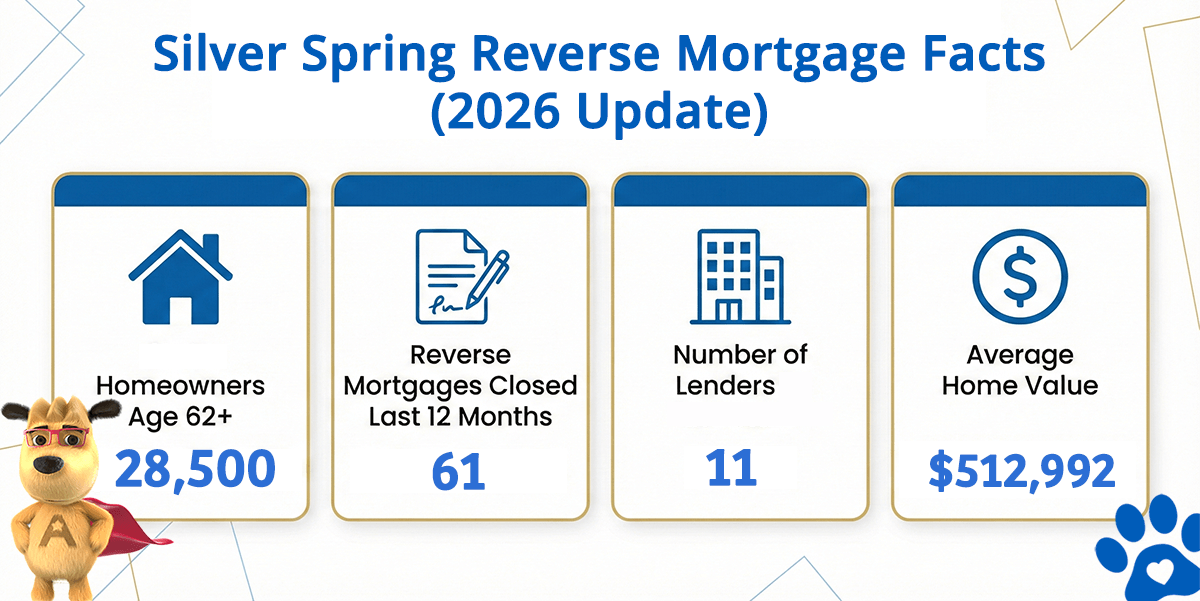
Silver Spring Reverse Mortgage Facts (2026 Update)
| City | Homeowners Age 62+ | Reverse Mortgages Closed Last 12 Months | Lenders in Silver Spring (est) | Avg. Home Value |
|---|---|---|---|---|
| Silver Spring | 28,500 | 61 | 11 | $512,992 |
How this data was derived: Reverse mortgage counts reflect FHA-insured HECM loans endorsed over a rolling 12-month period (Dec 2024–Nov 2025) using HUD HECM Snapshot data. Active lenders represent unique FHA sponsor numbers with at least one endorsed loan during this period. Estimated homeowners age 62+ are based on U.S. Census ACS 5-year owner-occupied households age 65+ as a conservative proxy. Home values are sourced from Zillow’s Home Value Index (latest available).
Understanding the HECM Reverse Mortgage Program
The Home Equity Conversion Mortgage (HECM) is the most widely used reverse mortgage program in the United States and is insured by the Federal Housing Administration (FHA) under the U.S. Department of Housing and Urban Development (HUD).
General HECM characteristics include:
-
Available to homeowners age 62 or older
-
No required monthly mortgage payments
-
Borrowers retain ownership of the home
-
Loan balances increase over time as interest accrues
-
Repayment typically occurs when the home is sold, vacated, or after the last borrower passes away
Borrowers must continue to occupy the home as their primary residence and remain current on property taxes, homeowners insurance, and required home maintenance.
Common Reasons Homeowners Explore Reverse Mortgages
Reverse mortgages are often reviewed as part of broader financial or housing planning. Common considerations include:
-
Eliminating an existing mortgage payment
-
Supplementing retirement income
-
Establishing a standby line of credit
-
Planning for long-term housing stability
Because a reverse mortgage affects home equity over time, it is generally evaluated alongside estate planning and long-term financial goals.
Silver Spring, Maryland Housing Market Overview
Silver Spring is one of the largest census-designated places in Maryland and part of the Washington, D.C. metropolitan area. The community has an estimated population of approximately 76,000 residents, with about 12 percent of homeowners age 62 or older.
The median home value in Silver Spring is approximately $521,887, reflecting steady appreciation in recent years. This places many properties well below the 2026 federal HECM lending limit of $1,249,125, while higher-valued homes may require proprietary or jumbo reverse mortgage programs.
Community, Economy, and Lifestyle
Founded in the 19th century, Silver Spring has evolved into a major commercial, cultural, and residential hub. Its proximity to Washington, D.C. has made it a popular location for long-term homeowners.
The local economy is driven by media, biotechnology, healthcare, and professional services, and the area is well known for its arts scene, festivals, and redevelopment initiatives. Silver Spring has received national recognition for urban planning and community revitalization.