

A+ BBB Accredited
★★★★★ 4.9/5 from 1,200+ reviews
HUD-Approved · NMLS #13999
X
ARLO Lower Rates = More Money to YOU
Lower Rates = More Money to YOU
Explore All Reverse×
Programs
How It Works
Calculators
Resources
Why All Reverse
HUD-approved direct lender · NMLS #13999
4.9/5 from 1,200+ reviews
ARLO

EXPLORE YOUR RATE OPTIONS

Find out if a fixed or adjustable-rate reverse mortgage fits your goals—complete with real-time insights!
Michael G. Branson Michael G. Branson, CEO of All Reverse Mortgage, Inc., and moderator of ARLO™, has 45 years of experience in mortgage banking, with the past 20 years devoted exclusively to reverse mortgages. A Forbes Real Estate Council member, he developed the industry's first fixed-rate jumbo reverse mortgage and has been featured in Forbes, Kiplinger, the LA Times, and Yahoo Finance. (License: NMLS# 14040)
Cliff Auerswald Cliff Auerswald, President of All Reverse Mortgage, Inc., and co-creator of ARLO™ — the industry's first real-time reverse mortgage pricing engine — has 27 years of experience in mortgage banking, with 20+ years focused exclusively on reverse mortgages. A recognized expert in reverse mortgage technology and consumer education, he has been featured in Kiplinger, Yahoo Finance, Realtor.com, and HousingWire. (License: NMLS# 14041)

Which is Best? Fixed vs. Adjustable Rate Reverse Mortgages

Michael G. Branson, CEO of All Reverse Mortgage
CEO · 45 yrs in mortgage banking
Cliff Auerswald, President of All Reverse Mortgage
President · All Reverse Mortgage Inc.
4 min read Fact Checked HUD-Lender #26031-0007 19 comments

If you’re planning to stay in your home but worry about your savings lasting through retirement, a reverse mortgage could help you achieve financial peace of mind.  Reverse mortgages allow you to access your home equity without making monthly payments, giving you flexibility and security in your retirement years.
ARLO teaching fixed vs adjustable reverse mortgage

What Are the Types of Reverse Mortgages?

The most common reverse mortgage is the Home Equity Conversion Mortgage (HECM), insured by the Federal Housing Administration (FHA).  HECMs are available with both fixed and adjustable interest rates.  For homeowners with properties valued above the 2025 HECM limit of $1,249,125, proprietary (or “jumbo”) reverse mortgages may be a better fit.

  • Fixed-Rate Reverse Mortgages: Provide a one-time lump-sum payment at closing.
  • Adjustable-Rate Reverse Mortgages: Offer flexible payout options, including monthly payments, a line of credit, or a combination of both.

Fixed vs. Adjustable Rate HECM Features

FeatureHECM FixedHECM Adjustable
2024 Lending Limit$1,249,125$1,249,125
Lump Sum✔ Yes✔ Yes
Purchase✔ Yes✔ Yes
Line of Credit✘ Not Available✔ Yes
Term Payments*✘ Not Available✔ Yes
Tenure Payments*✘ Not Available✔ Yes
Best ForSingle lump sum disbursementFlexible payment plans, line of credit, growth rate feature
RatesFixed: 7.560% (8.996% APR)Adjustable: 6.560% (1.750 margin)
Notes: Term = Payments over a set period (e.g., 5 or 10 years). Tenure = Payments for the borrower’s lifetime. Rates as of 2024.

Fixed vs. Adjustable-Rate Reverse Mortgages

Fixed-Rate Reverse Mortgages

  • Lump-Sum Payment: Borrowers receive all loan proceeds upfront, paying interest on the full amount from the start.
  • One-Time Draw: Funds must be fully accessed at closing, and repayments cannot be reborrowed.
  • Best For: Those with immediate financial needs, such as paying off debts or funding large expenses.

Adjustable-Rate Reverse Mortgages

  • Flexible Payout: Borrowers can take funds as needed, reducing interest costs on unused amounts.
  • Line of Credit Growth: Unused funds grow over time, increasing your borrowing power.
  • Best For: Homeowners who want ongoing access to funds or to preserve future flexibility.

Fixed Rates 60% Disbursement Limit Rule

Borrowers can access up to 60% of available funds in the first 12 months unless higher amounts are required to pay off liens or loan costs.  Adjustable-rate loans allow unused funds to grow over time, while fixed-rate loans require taking all funds upfront.


An Example: Choosing Between Fixed and Adjustable Rates

Suppose your reverse mortgage benefit is $400,000:

  • If you owe $100,000 on your current mortgage and need $50,000 for home repairs, you would draw $150,000 at closing.
  • With a fixed-rate loan, you must take 60% of available funds ($240,000).  The unused $90,000 would accrue interest immediately, even if you don’t need it.
  • With an adjustable-rate loan, you could draw $150,000 and leave the remaining $250,000 in a line of credit.  The unused amount grows over time, providing more equity to borrow in the future.
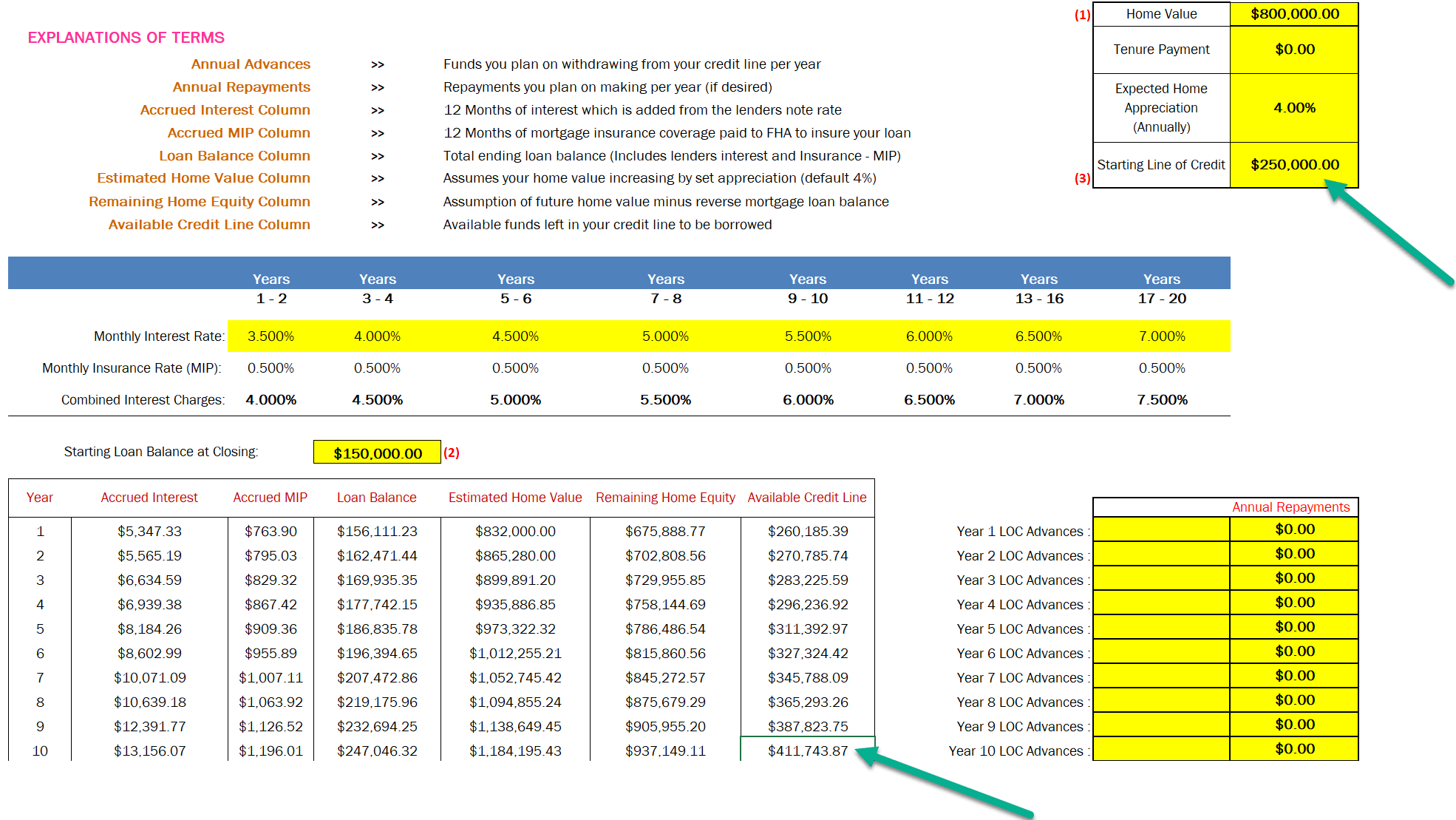
adjustable rate reverse mortgage amortization schedule

Under this circumstance, you would only have interest added to the $150k balance, and after 10 years at current interest rates, your loan balance will be around $247k 


fixed rate reverse mortgage amortization schedule


HECM Reverse Mortgage Rates

Fixed RateAdjustable Rate2026 Lending Limit
7.560% (9.081% APR)5.250% (1.750 Margin)$1,249,125
7.680% (9.219% APR)5.500% (2.000 Margin)$1,249,125
7.810% (9.367% APR)5.750% (2.250 Margin)$1,249,125
7.930% (9.505% APR)6.000% (2.500 Margin)$1,249,125
APR Disclosure: The Annual Percentage Rate (APR) figures shown are estimates calculated in accordance with Regulation Z (12 CFR Part 1026) and are provided for comparison purposes only. APR figures are based on the following assumed scenario: borrower age 70 | home value $500,000 | loan amount $250,000 | located in California. Finance charges included in the APR calculation: upfront Mortgage Insurance Premium (2.00% of the Maximum Claim Amount), annual Mortgage Insurance Premium (0.50% per year), estimated origination fee, and standard third-party closing costs (title insurance, appraisal, escrow, and recording fees). A loan term of 2 years is assumed for purposes of this APR calculation. Actual APR will vary based on borrower age, appraised home value, final loan amount, applicable fees, and closing costs. This is not a commitment to lend.


Fixed Rate FAQs

Q.

What is the current fixed rate for a reverse mortgage?

Rates can change daily based on market conditions.  Check with your lender for the most accurate information.
Q.

Why isn’t a line of credit available at a fixed interest rate?

No.  Proprietary reverse mortgages differ in terms of loan amounts and rules compared to HUD HECM loans.
Q.

Are all fixed-rate reverse mortgages the same?

All fixed-rate reverse mortgages are not the same.  Private or Proprietary reverse mortgages do not have the same loan amounts or rules as the HUD HECM loan, so borrowers should review both options when considering a fixed-rate loan.
Q.

How often do reverse mortgage interest rates change?

Fixed rates are locked in for the life of the loan. Adjustable rates change monthly and have a lifetime cap of 5% over the initial rate.


Key Takeaways

  • Fixed-Rate Loans: Offer certainty with a one-time lump sum but less flexibility for future needs.
  • Adjustable-Rate Loans: Provide flexibility with options for monthly payments or a growing line of credit.
  • No Prepayment Penalty: Both loan types allow for repayment without additional costs.

Choosing the right reverse mortgage depends on your financial goals and immediate needs.  Speak with a trusted lender to evaluate your options.


Fixed or Adjustable—Which Fits You? Find out with a free quote from All Reverse Mortgage—America’s #1 with a 4.99/5-star rating! Call (800) 565-1722 or click here for your free quote —simple, trusted, 100% secure!


ARLO recommends these helpful resources: 


ARLO Testimonials
America's #1 Rated Reverse Lender Celebrating 20 Years of Excellence.
Author Michael Branson
About the Author, Michael G. Branson | Mike@allreverse.com
Michael G. Branson CEO, All Reverse Mortgage, Inc. and moderator of ARLO™ has 45 years of experience in the mortgage banking industry. He has devoted the past 20 years to reverse mortgages exclusively.

Have a Question About Reverse Mortgages?

Look no further. Michael G. Branson, our CEO, brings a wealth of knowledge directly to you. With a robust 45-year tenure in mortgage banking and 20 years dedicated solely to reverse mortgages, he's the expert you want on your side.
Post your question in the comments below and anticipate a personalized response from Mr. Branson himself, typically within one business day. He's here to illuminate all angles of reverse mortgages, ensuring you're equipped with the knowledge to make informed decisions. Take this opportunity to gain insights from a seasoned professional.

Over 2000 of your questions answered by ARLO™
Ask your question now!

19 Comments on this Article
  1.   Albert P.
    June 7th, 2023
    Good day ARLO!
    I am very impressed by your knowledge. Perhaps you can help. I am 76, my wife same age. We own a home valued at around $275,000 with a mortgage of $103,000 at 2.75% and 12 years remaining. I currently work with a W2 income of 45k annually. My SSI is $30k annually, and my wife $12K annually. I can almost completely maintain our monthly expenses of $5 000+ net per month.
    Still, a few more debts have put more pressure on that, so I am looking at reverse mortgage, either fixed or hecm. I understand the basics of hecm. I am interested in understanding if certain fixed payouts and other benefits would be better for us. Due to some health problems of my wife I am concerned. I plan to work till I die, but who knows?
    Can you give me some insights based on this?
    Reply to Albert
    • Michael Branson Michael Branson
      June 7th, 2023
      Hello Albert,
      Yes, it would help if you spoke with a licensed Loan Officer who can review the fixed rate and adjustable options and discuss both with you. The acronym for HUD reverse mortgages is HECM, which stands for Home Equity Conversion Mortgage and includes both fixed and adjustable rate loans. The primary difference between the fixed and adjustable rate programs is two-fold. Firstly, the interest rate on the fixed rate loan is fixed for life, whereas the rate on the adjustable rate loan is not. The adjustable rate loan has an index and a margin, and the rate fluctuates with the market. The rate begins lower than the fixed rate and can rise or fall as interest rates move with the market. Most borrowers with adjustable-rate loans have done surprisingly well over the past 10 years, but no one can predict the future.
      The fixed-rate program requires that you take all available funds on the day the loan closes, and then there can be no further draws after that time. The adjustable rate loan allows you to take available funds or leave them in a line of credit to be drawn at your convenience/need. Neither requires you to pay on the loan for as long as at least one of you still lives in the home as your primary residence. In addition, you must continue to pay the taxes, insurance, and any other property charges on time (i.e., homeowners association dues, if any), and you must maintain the home in a reasonable manner.
      Several factors determine how much money you will receive with a reverse mortgage. Borrowers' ages, property value, and interest rates all go into a formula HUD uses to determine the funds available to borrowers under the program. With the current higher interest rates, You would not receive as much money as you would when interest rates are below 3%. Still, I believe you could pay off the existing loan and get some funds to allow you some breathing room on your monthly expenses. Only you and your spouse can decide if that would suit your circumstances. We don't believe in "selling" you the program but would love to show you what the loan will and will not do and let you make an educated decision.
      If you would like, you can also visit our online calculator where you can see what you might expect to receive for reverse mortgage proceeds based on your circumstances and can decide if you would like to proceed further after that.
      Reply to Michael
  2.   Kelly C.
    January 31st, 2023
    Under HECM reverse mortgage rates, what is the difference between the 4 rates shown for Fixed and Adjustable? Why do the rates increase, depends on number of years?
    Reply to Kelly
    • Michael Branson Michael Branson
      January 31st, 2023
      Hello Kelly,
      I think you are looking at the TALC, which is the Total Annual Loan Costs sheet, correct? When you look at the sheet, the rate is very high when the loan is only kept for a few years and then begins to lower as the loan is kept for longer and longer periods of time. This is because all the fees are front-end loaded.
      In other words, you pay them at the start of the loan, and they are the same whether you keep the loan for 2 years or 20 years. As you determine what those costs are over the life of the loan, the longer you keep the loan, the less those fees cost you on an annual basis.
      For example, if you pay $10,000 to get a loan and you only keep the loan for 2 years, the fees come out to be $5,000 a year cost which is very high. If you keep that same loan for 20 years, the fees only cost you $500 per year. It only stands to reason that as a percentage, the higher cost for the shorter period also drives the percentages up for the shorter periods as well.
      Therefore, we have always told people that the reverse mortgage is meant to be the last loan you will ever need. And that if you only need the loan for a couple years, unless there are extenuating circumstances, we do not recommend this loan for you. For some people, they absolutely needed the loan with no payments for a shorter period and the costs were much better than the alternatives.
      In the case where a borrower could lose a home to foreclosure or income or a lump payment is not received which could also cause the borrower to lose their home in less than 24 months, it might make sense for their circumstances even if they plan to move later or pay the loan off with the receipt of a bulk payment at that time.
      But for most people, it makes more sense if you can keep the loan longer, let the costs you paid to get the loan stretch out longer and therefore bring the cost of the loan down over time. The TALC allows you to see this by showing you the difference that time makes on the loan and its cost.
      Reply to Michael
  3.   T. Hartman
    August 31st, 2022
    Hi Arlo,
    I have $400,000 available after the sale of my home. I am 74 and will be buying another house for $500,00. Which plan should I use?
    Reply to T.
    • Michael Branson Michael Branson
      September 6th, 2022
      Good afternoon,
      Typically, the plan most often used by borrowers on purchase transactions is the fixed rate loan because you need to use the entire loan for the purchase anyway. If we were in a falling interest rate market, you may want to consider the adjustable-rate loan to take advantage of future rate reductions but at this point, there is no telling when that may occur.
      You will get more money on the adjustable rate loans because the expected rate is lower and therefore the proceeds are higher, but no one can predict the future so at this time it really is just your preference and what you think you are more comfortable with when you consider what each program will give you at the start and what you believe future rates will do (the fixed rate will never change, adjustable rates can go up and down with the market).
      Reply to Michael
  4.   Bernice B.
    August 28th, 2022
    Hi Arlo,
    It is my understanding that as a homeowner you will be responsible for the interests, MIP and homeowner insurance.
    1. Will the interest rates go up and down?
    2. Will the interest rate be fix?
    3. Will you be able to pay the monthly interests rate?
    Reply to Bernice
    • Michael Branson Michael Branson
      August 28th, 2022
      Hello Bernice,
      Yes, the homeowner is responsible for the taxes and insurance on the home. The Mortgage insurance and interest that accrues on the loan is added to the loan balance and you are not required to pay a payment on this balance for as long as you live in the home and pay property charges in a timely manner (taxes, insurance, HOA - if any, etc.). You can however choose to make any payment at any time you like up to and including payment in full with no prepayment penalty so the answer to your question #3 is yes, you can choose to make monthly payments if you want to but are not required to do so.
      You can choose a fixed rate loan or an adjustable-rate loan. If you choose a fixed rate, the interest will not go up or down while it can go up and down on the adjustable-rate programs with the market. However, the fixed rate programs require you to take all your funds at once at loan closing and you can never take another draw so if you do repay some of the funds, you cannot redraw them later. The adjustable-rate program is an "open-ended" loan which allows you to take only the funds you need to start the loan and then you can take additional draws later if you want.
      So if you do not need all the funds from the start (i.e. to pay off an existing mortgage) and want to just draw on them when needed, your only option is to take the adjustable rate line of credit (which will save you money in the long run because you only accrue interest on the money you actually draw and not the money remaining in the line that is available but not yet borrowed).
      Reply to Michael
  5.   Craig
    February 22nd, 2022
    Is the monthly adjustment the only variable rate available? What happened the annual adjustment option?
    Reply to Craig
    • Michael Branson Michael Branson
      February 22nd, 2022
      There is still an annual adjustment option available but it doesn't make sense right now. A combination of rising rates, the move to the CMT index after the disappearance of the LIBOR index and HUD's floor of 3% now makes the annual adjustable-rate loan a very unattractive option for borrowers.
      The loan pricing requires lenders to start the loan with a much higher margin and therefore, the borrowers receive so much less money with this option because the expected rate is well over the 3% floor. HUD sets the floor rate (it is currently at 3% after HUD's last move) and anything over that rate starts to lower the Principal Limit (the loan amount available to the borrower for their age(s) and property value) to the borrower on the loan.
      Based on the margins and the rates available on this product, all proposals would be well over those being offered for the monthly programs. You can request a proposal for an annual adjustable loan, but the loan amount available to you as a result would be much less and the interest rate much higher.
      Reply to Michael
  6.   Lyle B.
    July 7th, 2020
    Our home is also an investment and look at current mortgage payment as rent for a place to live
    A. One dilemma is deciding on whether to 1) go with a fixed 4%, (plus 0.05% for FHA insurance), -real rate of 4.5% interest rate with one time lump payment of around 40k or 2) go with an adjustable starting at about 2.5 plus the 0.05% FHA for insurance real rate to start about 3% and have about 80-90k at loan company available for use.
    B. A second question in our mind is should we just do a conventional refi at 3.25% 30 year fixed and save $175 a month or do a RM and save $1,500 a month. Seems like a no brainer!
    Our only debt is our mortgage. We do not need the money now we see no need in the future we see the ability to pay tax, insurance & upkeep and heirs know we come first and they get what may or may not be available when time comes.
    So, in your opinion, to do the smartest for heirs 1) should we go with the conventional refi or a RM and 2) if a RM should we go fixed or adjustable? (Our advice so far has been half saying fixed and other saying adjustable!) We think we can sleep at night with either one yet doesn't want to flip a coin either!
    Thanks, your advice will be appreciated
    Reply to Lyle
    • Michael Branson Michael Branson
      July 7th, 2020
      Hello Lyle,
      Your question is prefaced by what to do as the smartest choice for your heirs. If you are trying to leave behind the largest estate and biggest asset, then you would not want to use a reverse mortgage which require you to not pay any payments.
      On the reverse mortgage, as that interest accrues and you make no payments, the balance on the loan grows. That works well for homeowners looking to eliminate their expenses, but it means there would be less for heirs to inherit.
      So if you ask me what is the best way to leave your heirs the property with the largest value, I would tell you that if you can afford the payments on the home and never foresee a time when they might be restrictive, get the lowest rate you can on a forward rate and term refinance.
      However, if you ever see a possibility of the payments restricting your ability to enjoy your life or your home, or you think there may come a time when more funds are needed, the reverse mortgage is a great financial tool and there is more than one way to proceed that might really kill two birds with one stone.
      You can get the reverse mortgage and keep the balance from rising. Firstly, I would recommend that you look at the line of credit option. Yes, it is an adjustable rate loan, but the rates are low, and the life cap is under 8% with the current start rates. Not to mention that we have not gotten near that rate in over 10 years now.
      But also, the line of credit does not require you to draw funds you do not need or want currently. If you leave them in the line, you accrue no interest on those funds and the unused balance grows at a rate equal to the interest accrual plus the MIP which is approximately 3.4%.
      Now this is not interest you are earning; it is an increase available on the line that if you never use it does not need to be repaid and it costs nothing. If you ever do need additional funds though, they are there and higher than when you first closed the loan.
      Next, although there is never a loan payment due on the reverse mortgage as long as you live in the home, you can choose to make a payment in any amount at any time if you so desire. There is no prepayment penalty and so if you want to and can easily make a monthly payment, you can also keep the balance from growing or even pay it down or off with a reverse mortgage.
      But the great thing is that since it is not required, if anything comes up and you must skip a payment or just want to in order to do something else that month, you can do so with no negative credit or other issues.
      And the unpaid balance keeps growing the entire time you have the loan so if you are paying the loan down but things suddenly change and you find you have a need for the funds after all, they are always available to you.
      The reverse mortgage is the only loan that guarantees the funds will always be available (the lender cannot close the loan as they can with a Home Equity Line of Credit), You can make payments if you want to continue to pay the loan down to leave a larger asset to heirs, but if needed there are none required allowing you to live in the home payment-free for life if that becomes a primary concern later over the asset you leave to heirs.
      Only you can determine which is best for your needs but only one loan will allow you to change whether you make payments or not later to allow you to eliminate payments when needed and gain access to cash if you need it.
      Reply to Michael
  7.   Thomas W.
    October 6th, 2019
    Can you access the full amount of the loan up front? (At the completion of loan being approved)
    Reply to Thomas
    • Michael Branson Michael Branson
      October 6th, 2019
      Hello Thomas,
      HUD now only allows access to the full amount of the loan at closing if the funds are being used to purchase a home (on which the mortgage is being placed) or if you need the entire amount to pay off loans on the subject property.
      Otherwise, you would be limited to that amount or 60% of the available proceeds in the first 12 months with the remaining proceeds available literally on day 366.
      Reply to Michael
  8.   ALFONS B.
    May 6th, 2019
    ALFONS BONDE (alfons@usa.net) has sent the following question(s) in the ask experts blog.
    Is there a reverse mortgage that is best for a line of credit?
    Reply to ALFONS
    • Michael Branson Michael Branson
      May 6th, 2019
      Good Afternoon,
      Most people prefer the annual adjustable rate reverse mortgage over the monthly adjustable rate loan. It allows the rate to remain fixed for 12 months at a time and has a 2% cap in any one year and a 5% cap over the life of the loan which means that the rate can never rise more than 2% over the prior year or 5% more than the start rate. But I encourage all borrowers to compare all programs, discuss the options with your family and/or trusted financial advisor and decide for themselves which is the right program for them.
      Reply to Michael
  9.   Jessica P.
    March 28th, 2013
    Both Fixed vs. Adjustable Rate are good option, depending on the need and situation some prefer to go for fixed rate while some prefer to opt the adjustable option. Personally, I prefer to have fixed rate because here the rate of interest is fixed and not variable.
    Reply to Jessica
    •   Marty
      May 25th, 2021
      Hello Jessica; I have been thinking along those lines also. I have some concerns that the amounts of money being pumped into this ailing economy to rebuild people's lives and businesses MAY lead to some inflation. We really haven't seen inflation in a while, and we've become used to low rates. If rates rise, then adjustable rate reverse mortgages rates will rise too. So, I'm still thinking. Good luck with your deliberations.
      Reply to Marty
      • Michael Branson Michael Branson
        May 31st, 2021
        Hi Marty,
        Certainly, things to consider and here are also a couple of things to also keep in mind. Firstly, you can limit your upside risk by choosing a program with a 5% interest rate cap. That way the rate can never rise higher than 5% above the start rate. Secondly, you only accrue interest on the money you actually borrow.
        This is where taking draws only when needed and making repayments when you can really limit the amount of interest you accrue as well. And finally, the line of credit grows in availability on based on the interest rate accrual and the amount of the unused line available to the borrower.
        So, at those times when rates are higher, your available line of credit grows at a greater rate as well giving you access to more money later if you need it. The money available to you grows at a rate equal to the interest accrual rate plus the mortgage insurance renewal rate. This is not interest anyone pays you but rather additional funds available to you to borrow later if you need them.
        In other words, it doesn't cost you anything if you do not borrow them and if you need them later, they are there for you. Knowing these things gives a borrower access to a strong financial tool when used to their advantage.
        Reply to Michael

Leave a Reply to This Article